For fifteen years Halvard Nyqvist and Lucille Reyes-Tanner did not speak one word to each other, though they lived eight feet apart, separated by a cedar fence and an old argument about a tree. They said everything else in flowers.
This was Walla Walla, Washington, in the southeast corner of the state, wheat country and wine country, where the summers are long and dry and gold and the gardens, if you tend them, will give you back more than you put in. The two of them lived on a quiet street of postwar houses with deep back lots, Halvard on the north side of the fence, Lucille on the south, both of them widowed, both of them alone, both of them, as it happened, gardeners of the serious and slightly obsessive kind.
The argument had been about a tree, the way these things always are about something small. When Halvard’s wife was still living, a silver maple on the property line had dropped a limb in a windstorm onto Lucille’s late husband’s greenhouse, and there had been words about whose tree it was and whose insurance, and the words had been the kind that two proud people in grief say and cannot take back. The tree came down. The greenhouse was repaired. But the thing between them had set like concrete, and then both their spouses died within a few years of each other, and the two of them were left, alone, on either side of a fence, with nothing between them but a silence that neither knew how to be the first to break.
Halvard was a retired professor of botany. He had taught for thirty years at the college, a tall, formal, Norwegian-descended man who wore a cardigan even in July and pronounced the Latin names of plants with a precision that had terrified two generations of undergraduates. Lucille was a retired nurse, seventy-three to his seventy-six, a warm and stubborn woman of Filipino and Mexican descent who had raised three children in that house and buried a husband from it and was not, by her own cheerful admission, in the habit of apologizing to professors.
So they did not speak. But they both, every spring, went out into their gardens. And the gardens could see each other over the fence.
II. The first sunflowers.
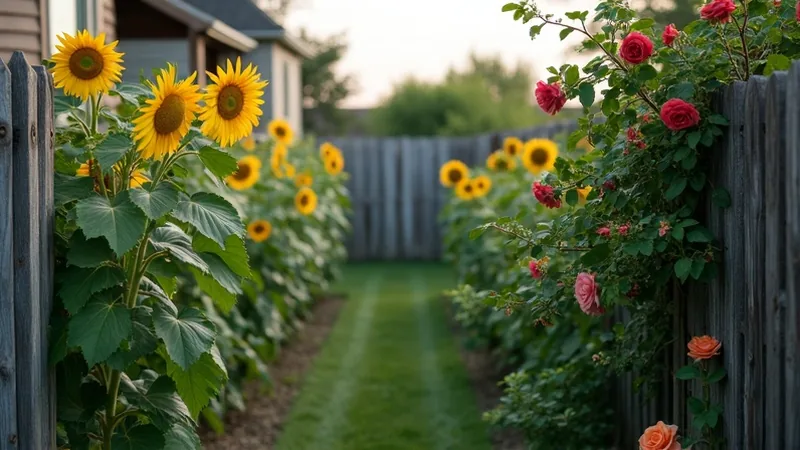
It began, as near as either of them can date it, the spring after Halvard’s wife died. Lucille noticed, that June, that the old man had planted a row of sunflowers along his side of the fence. This was unlike him. Halvard’s garden had always been a thing of order and restraint, clipped boxwood and labeled specimens, a botanist’s garden. Sunflowers are not restrained. They are loud and tall and a little ridiculous, and they turn their big foolish faces to follow the sun, and they had been, Lucille happened to know because the whole street had known, his late wife’s favorite flower.
She understood the sunflowers, then, as a kind of mourning, and she said nothing, because they were not speaking. But the following spring, Lucille planted sunflowers too. On her side. A matching row, along the fence. She has told me she did not entirely know why she did it. She told herself it was because they had done well in that light. But the truth, she admitted, sitting in her kitchen fifteen years later, was that she had wanted the old man, when he looked out at his wife’s flowers, to see them answered. To not be the only one. It was the first thing she ever said to him, and she said it in sunflowers, and he never knew she had said it, except that of course he did.
I asked Lucille how she could be certain the sunflowers were a reply and not a coincidence, two old gardeners simply liking the same flower, and she gave me a look that I have learned to recognize from people who have lived a long time and are being asked to explain the obvious. “A coincidence happens once,” she said. “This happened for fifteen years. You do not accidentally answer a person for fifteen years.” And she was right, of course. A single planting proves nothing. A correspondence proves everything, and a correspondence is exactly what it was, a letter and a reply and a letter again, written in a medium that takes a whole season to deliver each line.
Because the next year, Halvard, the man of boxwood and order, planted something at the base of his sunflowers that he had never grown in his life. Climbing roses. And he trained them, with a botanist’s patient skill, not up his own wall, but along the fence. Toward her side.
This is the part that I had to make them each explain to me separately, because neither would quite say it in front of the other, even now. The roses were a reply. A man who has spent his life naming plants does not accidentally train climbing roses toward his neighbor’s yard. He was answering the sunflowers. And Lucille, the following season, did the most remarkable thing in the whole fifteen-year exchange, a thing that still makes the old botanist look at his shoes. She cut a gap in her own prized hedge, a careful gap, low down, so that the roses he was sending over the fence would have somewhere to go, somewhere with light, on her side.
III. A grammar of plants.
I am a reporter, and I am wary of making too much of a coincidence, of seeing a love story in what might only be two old people gardening near a shared fence. So I spent a long time, over several visits, making sure. And I became convinced, because the exchange was too responsive, too turn-by-turn, to be accident. It had a grammar.
He planted something. The next season, she answered it. She planted something. The next season, he made room for it, or echoed it, or sent something back. Over fifteen years they built, along forty feet of cedar fence, a conversation conducted entirely in living things, on a delay of one growing season, never once in words. He planted lavender the year her husband would have turned eighty, and she has reason to believe he knew the date. She planted, the spring after his diagnosis, which the whole street knew about and no one mentioned, a flat of his late wife’s sunflowers on his side of the fence, slipping over in the early dark to do it, so that he would come out one June morning and find his wife’s flowers growing where he had not put them, and understand that someone had been paying that much attention.
“I knew it was her,” Halvard told me, in his precise professorial English. “Of course I knew. No one else on the street can grow that cultivar. It is difficult. She is a better gardener than she lets on. I never told her I knew. It did not seem to be the kind of thing one says.”
He walked me along the fence on one visit and read it to me like a text, which to him it was. Here, he said, in the third summer, she had answered his roses with a clematis, a climber to meet a climber, trained to the very same height. Here, the year his wife would have turned seventy-five, she had planted white, only white, the whole row, and he had understood it as a condolence and had not been able to thank her for it because they were not speaking. Here, he said, and his voice changed, was the lavender, and he stopped, and did not finish the sentence, and I did not make him, because some lines in a fifteen-year letter are private even from a reporter.
IV. Two kinds of stubbornness.
It would be easy to make this sweet, and it was not sweet. That is what I most want to get right. This was not two charming old people being adorable. This was two extraordinarily stubborn human beings, each of whom had decided, decades before, that they were in the right about a tree, and neither of whom could find the door out of that decision, and who had between them just enough tenderness and just enough cowardice to love each other for fifteen years without ever once risking the word.
Lucille was angry about it, some years. She told me that. There were summers she stood at her sink looking at the roses he had sent across the fence and felt not warmed but furious, furious that a grown man could say all of this in flowers and none of it in speech, furious that she was doing exactly the same thing, furious at the cedar fence and the dead tree and the dead spouses and the years. “We were old fools,” she said. “Two gardens did all our talking because we were too proud to do it ourselves. I am not going to pretend that is romantic. It is mostly sad. It is only a little romantic.”
And yet. I pressed her on the anger, because it is the truest and least sentimental thing in the whole story, and she let me. She said the anger and the tenderness were not opposites and were not even separate. She was furious at him precisely because she loved him, furious that the one person who saw her, who answered her, who knew her cultivars and her griefs and her schedule of plantings, was a man she could not bring herself to so much as wave to over a fence. The flowers were a confession and a cowardice at once, she said, and she had spent fifteen summers unable to decide which they were more of, and that, not the sweetness, was what it had actually felt like to live it.
They had built, season by season, a courtship that required everything of them except the one thing neither could manage, which was to be the first to speak.
V. The winter he didn’t come out.
The thing that finally broke the silence was not courage. It was illness, which is the lever that moves the immovable in the end. The winter Halvard turned eighty-one, his health failed badly, and for the first time in fifteen years, when spring came, he did not come out into the garden.
Lucille watched the north side of the fence stay bare through April, and through May, the boxwood untended, the rose canes unpruned and going wild, the ground unturned, and she understood what it meant. A gardener who does not come out in May is a gardener in trouble. She did not have his phone number. In fifteen years she had never had occasion to get it. She did not know his children, who lived away. She knew only the garden, and the garden was telling her, in the language they had built, that something was very wrong.
She told me she stood at her kitchen window through the whole of that bare spring arguing with herself, and that the argument was the same one they had both been losing for fifteen years. Pride said it was not her place. Pride said a fence is a fence, and a silence honored that long is a silence you do not get to break only because it has become inconvenient to keep. And against pride there was only the bare ground on his side, the unpruned canes, the absence of the one figure she had organized fifteen years of her watching around, and at some point in late May the bare ground won the argument that pride had been winning since the silver maple came down, which is to say since before either of them had quite understood how much time costs.
So she did the bravest thing either of them did in the whole story, which does not sound brave at all. On a morning in late May, Lucille Reyes-Tanner, seventy-three years old, walked out of her house, and down her driveway, and up his, to the front door she had never once approached in all the years they had been neighbors, and she knocked.
It took him a long time to come to the door. When he did, he was thinner than she had let herself imagine, and leaning on a cane, and for a moment the two of them simply stood there, on his front step, in the actual air, with no fence between them and no flowers to hide behind, two old people who had said a thousand things to each other and never one of them out loud.
VI. The first word.
She has told me what she said, and he has confirmed it, and it is not a grand sentence, and I have come to think that is exactly why it worked. She did not apologize for the tree. He did not either. Fifteen years of silence did not get a speech.
She looked at his wild, untended rose canes over his shoulder, going to ruin along the fence, and she said, “Halvard, your roses need pruning, and you are in no condition, so I am going to do it, and I am going to need you to sit on the porch and tell me how, because they are your roses and I will not have you saying I did them wrong.”
And the old botanist, who had a Latin name for every living thing and had not been able to find the English for fifteen years, began, helplessly, to laugh. And then to cry a little. And he said the first word he had said to her in a decade and a half, which was her name. Just her name. Lucille. And she said his. And that was the apology, both of them, the whole thing, names traded on a doorstep, and then she went and got her pruning shears.
I have turned that scene over many times, the two of them on the doorstep trading names like a password, and I have decided that its lack of grandeur is the most honest thing about it. We are sold, all our lives, a version of reconciliation that comes with a speech, a swelling of music, a clean accounting of who was wrong. Real ones almost never do. Real ones are two stubborn people who have run out of time and out of reasons and who reach, at last, for the smallest possible bridge, an offer to prune a rose, a name said out loud, and find that the smallest possible bridge was, the entire time, wide enough.
All the years they had spent not speaking turned out to weigh nothing against a single morning when one of them finally walked up the other’s driveway and knocked.
VII. The last gardens.
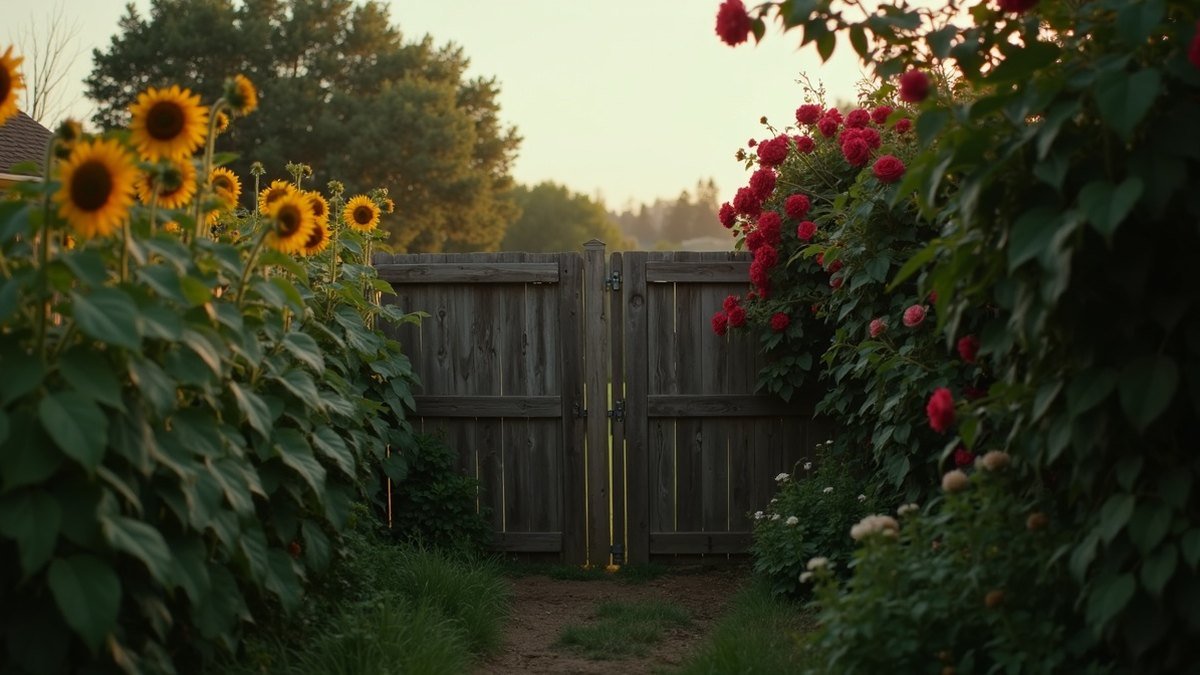
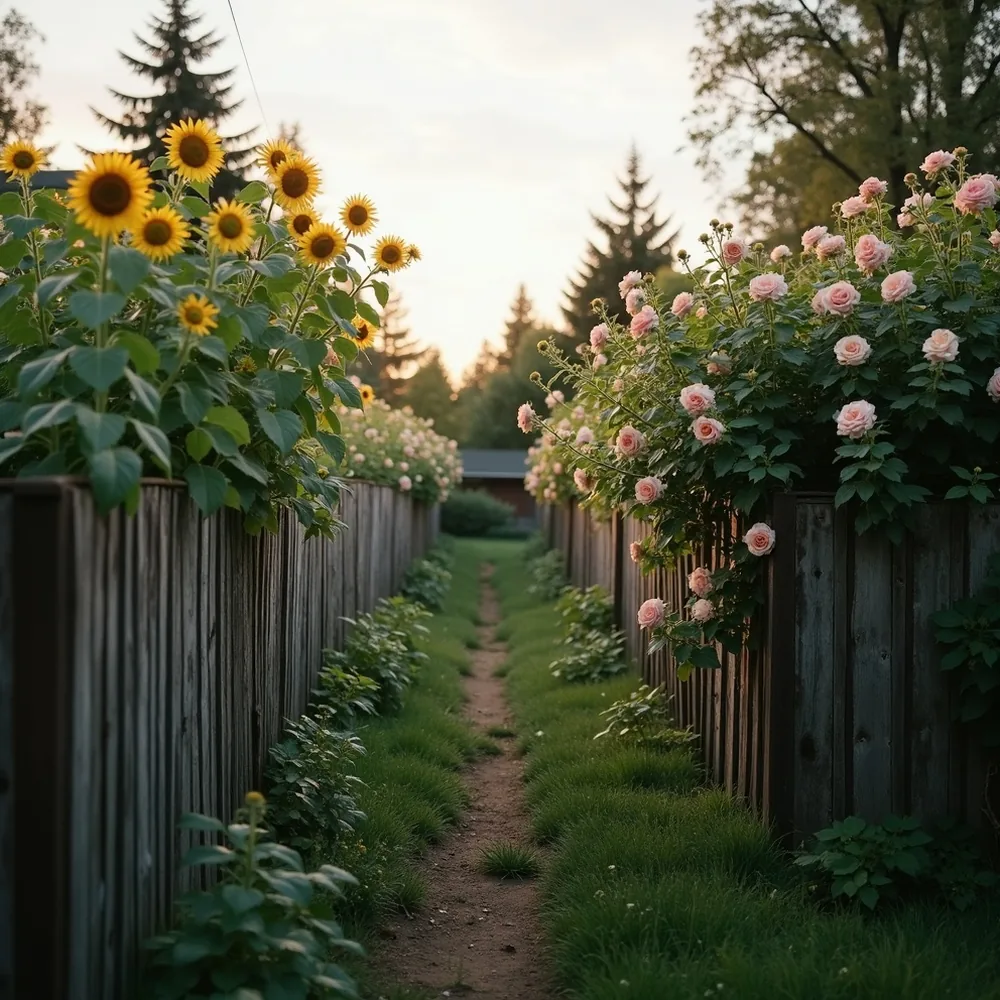
They had a little more than two years. I want to be honest about that, because I do not want to sell you a fairy tale with a wedding at the end. There was no wedding. There was something I think is rarer and in some ways better: two fiercely independent old people who kept their own houses and their own gardens and their own stubbornness, and who spent the last good seasons either of them would have moving freely back and forth through a gate that Halvard, that first summer, finally cut into the cedar fence himself, with Lucille holding the boards.
The gate is the detail I keep returning to. For fifteen years the fence was the whole problem, the thing between them, and the flowers had to climb it and reach over it and sneak through gaps in the hedge. And in the end the solution was the simplest carpentry imaginable. He cut a gate. He told me, with great botanical seriousness, that he should have done it in the first year, and that he had spent a long career studying how living things reach toward light and had somehow needed until eighty-one to apply the lesson to himself.
They did ordinary things, in the two years, and that is what Lucille most wanted me to know, as against the grandeur people try to put on it now. They drank coffee through the gate. He taught her the Latin names she pretended not to want to learn. She made him eat properly. They argued, still, about plants, about whether a thing wanted more sun, about the silver maple even, the old dead tree, which they could finally laugh about and did. It was not a romance for a film. It was two old people who had wasted fifteen years being right and had decided, with what was left, to be together instead, which is a less cinematic thing and a far harder one.
Halvard died in the autumn, two years after the doorstep. Lucille was with him. She tends both gardens now, hers and his, walking through the gate every morning with her coffee, pruning his roses the way he taught her from the porch, and she has kept planting his wife’s sunflowers on his side, every June, so that the conversation, in a sense, has not entirely stopped. It has just become a thing she says now to no one, and to everyone, and to him.
VIII. Why it stays.
I sat with Lucille Reyes-Tanner this past June, in her kitchen, with the gate standing open and both gardens visible through the window, his and hers, sunflowers on both sides of the fence now and roses going every direction, the whole forty feet a single tangled thing that no longer respects the property line at all. She is older. She moves more slowly. She still does the pruning.
I asked her the question I had been carrying through every visit, which was whether she regretted the fifteen years. Whether she wished they had spoken sooner. She was quiet for a while, turning her cup.
“I used to,” she said. “I used to think we wasted them. But I have decided I do not believe that anymore. We were not wasting them. We were courting. It was the slowest courtship in the history of this street, and it was conducted by two cowards in the only language two cowards could manage. But it was real the whole time. The flowers were real. He knew. I knew. We were just taking the long way.”
We tend to believe that love announces itself, that it is brave and verbal and on time. Mostly it is none of those things. Mostly it is two proud people doing the best they can in whatever language they have, and hoping the other one is reading. For the longer human history of gardens as a language of memory and devotion, readers can spend time with the collections at Smithsonian Gardens or the public material from the U.S. National Arboretum. The Chapbook keeps its narratives clean, human, and responsible, read more in the Editorial Policy.
Before I left, Lucille walked me out through the gate, through Halvard’s side, past the roses he had trained toward her for fifteen years and that now grew wherever they pleased. She stopped at the row of sunflowers along the fence, his wife’s cultivar, the difficult one, just coming up green and knee-high in the June light, and she straightened one that had leaned, the way you would straighten a collar, and she did not say anything, and she did not need to, because by then I had learned to read it too.