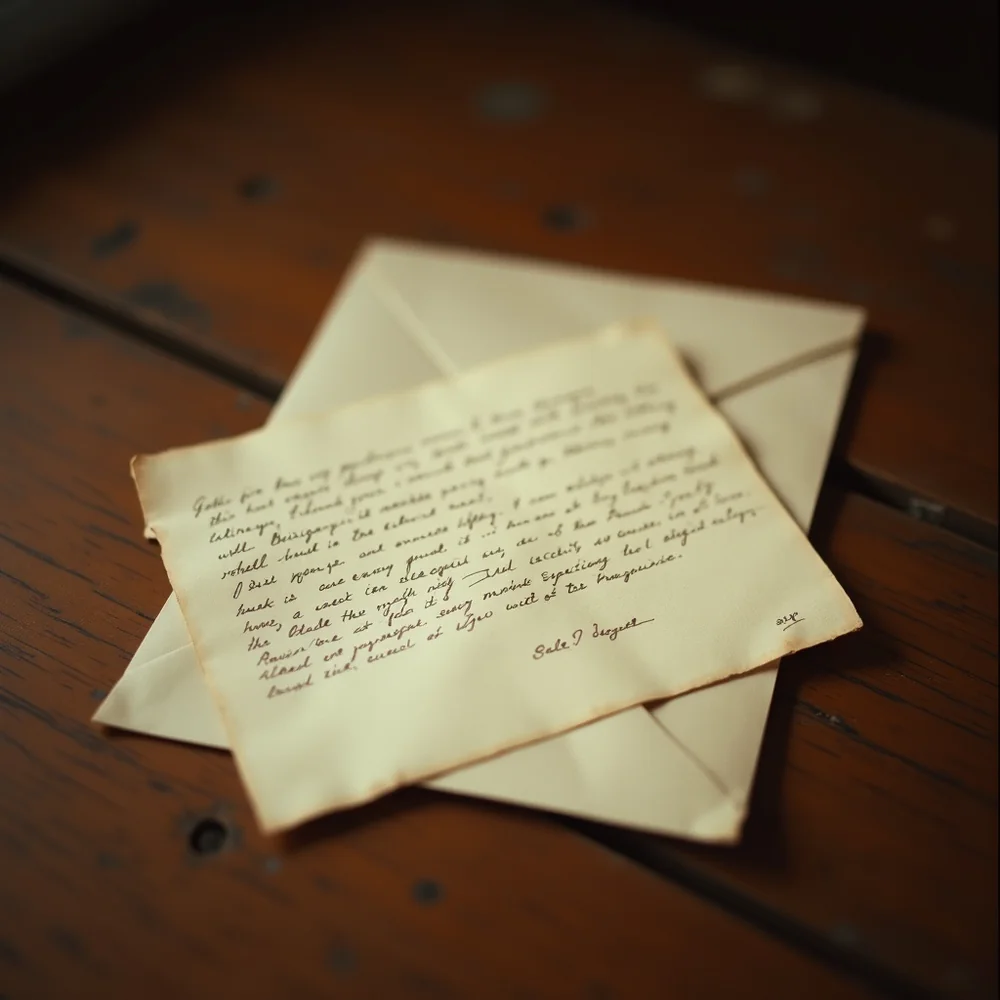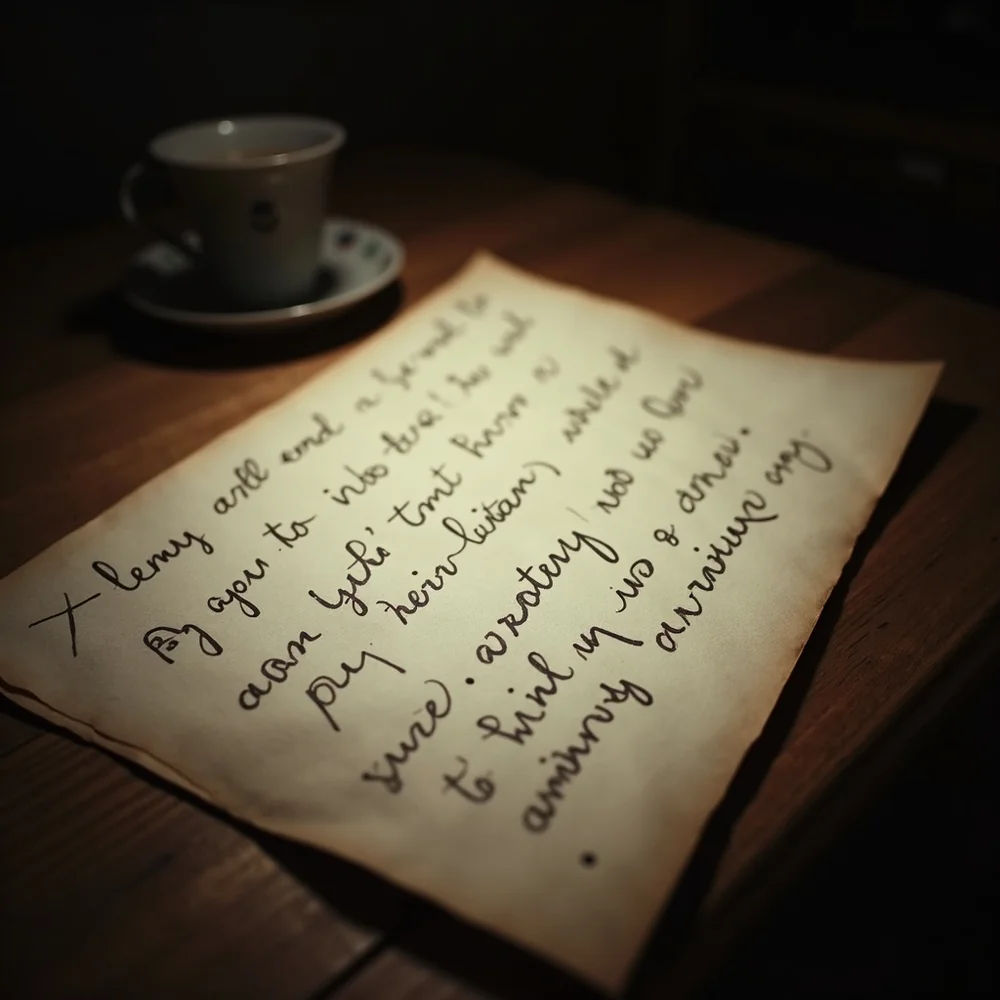
Every February 14 since 1984, the same dedication request has arrived at a radio station in Bismarck, North Dakota. Eleven words, typed on a plain index card: Moon River, for Constance, from the one who should have stayed.
The station is KFYR, an AM voice that has been talking to the middle of the state since the 1920s, through blizzard closings and cattle reports and four generations of school lunch menus. The card comes by mail in the last week of January. The envelope is always postmarked Bismarck. There is never a return address. Folded inside, every year, is a two-dollar postal money order, which nobody at the station ever asked for and nobody ever cashed.
You have to understand what February is in Bismarck to understand what the dedication became. The Missouri River locks up white and silent below the bluffs. The wind comes down out of Saskatchewan with nothing to slow it but fence wire. Cars idle in driveways at six in the morning, breathing exhaust into air so cold it squeaks underfoot, and the radio is not background in a month like that. The radio is company.
So at nine o’clock on the night of February 14, in the middle of whatever else the evening host had planned, the ritual would happen. The host would read the card, word for word, adding nothing. Then the needle would drop on Andy Williams singing “Moon River,” two minutes and forty-four seconds of strings and longing, and for that stretch of the evening the whole listening area, from Wilton down to Linton and west across the river into Morton County, held one stranger’s secret together.
Inside Studio B, taped to the cabinet below the console, there was an index card of the station’s own. It had been recopied twice when the ink faded. It read: On Feb. 14, 9 p.m., air Moon River. Read the Constance card exactly as written. Do not editorialize. Do not speculate on air. This is ours to carry, not to solve.
For forty years, nobody knew who sent it. And then, in the winter of 2024, somebody decided to find out.
II. The heirloom.
The first card arrived in January of 1984, addressed in type to the overnight host, a heavyset and gentle man named Marv Tellefson who had been doing the late shift since the Nixon years. Marv assumed it was a one-time request, the ordinary Valentine traffic of a small-market station. He read it at nine on the fourteenth, played the record, and thought no more about it.
The second card arrived in January of 1985. Identical wording. Identical two-dollar money order. Marv kept that one in his desk drawer.
By 1988 the dedication was furniture. Regulars called the request line in early February just to confirm it was coming, the way you might call to ask whether the church supper was still on. A bartender on Main Avenue told Marv he could set the closing of his till by it.
When Marv retired in 1991, he did a thing that nobody instructed him to do. He walked the new evening host, a sharp young woman named Donna Kessler, into Studio B, showed her the card taped under the console, and said, “Whatever else you change, you don’t change this,” he said it the way men of his generation said things they would not say twice.
Donna carried it for twelve years. She admits now that she tried, once, in 1996, to solve it. She compared the typeface against the typewriters at the courthouse and the high school. She asked a friend at the post office, who told her, correctly, that a money order purchaser’s name was not hers to have. After three weeks she stopped, and she says the stopping felt less like failure than like putting something back where she had found it.
In 2003 Donna handed the card, and the obligation, to Rich Halverson, a former farm reporter with a voice like gravel settling. Rich read the dedication twenty-one times, twenty-one Februaries in a row. He read it the year his own wife was in surgery in Fargo and he had no business being on the air at all. He drove in through a ground blizzard to do it.
“It was the one night a year the job felt like a sacrament,” he told me. “You’d read those eleven words and you could feel the county lean in.”
Three hosts, one card, four decades. The mystery was passed down the way a family passes down a watch. Nobody owned it. Everybody wound it.
III. The man who decided to look.
Caleb Stenseth arrived at the station in October of 2023 as the new program director. He was thirty-four, raised in Minot, hired away from a Fargo talk station, and he came in with the usual mandate of new program directors everywhere, which is to make an old thing sound newer without breaking what people love about it.
Rich Halverson took him to lunch in his first week and told him about the card before he told him about the ratings book. Rich was planning to retire after the spring pledge of allegiance to planting season. Somebody, he said, had to take the fourteenth.
The January 2024 envelope arrived on schedule. Caleb opened it himself. He noticed two things that the previous hosts, living inside the ritual year by year, had been too close to see. The typing was fainter, the letters struck unevenly, the ribbon long past its life. And the address on the envelope, handwritten as always, had developed a tremor.
He did the arithmetic on a legal pad in his office while the heat pipes ticked. If the sender had been even twenty-five years old in 1984, he was now pushing seventy. The handwriting suggested older. The tradition was not going to end with a decision. It was going to end with a silence, some January when no envelope came, and nobody would ever know what the eleven words had meant.
“I didn’t want to expose anybody,” Caleb told me. “I wanted to find him while there was still a him to find. There’s a difference between solving a mystery and catching a story before it hits the ground.”
He aired the 2024 dedication exactly as written, the forty-first February. Then he went down to the basement.
IV. Request slips and money orders.
Radio stations are terrible archivists of everything except sound. The basement held water-stained boxes of program logs, promotional bumper stickers from 1979, and a metal file cabinet with a drawer that somebody, decades ago, had labeled in grease pencil: FEB 14.
Inside were seven of the original envelopes, saved at random across the years, 1987, 1992, 1997, 2003, 2009, 2016, 2021. Marv had saved some, Donna others. The cards were identical down to the comma. The money orders sat with them, forty-some dollars of uncashed paper, each one purchased in late January at the downtown post office on Rosser Avenue.
Caleb spread them out on the conference room table under the fluorescent hum and looked for what archives always eventually give you, which is the one mistake. He found it in the 2009 envelope. That year, and only that year, the sender had folded in not just the money order but, stuck to its back, the purchaser’s carbon receipt, the stub the post office hands you at the counter. On the purchaser line, in the same trembling hand as the address, was a name: V. Aldous.
There was exactly one Aldous in the Bismarck directory. Vernon, with an address on North Griffin Street, a few blocks up from the Cathedral district, in one of those wartime story-and-a-half houses with a mountain ash in the yard.
Caleb sat with the name for nine days. He says he wanted to be sure of his own reasons before he knocked on a stranger’s door. Before he went, he did one more piece of homework. He went looking for Constance.
V. Constance.
He found her in the Tribune’s microfilm at the public library on a Tuesday afternoon, the reader’s lamp warm against the February dark outside the window. Constance Meriwether. Born 1941. A third-grade teacher at Roosevelt Elementary for thirty-one years, a soprano in the Trinity Lutheran choir, a wife to Harold Meriwether, the pharmacist on Main Avenue. Survived by her husband, two sisters in Dickinson, and, the obituary said, “several hundred former students who still wave at her in the grocery store.”
The date stopped him cold. Constance Meriwether died on February 27, 1989.
The dedication began in 1984. She had been alive for six of them. The last thirty-five Februaries, every card, every money order, every reading at nine o’clock, every needle drop, had been addressed to a woman who could not hear it.
For five winters the song was for her. For thirty-five more, it was for her absence, and nobody listening ever knew the difference.
Caleb sat in the library until they flicked the lights for closing. He says he understood, in that chair, that whatever was waiting on North Griffin Street was not the love story the station had been imagining for forty years. Sweethearts separated by feuding families, a war bride, an old flame in another state. The county had written a hundred versions over the decades, and every one of them required Constance to be out there somewhere, listening.
The next morning he drove over. The mountain ash was bare and full of waxwings stripping the last frozen berries. The man who opened the inner door was tall, stooped, neatly shaved, in a flannel shirt buttoned to the collar. Vernon Aldous was eighty-one years old.
Caleb introduced himself and said the only thing he had rehearsed. “I’m from KFYR. I think I’m the one who reads your card.”
Vernon looked at him for a long moment through the storm door, and the door breathed cold between them. “Forty years,” he said. “I figured one of you would come eventually. You’d better get in here. The coffee’s already on.”
VI. The kitchen on North Griffin Street.
The kitchen smelled of percolator coffee and pipe tobacco gone cold in an ashtray Vernon no longer used but would not throw out. A Northern Pacific calendar from 1981 hung framed by the door, and on the windowsill, in a brass frame, a woman who was not Constance. That was Adele, his wife of thirty-eight years, gone since 2009. The story he told Caleb across the oilcloth took most of an afternoon, and he told it to me, a year and a half later, almost word for word.
Vernon and Constance were engaged in the spring of 1962. He was nineteen, she was twenty, and “Moon River” was on every radio in America that year, which made it theirs without either of them choosing it. In 1963 the railroad offered him a dispatcher’s posting in Havre, Montana, real money, a real future, and he took it, telling her it was one year, two at the most.
It was not one year. Postings became promotions. Letters thinned. In the fall of 1966 Constance mailed the ring back to Havre wrapped in cotton wool, with a letter he still has, a letter so free of bitterness that he says it took him a decade to understand it was also a verdict. She married Harold Meriwether in 1968. Vernon married Adele, a schoolteacher herself, in Havre in 1971, and he wants it understood that he loved his wife, that the marriage was a good one, that this is not that kind of story.
In 1981 the railroad moved him back to the yard across the river in Mandan, and Bismarck did what small capitals do. It reintroduced them. Same church, same grocery store, same pharmacy counter where Harold filled Adele’s prescriptions. The four of them became friends, careful at first, then genuinely. Sunday dinners. Whist on winter nights while the wind worked the storm windows.
In 1983 Constance was diagnosed with the cancer that would take six years to finish its work. That winter Vernon and Adele drove her to appointments when Harold could not close the store. On one of those drives, stopped at the light at Ninth and Broadway with the defroster roaring, Constance brought out the old joke between them, the one that had stopped having any sting in it years before. The one who should have stayed. Then she said the serious thing underneath it.
“She told me she wasn’t afraid of dying,” Vernon said. “She was afraid of being filed away. She taught third grade for thirty-one years, she knew exactly how fast a town forgets. So she asked me for one thing. Once a year, say my name out loud, someplace it can travel. Not in your head, Vern. Out loud. The air remembers better than people do.”
She chose the radio herself. She chose the song. She even chose the wording, teasing him one last time in a sentence that would outlive her, and she made him promise not to sign it. The first card went out in January of 1984, and on Valentine’s night Constance Meriwether sat in her own kitchen and heard her name go out over fifty thousand watts of prairie dark.
She heard six of them. The sixth aired thirteen days before she died.
At the funeral, Vernon asked Harold whether the dedication should stop. Harold, by every honest accounting a man secure in what his marriage had been, shook his head. “She asked you,” he said. “Not me. Keep your promise.” Harold listened every year until his own death in 1997.
So Vernon kept it. Adele typed the card with him each January at this same table, her hand steadying the ritual the way wives steady things, and after she died in 2009, the year of the slipped receipt, he typed it alone. He never once thought of the dedication as a love letter to a dead woman. He thought of it as a debt of memory, paid annually, in public, in the only currency Constance had ever asked for.
“People think I was carrying a torch,” he said, turning his cup a quarter turn on the oilcloth. “I wasn’t. I was carrying a name.”

VII. The last dedication.
They agreed on it together, over several more pots of coffee through the fall of 2024. Vernon’s eyes were going. The typewriter ribbon was finished and so, he said plainly, was he, not in any dramatic way, just in the way of a man who knows the difference between quitting a promise and completing one. The February 1989 promise had been to say her name aloud once a year. It had never been a promise to do it anonymously forever. It had been Constance’s mischief to keep the town guessing, and forty-one years, they decided, was enough mischief.
On the night of February 14, 2025, Vernon Aldous sat in Studio B in headphones a size too big for him, his pressed flannel buttoned to the collar, while snow ticked against the dark glass and the transmitter hummed somewhere behind the walls. At nine o’clock Caleb opened the microphone and told the listening area, in a little under five minutes, the story you have just read.
Then he asked Vernon if there was anything he wanted to say. Vernon leaned in too close to the microphone, the way first-timers do, and said one sentence.
“Constance Meriwether taught third grade in this town for thirty-one years, and she is remembered,” he said. His voice did not break. He had practiced it at the kitchen table for a week so that it wouldn’t.
The needle dropped. Two minutes and forty-four seconds. The phone bank lit up before the song ended and stayed lit until past midnight. A woman from Hazen who had been one of Mrs. Meriwether’s third-graders in 1971 called in crying about a spelling bee. A long-haul driver on I-94 said he had pulled over at the Sterling exit to listen, engine running, because it felt wrong to take the song at seventy miles an hour. A nurse coming off shift at the hospital said the whole break room had gone quiet.
Before sign-off, Caleb made an announcement that he had cleared with no consultant and no committee. The card was retiring, but the dedication was not. From now on it belonged to the station. Every February 14 at nine o’clock, KFYR would air “Moon River” for Constance, from the one who should have stayed, for as long as there was anyone in the building to cue it.
The heirloom had been passed down host to host for forty years. That night it was passed, all at once, to everyone.
In February of 2026, for the first time since 1984, no envelope arrived in the mail, and the dedication aired anyway. Vernon listened from his kitchen, the radio on the counter, the percolator going. He says it was the first year he ever got to hear it the way the rest of the town always had. As a gift arriving, instead of a debt going out.
VIII. Why it stays.
I sat with Vernon on North Griffin Street this spring, the windows open at last, the mountain ash in leaf, the same brass frame on the sill. He brought out the wooden cigar box where he keeps the uncashed money orders the station returned to him, Constance’s 1966 letter, and the last typewriter ribbon, wound tight as a watch spring. He let me hold the ribbon. It weighs nothing.
This story stays with me for a simple reason. We tell ourselves that love stories are about what two people get to keep, and we grade them on whether the right pair ends up in the same kitchen. Vernon and Constance fail that grading completely. He left. She married well, and so did he. Nobody was wronged, nothing was recovered, and the romance, in any usual sense, was over by 1966.
And yet for forty-one years a man kept a promise that outlived its witness, and a radio station kept a ritual it could not explain, and a county kept leaning in. The dedication did not survive because anyone was in love. It survived because Constance understood something true about towns and air. A community’s memory is not stored in its records. It is stored in its repetitions, in the things it does again on purpose, at the same hour, every year, out loud.
Readers who want the broader history of how American radio became this kind of vessel, the late-night dedications, the storm closings, the voices that stitched rural counties together, can lose an afternoon in the recorded sound collections of the Library of Congress or among the broadcasting artifacts held by the Smithsonian. The Chapbook keeps its narratives clean, human, and responsible, read more in the Editorial Policy. Somewhere in your own county, I suspect, there is a card like Vernon’s, a name being said out loud once a year, someplace it can travel. February will come again to Bismarck, the river will lock up white below the bluffs, and at nine o’clock on the fourteenth a needle will drop. The air remembers better than people do. She made sure of it.