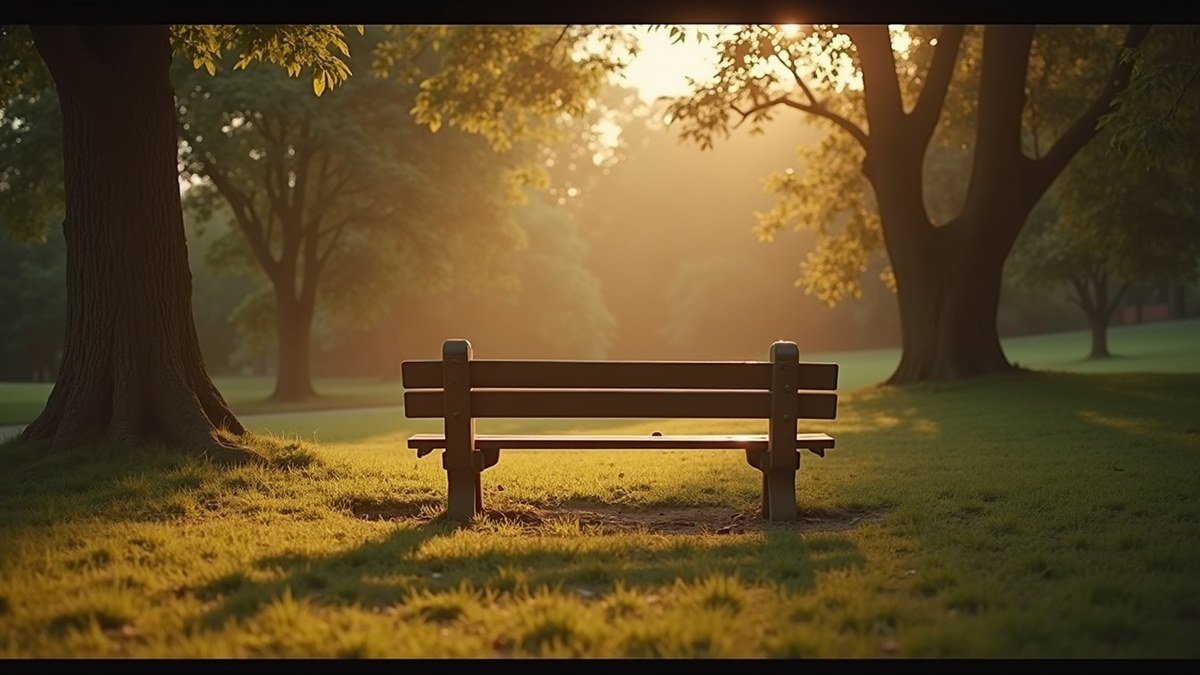
He sat on the same bench in the park every Sunday at three. For fourteen years, she watched him through her kitchen window.
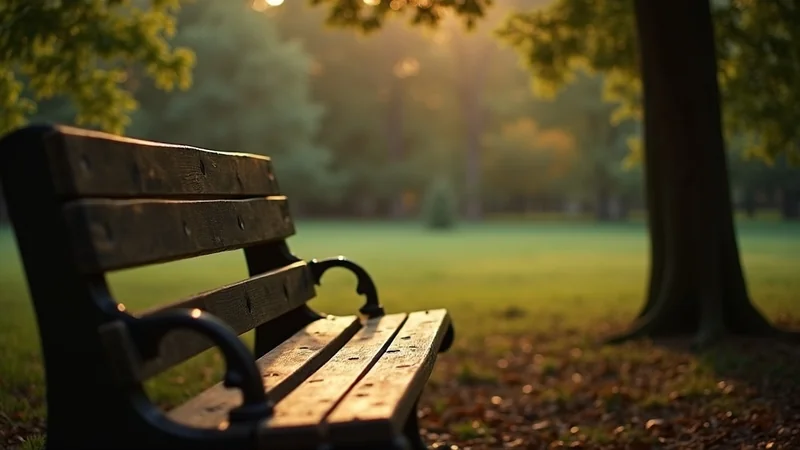
The small park along the Conestoga River on the southwest edge of Lancaster was the kind of compact urban green space that older Pennsylvania cities tend to have, three acres of mown grass, two stands of oak, a small paved path along the riverbank, and four wooden benches placed at irregular intervals along the path. The bench second from the south end had a small bronze plaque on the back that read IN MEMORY OF DOROTHY HEISER · 1924 to 2001 · WHO LOVED THIS RIVER. Dorothy Heiser had been the mother of Margaret Heiser, who lived in the small brick row house at 218 South Marshall Street, whose kitchen window faced directly across the park to the bench.
Margaret had been forty-three when her mother had passed. She was fifty-six now. She had been a high school chemistry teacher at McCaskey for twenty-eight years, was three years from retirement, and had developed, over the long careful decade following her mother’s death, the habit of drinking her Sunday afternoon coffee at the small breakfast table in the kitchen, where she could see the bench her mother had loved and which she had, by quiet personal arrangement with the city in 2002, paid to have memorialized.
The man had first appeared on the bench on a Sunday in October of 2011.
She had not, at the time, thought anything of it. The bench was a public bench. People sat on it. He had been, that first Sunday, a stranger in a green field jacket and dark trousers, sitting upright with his hands folded in his lap. He had stayed for about forty-five minutes. He had not read a book. He had not used a phone. He had simply sat, looking out at the river, in the small composed way of a man who had come to the bench for a specific reason.
He had returned the following Sunday at the same time. And the Sunday after. And the Sunday after that.
By the end of 2011, he had become, by Margaret’s quiet weekly observation through the kitchen window, a small recurring fixture of her Sunday afternoons.
II. The fourteen years.
She did not, in any of the fourteen years that followed, ever go out to the bench to introduce herself.
She had thought about it many times. She had the small reasonable curiosity of any woman who had watched a stranger return to the same bench in a small public park for fourteen years. She had, on perhaps a dozen Sundays over the slow accumulated time, considered putting on her coat and walking the short hundred yards across the park and saying something polite and noncommittal. Lovely afternoon. Do you mind if I sit. The plaque, by the way, is for my mother.
She had not, in any of the dozen Sundays, gone.
She had not gone because the man’s posture, every single Sunday, was the posture of a person who had come to the bench to be alone with something. The shoulders carried a kind of held containment. The folded hands suggested the man was deliberately not occupying himself. The face (which Margaret could only ever see in three-quarter profile from her kitchen window, never directly) had the steady neutrality of a man who was practicing the kind of attention that does not want company.
She had learned, by long teaching experience, to recognize that kind of attention. It was the attention of a student sitting alone at the back of her chemistry classroom because the student had something specific to think through, and the polite professional thing was to let the student think through it. She had decided, by the second year of the man’s Sunday visits, to treat him in the same way.
She had simply watched.
Over the fourteen years, she had built up a quiet inventory. The man was, by her steady weekly observation, between sixty and sixty-five in 2011. He was tall, perhaps six-one. He had short gray hair that had been short and gray since the first Sunday. He always arrived between two fifty-five and three. He always left between three forty-five and four. He sat for approximately forty-five to fifty minutes. He sat in all weather. He had sat in light rain. He had sat in snow. He had sat in the bright cold of late January and the heavy heat of mid-August. The only Sundays he had missed, by Margaret’s careful informal count, had been six over fourteen years, three in 2014 (a consecutive run that had concerned her), one in 2018, one in 2022, and one in 2024.
He had never, by her observation, brought flowers. He had never brought any visible object. He had simply sat.
III. The end of the fourteenth year.
He stopped coming on the second Sunday of October last year.
She did not notice the absence immediately. She had been at her sister’s house in Reading that Sunday for a family lunch, and had not been at her kitchen window at three. But on the third Sunday, when she had been at the kitchen window at three with her coffee, the bench had been empty.
She had assumed, in the moment, that the man had simply skipped a week.
He did not return the following Sunday. Or the Sunday after. Or any Sunday in November.
By the first Sunday of December, when the bench had been empty for almost eight weeks, Margaret had begun to do the slow internal accounting of his absence. The man had been, by then, perhaps seventy-three or seventy-four. He had been visibly slower in the previous year, the walk from the south entrance of the park, by her observation, had taken him perhaps a minute longer than it had in 2020. He had been thinner. The green field jacket, by 2024, had been carried by a frame that no longer quite filled it.
She had begun, by the second Sunday of December, to assume the most reasonable of the possible explanations.
She had not, in fourteen years, known his name. She had not known his neighborhood. She had not known why he had been coming. There was no available way for her to find out what had happened to him.
She did, on the third Sunday of December, walk across the park to the bench.
She sat on it for almost an hour. She had brought her coffee with her in a thermos. The Pennsylvania December was clear and cold. She had on her good wool coat and the gray scarf her mother had knitted in 1998. She sat in the spot the man had sat in for fourteen years. She looked across the river in the direction his face had been facing every Sunday at three.
There was nothing specific on the other side of the river. There was only the small slope of riverbank, the bare oaks of the small wooded strip that ran along the far side, and the slow steady running of the Conestoga.
She sat for forty-five minutes. Then she walked home.
IV. The letter at the door.
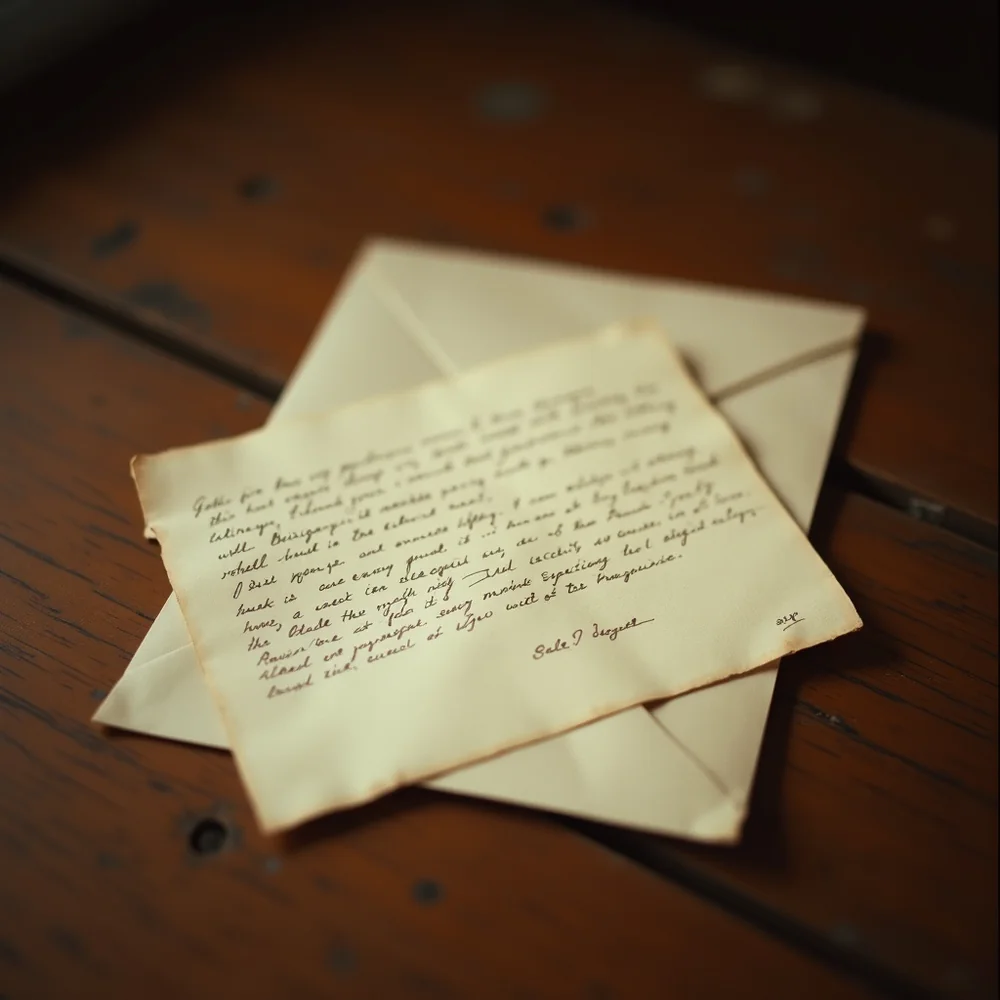
The letter arrived on a Wednesday morning in late January. It was in a plain white business envelope with no return address. The address was handwritten in a careful blue-ink hand she did not recognize. The postmark was Lancaster.
She opened it at the kitchen table over a second cup of coffee.
Dear Mrs. Heiser,
I am writing to you because my father, who passed away on the second of October last year, asked me to. He told me, in the last conversation we had at his hospital bedside, that there was a woman who lived in the brick row house at 218 South Marshall Street who he believed had been watching him from her kitchen window for fourteen years. He told me that he had never spoken to her. He told me that he did not, in any sense, want me to attempt to make her acquaintance on his behalf. He told me only that he wanted her to be told, after his death, what he had been doing on the bench.
My father’s name was Walter Lieb. He was born in Lancaster in 1947. He was a veteran of the Vietnam War, he served with the First Cavalry Division between January of 1968 and February of 1969. He returned to Lancaster in March of 1969. He married my mother, Dorothy Lieb (née Stoltzfus), in June of 1971. He worked for thirty-eight years as a machinist at the small precision-tooling shop on Manor Street. He was a good father. He was, by every honest account my brother and I can give, a good husband.
He was also, for fifty-five years, a man who carried a number of things from his fourteen months in Vietnam that he was not, in any practical sense, ever fully able to put down.
In October of 2011, on the recommendation of a small veterans' counseling group he had quietly joined the previous summer, my father began a practice the counselor had suggested. The practice was that he would go, once a week, at a specific time, to a specific public place near water, and that he would sit for forty-five minutes and do nothing. He was instructed not to read, not to listen to music, not to use a phone. He was instructed to simply sit. He was instructed to allow whatever came up to come up. He was instructed not to push any of it away.
The bench in the small park along the Conestoga was the place he chose. He chose it because the plaque on the back of the bench was inscribed to a woman named Dorothy, which was also the name of his wife, who was alive at the time, and is alive still. He told me, in our last conversation, that he had liked the small private feeling of sitting on a bench inscribed to a woman named Dorothy, while doing the slow patient work of remembering things that he had not, in his marriage to his own Dorothy, ever been able to bring himself to fully describe.
He sat on the bench for fourteen years. He sat through the period, between approximately 2013 and 2017, when the slow patient work had been particularly difficult. He sat through the period, between 2017 and 2021, when the work had begun, by his own description to me in the years afterward, to make a small available difference. He sat through the slow last years, when, by his own honest description, the work had become a small quiet companion rather than a small ongoing labor.
He told me that he had noticed your kitchen window, sometime in the second or third year. He had noticed that there had been a woman at the window most Sundays. He had noticed that the woman had been holding a coffee cup. He had noticed that the woman had never come out of the house, and had never appeared to be staring, and had simply, by every reasonable interpretation, been present at the window during the same hour he had been present on the bench.
He told me that he had taken a private comfort from this. He told me that he had decided, by his own private accounting, that the woman at the window was almost certainly the woman who had paid for the plaque. He told me that he had imagined, over the fourteen years, that the woman at the window was, in some small way that he could not quite name, sitting with him.
He asked me to write to you, after his death, to tell you that he had known you were there.
He also asked me to tell you, in case it would mean anything to you, that the woman to whom the plaque is inscribed, Dorothy Heiser, had, by his own quiet weekly imagination of her, become a small specific companion of his over the years. He had carried, by the bench plaque, the small private illusion that he was sitting with two Dorothys at once, his wife at home on Manor Street, and your mother at the bench. He told me to thank you, on his behalf, for the plaque.
With the gratitude of our family, and with my own gentle apologies for sending this letter to a person I have never met, Daniel Lieb
There was a small additional line at the bottom, in the same careful blue-ink hand.
P.S. My mother is well. She is seventy-six. She lives in the same house on Manor Street. She would, by my honest private estimate, be moved to know that there had been a woman watching for my father over the long years. I have not yet decided whether to tell her. I will, if you have no objection, decide that question slowly.
V. The afternoon Margaret did not call.
She did not, that Wednesday morning, do anything immediately.
She sat at the kitchen table with the letter in front of her for almost two hours. She drank her coffee. She made a second cup. She read the letter again. She read it a third time.
She did not, by her own honest later description, cry. She did the small slow available thing that women in their fifties sometimes do when a long quiet observation of their own private weekly life has finally been given a name. She sat with it. She let it settle.
Around eleven, she stood up. She put on her wool coat. She walked across the park to the bench.
She sat in the same spot she had sat in on the third Sunday of December. The January Wednesday was cold and bright. The bench was empty in both senses, both empty of the man, and empty in the small quiet way of any unoccupied public bench on a weekday morning.
She read the letter for the fourth time. She sat for almost an hour. She walked home.
She did not, by her own gentle decision over the slow following weeks, write to Daniel Lieb in reply. She had thought about it. She had drafted a letter twice, in the small private way of a woman who had spent twenty-eight years teaching chemistry students how to do their work clearly. She had not, by the second draft, been able to find a way of writing back that did not feel, by her own honest reading, like a small claim on a fourteen-year ritual that had been, in its honest essence, the man’s and not hers.
She had been at her kitchen window. She had held her coffee. She had watched.
She had not, by her honest reading of the slow internal accounting, done any of the actual work the man had been doing on the bench. She had simply been present in the same hour.
She did not want, by her honest later description in our conversation in March, to be in any way the protagonist of his story.
She decided, by her gentle private decision in late January, to honor his son’s letter by not making any reply.
VI. The first Sunday in February.
She had been, by her long internal habit, expecting to slowly let the Sunday three-o’clock window become an ordinary Sunday three o’clock again. She had assumed, by her own honest description, that the slow weeks following the letter would gradually reclaim the small Sunday hour from the fourteen-year ritual.
What she did not, by her own count admission, expect was for the bench to be occupied on the first Sunday of February.
She had been at her kitchen window at three. She had had her coffee. She had not been, by her own description, fully present, she had been thinking about something at school, the small mid-semester preparations for the spring chemistry units. She had glanced out the window the way she glanced out every Sunday.
There was a woman on the bench.
The woman was perhaps in her mid-seventies. She had on a small dark coat. She was sitting upright with her hands folded in her lap. She was facing the river. She did not, by every visible sign, appear to be reading or using a phone.
Margaret stood at the kitchen window for a long minute.
The woman stayed for forty-five minutes. She left at three forty-five.
Margaret did not, that Sunday, go out.
The woman returned the following Sunday. She returned the Sunday after. By the third Sunday in February, Margaret had begun, by her quiet honest internal arithmetic, to understand who the woman on the bench almost certainly was.
Some long quiet rituals, once understood, are inherited.
VII. The note Margaret left.
She did not, by her private reckoning description, intend to leave the note. She had been, by her own gentle internal accounting, holding to her decision not to make any small claim on the bench or on the family that had been quietly using it.
But on the second Sunday of March, after Dorothy Lieb (for she was, by every available reading, almost certainly Dorothy Lieb) had been on the bench for six consecutive Sundays, Margaret did something small and unplanned.
She walked, on a Saturday morning when the bench was empty, to the small flower shop on West King Street. She bought a small bunch of yellow tulips. She walked to the bench. She left the tulips on the small wooden seat, with a small folded note tied to the stems by a piece of garden twine.
The note said only:
For the woman who comes on Sunday afternoons. The plaque on this bench is for my mother. She would, by my honest estimate, be glad to have the company of another careful woman named Dorothy., M. Heiser, 218 South Marshall.
She did not, that Saturday, see whether Dorothy Lieb received the note. She did not, by her own arithmetic description, intend to.
On the following Sunday, at three, she was at her kitchen window with her coffee. Dorothy Lieb arrived at the bench at two fifty-eight. The tulips were no longer there (they had, by Margaret’s quiet description, been removed by the city’s small park maintenance crew at some point during the previous week) but Dorothy paused, briefly, at the spot where they had been. She held something small in her hand. She read it. She looked, for a small clear deliberate moment, across the park toward Margaret’s kitchen window.
She did not, by every visible sign, wave. She did not, by any visible sign, signal that she had read the note in any specific way.
She simply nodded, once, in the small clear direction of the window.
Then she sat down on the bench.
VIII. Why it stays.
I sat with Margaret Heiser at her kitchen table on a Sunday afternoon in late March, almost six months after the second Sunday of October when Walter Lieb had last sat on the bench. The kitchen window faced, as it had faced for fourteen years, directly across the small park toward the second bench from the south end. The bench was, at three o’clock that afternoon, occupied by a woman in a dark coat with her hands folded in her lap.
Margaret did not, in our conversation, characterize her fourteen years of Sunday-window observation in any romantic or heroic terms. She characterized it the way a high school chemistry teacher in her mid-fifties would characterize it. She had developed, by accident, a small weekly habit. The habit had run alongside, by the small geographic coincidence of her kitchen window and her mother’s bench, the slow patient private work of a man she had never met. The habit had, by her own gentle description, become a small thing she had not, in fourteen years, been willing to name.
She has, in the slow weeks since March, continued the small Sunday window habit. She has not, by her gentle private description in our March conversation, met Dorothy Lieb in person. She has, by gentle private observation, watched Dorothy Lieb arrive at the bench at almost three every Sunday for six months and stay for the same forty-five minutes her late husband had stayed for fourteen years.
The slow Sunday ritual has, by every available reading, been inherited.
Across the United States, in small public parks and small bronze memorial plaques and small kitchen windows that face slow patient riverbanks, the long quiet rituals of small careful Americans are slowly being passed, by small accidents of geography and shared first names, from one careful sitter to the next. For broader context on the long American history of veterans' counseling and the slow patient work of small weekly ritual practice, readers can spend time with the materials at the U.S. Department of Veterans Affairs or the long-form reporting at PBS NewsHour. The Chapbook keeps its narratives clean, human, and responsible, read more in the Editorial Policy.
The bench is, this afternoon, occupied by Dorothy Lieb. Margaret Heiser is at her kitchen window with her coffee. She has not, in six months, walked across the park to introduce herself.
She has, by her own quiet accounting gentle decision, decided that the small forty-five-minute hour belongs to Dorothy Lieb.
She will, by her quiet steady weekly practice, continue to be at the window.
The small inherited ritual, in the slow honest arithmetic of small Pennsylvania life, is exactly where it ought to be.