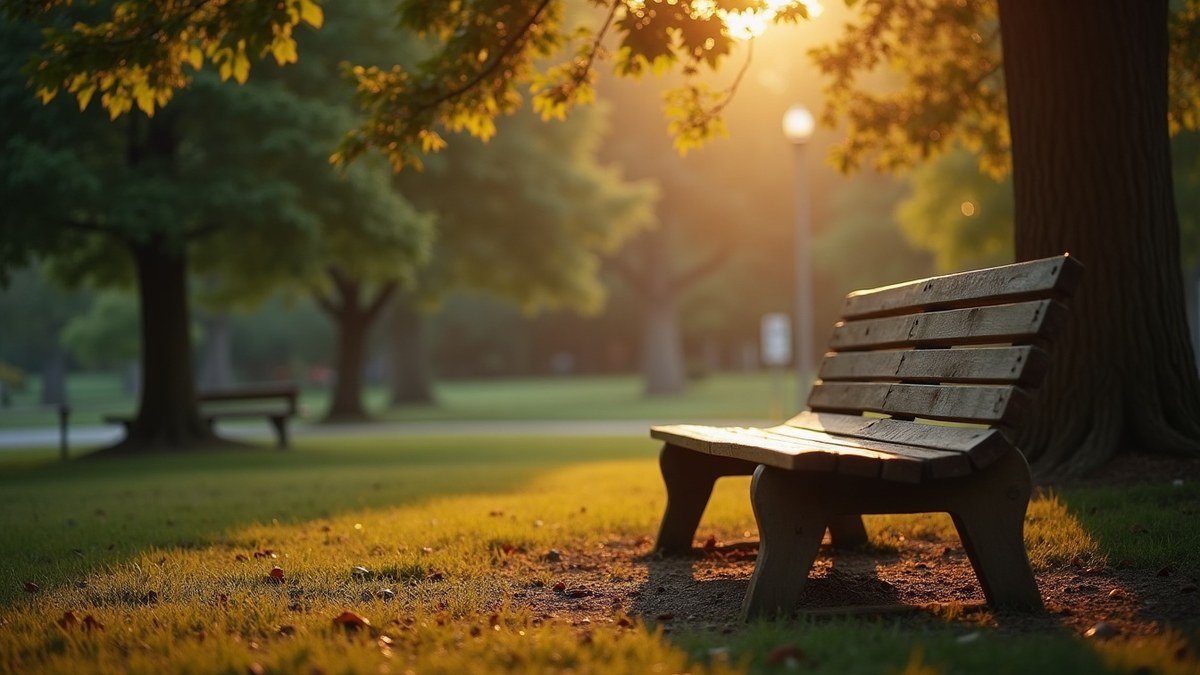
They kissed on this bench in the summer of 1994, and then they lost each other for thirty years. On a cool Tuesday morning in May of 2024, without planning it, they sat down on it again.
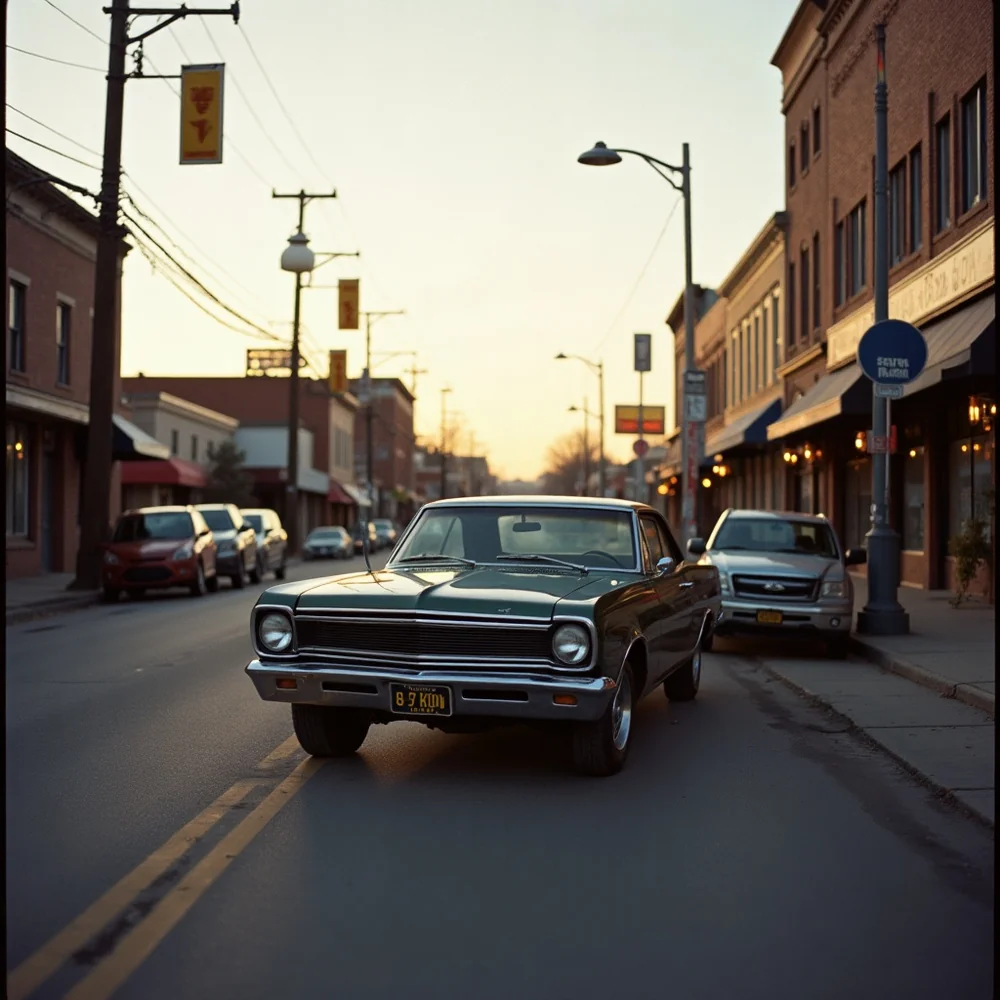
The bench sits on the eastern edge of Pack Square in downtown Asheville, North Carolina, facing the old Buncombe County courthouse and the pink and green tiled roof of City Hall. It is not, strictly, the original bench. The city has replaced the slats at least twice since the nineteen nineties, and the stone obelisk that stood over the square for more than a century is gone now, taken down in 2021, leaving a plainness in the middle of the bricks that people who knew the square before tend to notice within their first minute back. Eleanor Brashears noticed it before she had finished crossing College Street.
She was fifty-eight that morning. She had driven down from Charlottesville, Virginia, the day before, alone, with a thermos and a paper road atlas she did not actually need, and she had slept badly in a hotel off Biltmore Avenue, listening to the rain finish itself against the window.
She had not been in Asheville since the last week of August, 1994.
At twenty minutes to nine she bought a coffee on Biltmore Avenue and carried it up to the square. The morning was cool for May, mountain-cool, the brick still dark from the night’s rain, and the air smelled of wet stone and roasting beans and, faintly, of diesel from a delivery truck idling over on Patton Avenue. The bench was empty. She stood in front of it for a moment, the way a person stands in front of a grave or a door, and then she sat down at the north end, which had been her end, and balanced the cup on her knee and waited for nothing in particular.
She has tried, since, to explain to herself what she was doing there. “I wasn’t expecting anything,” she told me this past winter. “I want to be clear about that, because the story sounds invented otherwise. I was not waiting for him. I was visiting a version of myself. He just happened to still use the bench.”
II. Eleanor, and the year she finally drove south.
Eleanor Brashears spent thirty-one years as a librarian in Charlottesville, most of them in reference and local history, the last nine running a branch. She is the sort of person the word steady was built for. She kept the same house on Locust Avenue for twenty-six years, the same husband for twenty-three, the same Tuesday volunteer shift at an adult literacy program for eleven.
Her husband, Phil Brashears, taught high school chemistry. They married in 1998. By every account I could gather, including hers, it was a good marriage, unglamorous and durable, built on crossword puzzles and a shared distrust of drama. Phil died of a heart attack in October of 2021, in the driveway, with the leaf rake still in his hand. Their son, Marcus, was twenty-one then. Eleanor went back to work eleven days after the funeral, because the silence in the house had a texture she could not stand, a hum like a refrigerator that never cycles off.
She retired in June of 2023. That first winter alone, with no job to shape the days, she did what retired librarians do. She organized. And in a shoebox of unsorted photographs, between Marcus’s kindergarten pictures and somebody else’s wedding, she found a snapshot of herself at twenty-eight, sitting on a bench in Asheville, North Carolina, laughing at the person holding the camera, in the summer of 1994.
She knew exactly who had been holding the camera.
She put the photograph on the refrigerator. It stayed there through February and March, and in April she told Marcus she was driving to Asheville to look at galleries, which was not a lie so much as a tenth of the truth. She booked two nights. She packed the photograph in the side pocket of her bag, like a document she might be asked to produce at a border.
III. The summer of 1994.
She had come to Asheville in May of that year, at twenty-eight, between lives. She had finished a library degree in Chapel Hill, deferred a job in Virginia until the fall, and taken a summer position at Longacre Books, a narrow used bookstore on Wall Street that smelled of pipe smoke and binding glue and that closed for good in 2006. She shelved fiction in the mornings, worked the register in the afternoons, and on her breaks she sat on the bench at the east side of Pack Square.
Theo Mackenzie was thirty, and he played cornet on the square most evenings, a felt hat upside down on the bricks in front of him. He played standards, mostly. “On the Sunny Side of the Street.” “Stardust.” Long, unhurried versions that made tourists slow down without knowing why. He had grown up in Knoxville, walked away from a music program two semesters short, and was, that summer, the best unfamous musician in a town that has always kept a few on hand.
The first week, she walked past him eight times without speaking. The second week she brought him an iced coffee from the shop next to Longacre, set it beside the hat, and walked off before he finished the chorus. The third week she brought him a piece of fruit. By the first week of July they were sharing the bench every evening when he packed up, and on one of those evenings, with the streetlights coming on and the square emptying out, he kissed her, or she kissed him. Thirty years later they still disagree about the order of operations, gently, like two people arguing about the weather of a vanished country.
It was a summer with the exact dimensions of a summer. They swam in the French Broad below the warehouses. They stayed late in a music room on the Block, the old African American business district off Eagle Street, where the bandleader let Theo sit in after midnight. She read to him on the bench from whatever strange thing had come into the store that week. He played her requests badly on purpose to make her laugh. Neither of them said one word about September.
September arrived anyway. He had been offered a chair in a working band relocating to New Orleans, regular money, real rooms, the first solid thing his playing had ever produced. She had a position waiting at a university library in Virginia, the kind people in her field waited years for. On a hot night in the third week of August, on the bench, with the air thick enough to lean on, each asked the other to give their thing up. It went the way those conversations go between two proud people who have not yet learned how to be wrong.
He told her she was choosing the quietest possible life because it could never disappoint her. She told him the horn was just a way of making sure he never owed anybody anything. Both sentences were about forty percent true, which is the most dangerous percentage a sentence can be. He left for New Orleans four days earlier than he had planned. She worked her last shift at Longacre, returned her key, and drove north. There was no email between them, no cell phones, no mutual friend who stayed put. 1994 could still swallow people whole, and it swallowed them.
Some arguments do not end a love. They mislay it, the way a library mislays a book that is technically still in the building.
IV. The man who sat down.
Theo Mackenzie, at sixty, still plays for a living, which he will tell you is either a triumph or a diagnosis, depending on the month. He lives in the Marigny in New Orleans, keeps a dozen students, and tours small rooms in the spring. That May he was booked for three nights at a listening room off Eagle Street, two blocks from where he used to busk. He had played Asheville maybe ten times across the decades, and every time, whatever the weather, he walked up to Pack Square in the morning with a coffee and sat for a while on the bench. He never examined the habit. “You don’t ask a dog why it checks the same corner,” he said.
He reached the square at a quarter past nine. There was a woman at the north end of the bench, reading glasses pushed up into gray-brown hair, a paper cup balanced on her knee. He sat down at the south end, which had been his end, and for several minutes neither of them said anything, in the comfortable way of strangers who have each decided the other is harmless.
He spoke first. He nodded at the empty middle of the square and said, “They took the monument down. I keep looking at where it isn’t.”
“Three years ago,” she said. “I read about it. It’s strange. My eyes keep going there too.”
They talked the way you talk to a stranger on a bench, in safe, widening circles. The square. The new hotels. The way a city edits itself the moment your back is turned. He said he was a musician, in town for a few nights of work. She said she was a retired librarian from Virginia, in town for, and here she paused very slightly, the galleries. He said New Orleans was the only city he knew where the past was louder than the present. She laughed at that, one short surprised note, and something moved at the edge of his memory like a fish under ice, and was gone.
“What do you play?” she asked.
“Cornet,” he said. “Trumpet’s pushy little sister.”
Eleanor looked at her coffee for a long moment. The square was filling slowly around them, office workers cutting across the wet bricks, a man unloading folding tables for a market, somewhere a hand truck rattling over a curb. She has told me she did the arithmetic three times before she spoke again, the age, the hat she could almost see on the bricks, the instrument, and that some cowardly, sensible committee inside her voted to say nothing at all, finish the coffee, and drive back to Virginia with the morning intact.
V. The recognition.
“There used to be a bookstore on Wall Street,” she said, not looking at him. “Used books. Narrow as a hallway.”
“Longacre,” he said, without a beat of hesitation. “Closed a long time ago. There was a girl who worked there the summer I played the square. She used to leave an iced coffee next to my hat and walk off like she hadn’t done it.” He smiled at the empty middle of the square. “Once she left a peach.”
“It was a nectarine,” Eleanor said.
What happened next happened slowly, and both of them insist on the slowness. He did not gasp. He did not stand. He turned his head and looked at her properly, the way nobody looks at a stranger, and she watched thirty years cross his face like weather, doubt first, then arithmetic, then fear, and then something that was not quite joy yet, because it had not been given permission to be.
“Eleanor,” he said. Not a question, quite. A word he was checking the weight of.
“Hello, Theo.”
They did not embrace. This matters to both of them, for the record. They sat where they were, three feet of municipal lumber between them, and were almost entirely silent for what she estimates as one minute and he estimates as five. His hands, she noticed, had the first knots of arthritis at the knuckles. Her ring, he noticed, was a wedding band, worn on the right hand now, the way widows sometimes carry them.
“I’d like to say something graceful,” he said finally, “and I don’t have anything.”
“Good,” she said. “Don’t perform. You always performed.”
“You always shelved,” he said, and the laugh they produced together was crooked and a little frightened, and it was, they told me separately and in nearly the same words, the moment the morning stopped being impossible.
Recognition at fifty-eight is not a door thrown open. It is a door unlocked slowly, from both sides at once.
VI. What thirty years had done.
They stayed on the bench for almost three hours. The market assembled itself in front of them, table by table. The sun came around the courthouse and dried the bricks, and the smell of wet stone gave way to kettle corn. What they did with those hours was not reminiscing, or not mostly. They reported. Two adults, item by item, declaring three decades at customs.
His report: New Orleans had taken him in the way that city takes horn players, thirty years of work, four of them flush. He married Renee Fontenot, a singer, in 2002, and they divorced in 2011, with no children and, he says, no villains, just two touring schedules that waved at each other from passing vans. The flood in 2005 took his apartment and his record collection, and he spent two years in Houston playing hotel lobbies before he could get home. He made one album under his own name, in 2009, that almost nobody bought and that he is still proud of. His knuckles ache in cold weather now. He teaches, he tours small rooms in the spring, and he had been, until that morning, by any honest accounting, content.
Her report was quieter, and she refused to apologize for the quiet. The university library, then the public system. Phil, the chemistry teacher with the crossword and the kind eyes, who in twenty-three years never gave her a single evening of wondering where he was. Marcus. The house on Locust Avenue. The driveway, the leaf rake, the eleven days. She told Theo about Phil with her chin up, watching to see whether he would try to shrink it, and he did not. “He sounds like a man I’d have liked,” he said. Then, after a moment, “And I’d have bored him inside an hour,” and she laughed for the second time that morning.
“Neither of us got cheated,” she told me later. “That is what I needed him to understand on that bench, and he understood it. I was not a sad woman who waited thirty years. I had a whole life. So did he. We were not restoring anything, because there was nothing to restore. There were two new people sitting where two old people used to sit.”
Around noon they finally said the hard part out loud. She apologized for the sentence about the horn. He apologized for the sentence about the quiet life. “You weren’t altogether wrong,” he said. “I wasn’t altogether right,” she said, and that, they agreed, was as far back as either of them was going to dig.

VII. The dinner, and the agreement.
She came to his show that night, the second of the three. She sat at the back of the listening room off Eagle Street with a glass of wine she barely touched, and he played, she says, like a man being graded, which he denies and his bass player confirms. He put the long, unhurried “Stardust” second to last, the horn low and unhurried under the stage lights, and did not look at her once while he played it, which she understood as exactly the look it was.
Dinner was two nights later, his last in town, at a small place on Lexington Avenue. They have both declined to describe most of it, politely and almost identically, and I have decided their refusal is its own kind of report. What they will say is this. It lasted four hours. The staff turned every other table around them twice. Nobody cried, or nobody admits to it.
At the end of it, on the sidewalk, came the agreement, and the agreement is the part of this story I have been asked to render exactly, because both of them are tired of their friends improving it. They exchanged phone numbers, his written on the back of a set list, hers on a deposit slip from her purse. He would call on the first of each month. She would answer, or call back within the day. And in October, between his fall dates, they would meet again in Asheville, neutral ground, for one dinner.
“One dinner,” Eleanor repeated to me, holding up one finger, a librarian renewing a loan rather than giving the book away. “That was the whole contract. Not a courtship. Not a reunion. One phone call a month and one dinner. Two people our age do not owe the past a romance. We owed it a conversation, and we decided to pay in installments.”
“I have made big promises before,” Theo told me from New Orleans, “and I have watched them die of exposure. A phone call a month is a promise I can keep at sixty. I would rather be a man who keeps a modest promise than one more man who breaks a beautiful one.”
VIII. Why it stays.
I sat with Eleanor Brashears in her kitchen in Charlottesville this past February, the 1994 photograph still on the refrigerator, and I reached Theo by phone in the Marigny, where I could hear a student running scales in the next room. Here is what I can report, and all I can report. The October dinner happened. It went well enough that there has since been a second, in January, and the first-of-the-month phone calls have not yet missed a month. Neither of them will give the thing a name. When I pushed, Eleanor offered “a correspondence,” and Theo offered “a residency,” and each seemed quietly pleased with their own answer.
It would be easy to write the ending the movies have trained readers to expect, the two of them old and certain, the horn case standing in the hallway on Locust Avenue. It would also be a lie, or at least a guess wearing a lie’s clothes. What is true is smaller and better. Two people who said forty-percent-true things to each other on a bench in 1994 sat back down on that bench in 2024 and discovered that the people who had said those things no longer existed, and that the two people who had replaced them were honestly curious about each other.
A bench is the cheapest archive a city keeps. It records nothing, it holds everything, and it does not care how long you take to come back and check the records.
The bench itself appears on nobody’s map. The librarians at Buncombe County Special Collections can tell you what stood on Pack Square in any decade you like, but no ledger anywhere records who kissed whom at the east end of it in July of 1994, which is, Eleanor points out, exactly the kind of gap a local history librarian spends a career trying to close. Readers who want the wider music this story sits inside can spend an afternoon with the American jazz and folk collections at the Library of Congress, which hold the tradition Theo busked from, or with the Smithsonian, which keeps the long national record of what ordinary American summers leave behind. The Chapbook keeps its narratives clean, human, and responsible, read more in the Editorial Policy.