She had borrowed the umbrella from a stranger on Michigan Avenue. Eight years later, she returned it.
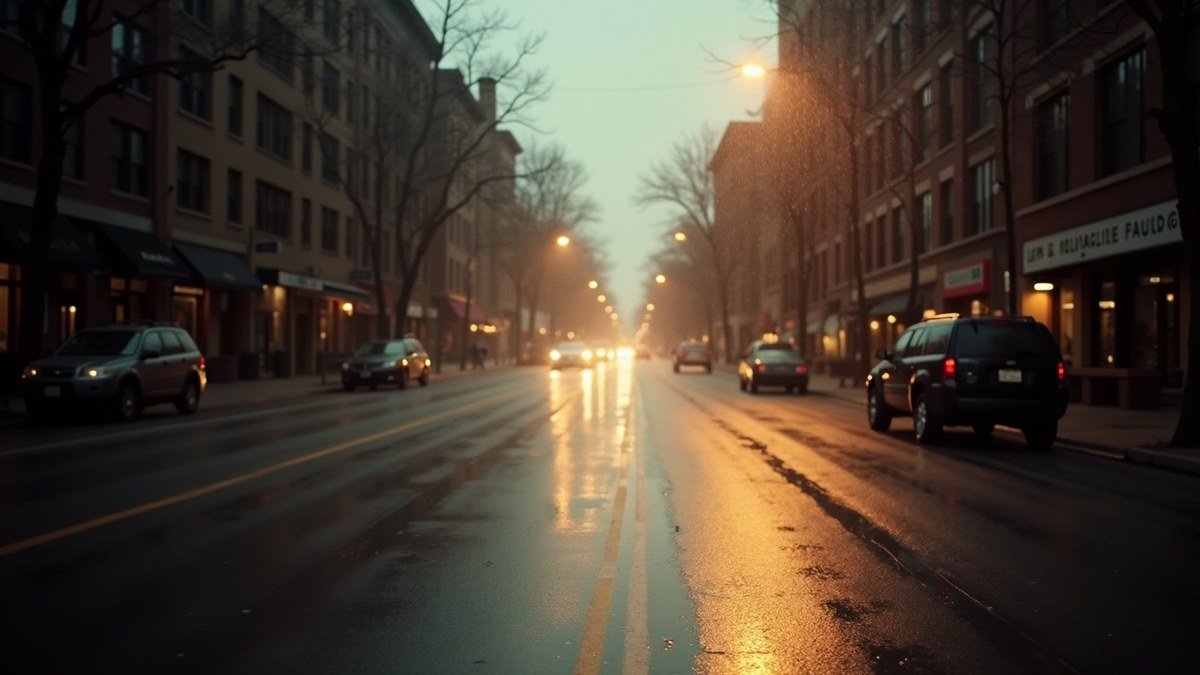
The rain on the afternoon of November the second, two thousand and seventeen, had been the slow heavy kind of Chicago rain that the city sometimes gets on the back edge of a Great Lakes cold front. Elena Voss had been twenty-five. She had been walking south on Michigan Avenue, from the small office building on Ohio Street where she had just finished a job interview, toward the small Bronze Line stop at Lake. She had been wearing the small navy interview suit her mother had bought her in Iowa City in 2014, the small black flats that had been pinching her left heel for almost an hour, and the small thin trench coat that had, by every honest reading of the small Chicago weather report she had not bothered to check that morning, been a small inadequate choice.
The umbrella had appeared at Ontario Street.
A man had been standing at the curb under a small black golf umbrella. He had been perhaps thirty-five, in a dark wool overcoat. He had been waiting for the light to change. He had glanced at her (at the small rain in her hair, at the small water running down her trench coat, at the small soaked manila folder she had been carrying) and he had, in the small unhesitating manner of certain Chicago men, stepped to the side and held the umbrella over her.
“Take it,” he had said.
“Oh, no, I am fine.”
“You are not fine. Take it. I am going two blocks. You are going farther. Take the umbrella.”
He had handed it to her. The light had changed. He had walked, hatless, into the small Tuesday afternoon downpour, in the small composed manner of a man who had decided he was going to be wet for the next ten minutes and had accepted it.
She had stood on the curb with the umbrella in her hand. He had not, in the moment, given her his name. She had not, by the small embarrassed quickness of the exchange, given him hers. She had watched him walk south for half a block before she had thought to call after him. She had called once. He had not, by the small specific volume she had managed, heard her. She had let him go.
She had taken the umbrella to the Lake Bronze Line stop. She had taken it home to the small one-bedroom she had been renting in Lincoln Park. She had set it inside the small umbrella stand by her front door.
She had not, in any of the eight years that followed, used it.

II. The eight years.
She had kept the umbrella the way some people keep small objects that have been given to them by strangers under specific circumstances. She had not, by her own honest description, treated it as a small sentimental object. She had treated it as a small specific debt. The umbrella was, by her honest private accounting, not hers. It belonged to a man whose name she did not know.
She had not used it because the small unbroken physical condition of the umbrella was, by her quiet private logic, the only thing she could still preserve about the small obligation. Using it would have meant accepting it. Returning it intact, eight years later, would mean returning the exact small object that had been handed to her.
She had moved, in the eight years, four times. The umbrella had moved with her. From the small one-bedroom in Lincoln Park, to the small studio in Wicker Park she had taken in 2019, to the small two-bedroom on Damen Avenue she had shared with a small careful boyfriend named Theo between 2021 and 2023, to the small one-bedroom on Cortland Street in Bucktown she had taken after the small kind end of the relationship with Theo. The umbrella had been in four umbrella stands. She had never opened it.
She had been hired, in the small November of 2017, at the small public-relations firm whose interview she had been walking home from in the rain. She had stayed at the firm for almost six years. She had moved, in 2023, to a small in-house communications role at a small Chicago nonprofit that worked on public-housing policy. She liked her work. She was, by her own honest description, the small kind of careful thirty-three-year-old Chicagoan whose long young adulthood was settling, in the small steady way of long young adulthoods, into the small available shape of an actual adult life.
She had also, in the eight years, occasionally thought about the man under the umbrella. She had thought about him in the small specific way one thinks about strangers who have done small specific kindnesses for one. She had imagined him, on the small handful of slow Chicago Sunday afternoons when she had let herself imagine, as a small specific kind of Chicago man, careful, married, the small father of two careful Chicago children, the small kind of man who had been raised by his own careful parents to be the small kind of man who hands his umbrella to a soaked young woman on Michigan Avenue and walks the remaining two blocks of his own afternoon hatless.
She had imagined him, mostly, the way one imagines a small fixed star.
She had not, by her own honest description, expected to ever see him again.
III. The conference.
The small conference at the Drake Hotel on November the second of last year had been the slow culmination of about eighteen months of small work on Elena’s part. The conference had been a small two-day gathering of careful public-housing professionals from across the Midwest, organized by the nonprofit she worked for, and she had been the small lead staff coordinator for the second day. She had been at the Drake since six-thirty in the morning. She had been doing the small steady careful infrastructural work of a small conference coordinator. She had not, by any small visible sign of her own intentional planning, been thinking about the small November weather.
It was the afternoon of November the second.
It was raining.
She had not, in any small honest available sense of her own preparation, brought an umbrella that morning.
At three forty-five, she was standing under the small black canopy at the Walton Street entrance to the Drake, waiting for the small black town car that was supposed to take a small visiting Detroit nonprofit director back to O’Hare. The town car had been small late. The Detroit director (a careful woman in her late fifties named Vivian Pierce) had been making polite small conversation with Elena under the small canopy for almost six minutes.
A man came out of the small Walton Street entrance behind them. He had a small black golf umbrella. He opened it. He glanced, in the small unhesitating manner of certain Chicago men, at Vivian and Elena. He stepped to the side. He held the umbrella over them.
“Ma’am,” he said to Vivian. “Are you waiting for the car?”
“Yes,” Vivian said. “Thank you.”
He held the umbrella over both of them for almost three minutes. Vivian and the man made small polite Chicago weather conversation. Elena did not speak. She was, by every small honest interior fact she could later identify, looking at the man’s face.
He was perhaps forty-three. He had short dark hair. He had a small thin face. He had, on the small ring finger of his small left hand, a small simple gold wedding band. He had, by every small recognizable detail of the small Tuesday afternoon in November, the same face Elena had been imagining, on the small handful of slow Sunday afternoons, for eight years.
The town car arrived at three forty-nine. Vivian got in. The car pulled away. The man closed the umbrella. He nodded at Elena. He turned to walk back into the Drake.
“Excuse me,” she said.
He stopped. He turned. He smiled, in the small polite way of a Chicago professional who had been politely smiled at by a small number of small Chicago professional strangers over the years.
“Yes?”
“This is going to sound strange,” she said. “But I think I borrowed an umbrella from you. In two thousand and seventeen. On Michigan Avenue. At Ontario Street.”
He looked at her.
There was a small slow pause. The small pause was, by her later honest internal description, the modest, deliberate length of a man trying to retrieve a quiet, unhurried November afternoon from approximately twenty thousand other November afternoons. Then his face shifted, in the neat, patient way a face shifts when the retrieval has succeeded.
“You had a manila folder,” he said.
“Yes.”
“You had been at an interview.”
“Yes.”
“You were soaked.”
“I was.”
He laughed, in the small genuine kind of laugh that men in their early forties sometimes make when a small particular memory from their early thirties returns to them under the small canopy of a hotel they had not, in 2017, ever expected to be standing under in 2025.
“I am,” he said, holding out his hand, “Adam Tessier.”
She shook his hand.
“Elena Voss.”
“How long have you been in Chicago, Elena?”
“Eight years, Adam. Since two thousand and seventeen.”
“That was a very generous umbrella decision on my part,” he said. “I want to be honest. I have wondered, on perhaps five separate occasions over the years, what happened to that umbrella.”
“I have it,” she said. “I have had it for eight years. It is in the small umbrella stand in my apartment in Bucktown.”
He looked at her for a long moment.
“I would like to invite you,” he said, “to coffee. So that I can return the small intact umbrella to its small original owner, on a slow Sunday afternoon, at a slow Sunday Chicago coffee shop, at a small available scheduled time when neither of us is in the small frantic middle of a small workday. Would you be willing?”
She would be willing.
IV. The slow coffee.
They met three Sundays later at a small coffee shop on Damen Avenue in Bucktown that was, by Elena’s slow private suggestion, within walking distance of her apartment. She had walked over with the small folded umbrella in her tote bag.
He had been at the small back table when she arrived. He had a small cup of coffee in front of him. He had not, by the small honest visible evidence of the small ring finger of his small left hand, been wearing the small simple gold wedding band she had noticed at the Drake.
She sat down.
She did not, by her own honest description in our conversation in March, attempt to be subtle. She had been a small public-relations professional for almost eight years. She had learned, by the slow patient work of those eight years, that the small honest direct question was almost always the small honest direct shortest path.
“Adam,” she said. “I noticed at the Drake that you were wearing a wedding ring. You are not wearing one today. I do not want, by any sense of polite Chicago hesitation, to begin a small coffee conversation that turns out, by the small thirtieth minute of it, to have begun on the small honest false footing of my having quietly assumed you are not married.”
He looked at her.
“I was married,” he said. “Between two thousand and seven and two thousand and twenty-two. Her name was Kate. She passed in August of two thousand and twenty-two, of a small deliberate kind of cancer, at the age of thirty-nine. I have, in the three years since, been wearing the small gold band when I go to small professional events because the small ongoing emotional infrastructure of small professional events is, by my own honest description, easier with the small ring on. I do not wear it on small Sundays. I have not, in the three years, dated anyone.”
He paused.
“I was, by my own honest description, going to tell you all of this at some modest, attentive point in our small coffee. I am, in some honest sense, relieved that you noticed.”
She did not, in the quiet, exacting moment, respond immediately.
She took out the small folded umbrella from her tote bag. She set it on the small table between them.
“Adam,” she said. “I am sorry about Kate.”
“Thank you, Elena.”
“I have, in the small honest interior, been imagining you for eight years.”
He looked at her.
“In what way?” he said.
“In the small unhurried way one imagines a small fixed star. I had imagined you as a plain, watchful kind of Chicago man. I had imagined you as the small kind of man who had been raised by his own careful parents to hand his umbrella to a soaked young woman on Michigan Avenue and walk the small remaining two blocks of his own afternoon hatless. I had imagined that you were married. I had imagined that you had two careful Chicago children. I had imagined that you had a modest, deliberate Chicago career that involved quiet, unhurried interactions with neat, patient people. I had not, by any small available honest accounting of myself over eight years, imagined that I would ever see you again.”
He sat with this for a small long moment.
“I have,” he said carefully, “no children. I had two careful interactions a week with Kate’s small deliberate nieces in Evanston between two thousand and seven and two thousand and twenty-two. I have, by my own honest description, a modest, attentive Chicago career that involves quiet, exacting interactions with small unhurried people, I am a plain, watchful tax attorney at a small firm on LaSalle. I was, by your honest small framing, raised by modest, deliberate parents in Oak Park.”
He paused.
“I did not,” he said, “imagine that I would ever see you again either.”
V. The slow careful months.
I want to be careful, in writing the rest of this piece, about the small slow shape of what has happened between Elena Voss and Adam Tessier between November of last year and the May afternoon I sat with them at the small back table of the small coffee shop on Damen Avenue. They have given me gentle joint permission to summarize the broad shape. They have asked me not to dramatize.
They have, in the slow careful four months between the small Sunday coffee and the small May afternoon I sat with them, been seeing each other. They have, by their gentle joint description, been doing it slowly. They have had, by their gentle private estimate, perhaps fourteen meetings, coffees, dinners, two small walks along the lake, one small Sunday afternoon at the Art Institute. They have not, by their gentle joint description, attempted to compress the small unknown shape of whatever was beginning into any specific small named arrangement.
They have, by gentle small joint description, been honoring two small parallel honest facts.
The first small fact was that Elena had, by her own gentle honest admission, been carrying a small particular imagined version of Adam Tessier for eight years. The slow patient careful work of those four months had been, by her honest description, the slow patient work of replacing the small imagined version with the small actual version. The small actual version was, by her gentle honest description, both familiar and unfamiliar, the quiet, unhurried man under the umbrella at Ontario Street in 2017 had been, by Adam’s own honest description, a small thirty-five-year-old Adam who had not yet lost his wife and who had been, in his own slow gentle way, a small different man from the small forty-three-year-old Adam now sitting across the small table at the small Damen Avenue coffee shop.
The second small fact was that Adam had, by his own gentle honest admission, been the small slow gentle widower for three years. The slow patient careful work of those four months had been, for him, the slow patient work of allowing himself to be in the small unfamiliar shape of being someone who could, in the small available shape of slow patient new attention, be paid attention to by another person without feeling that he was, by the act of accepting it, in some small unspoken sense being unfaithful to a wife who had been gone for three years.
The slow careful work of beginning a small new thing in one’s early forties, after the neat, patient grief of one’s late thirties, is the slow patient work of learning how to receive small available kindness without converting it, in the small interior, into a small private debt.
They have, in the small deliberate months, been doing the slow careful work.
VI. The small umbrella.
The small umbrella has, by their gentle joint decision in late January, been placed in the small umbrella stand by Adam’s front door, in the small apartment he has kept on East Walton Street since 2008. It is the small black golf umbrella he had, in 2017, originally bought at a small Brookstone in Water Tower Place. The small Brookstone had closed in 2020. The modest, attentive small umbrella has been the small last remaining small evidence of that quiet, exacting small store.
Adam has, by his gentle joint decision with Elena, agreed to use it.
He uses it, by his gentle private decision, only when it is small unhurriedly raining. He does not use it on small light drizzles. He does not use it on small overcast days. He uses it only when the small Chicago rain has reached the plain, watchful intensity of the small November afternoon in 2017 when he had originally handed it to a soaked young woman at Ontario Street.
He has, by his gentle honest description in our conversation in May, used it three times since January.
VII. The slow small things.
I sat with Elena and Adam together at the small back table of the small coffee shop on Damen Avenue on a small Sunday afternoon in May. The small coffee shop was, that afternoon, busy with the small steady Sunday Bucktown traffic. Elena had walked over from her apartment. Adam had taken the small Brown Line from his apartment downtown. They had been, by their gentle joint admission, doing this small particular small Sunday arrangement most weekends since late February.
They were not, by their gentle joint clarification, engaged. They were not living together. They had not, by their gentle joint description, had the modest, deliberate conversation about what they were calling each other.
They were, by their gentle joint estimate, doing slow patient honest work.
Elena had on, that afternoon, a small simple silver chain her grandmother had given her at her college graduation in 2014. Adam had on the small simple wool sweater he had been wearing on the small Sunday afternoon of their first coffee in November. They sat across from each other in the small comfortable way of two careful adults in their thirties and early forties who had, by the slow patient careful months, become small comfortable in the small comfortable manner of small comfortable people.
I asked them, near the end of the conversation, whether they had, in any sense, thought of the small November afternoon at Ontario Street as a quiet, unhurried meaningful event.
They looked at each other for a long moment.
Elena answered.
“No,” she said. “It was a small kind interaction between two careful Chicago strangers. The neat, patient meaningful event was the small Tuesday afternoon at the Drake. The small deliberate meaningful event was Adam not noticing me at the Drake, he did not, in the small honest immediate moment, recognize me. He recognized me only when I said the modest, attentive thing about the small folder and the small interview. The small meaningful thing was that I said the quiet, exacting thing.”
Adam nodded.
“The small original moment,” he said, “was small. The small returning moment, eight years later, was the small unhurried thing.”
VIII. Why it stays.
I have been writing for The Chapbook for almost nine years, and the stories I have come to write most carefully are the stories in which a small ordinary moment of small American kindness (a small black golf umbrella handed across a small wet curb at Ontario Street in November of 2017, by a small thirty-five-year-old Chicago man to a small twenty-five-year-old soaked young woman whose name he had not asked) turns out, by the slow patient eight-year accidents of Chicago career geography, to have been the plain, watchful seed of a slow patient honest small thing that the two people involved had not, in any sense, set out to plant.
Adam Tessier did not, in 2017, hand his umbrella to Elena Voss because he was, by any honest reading of his own internal state at thirty-five, attempting to make any specific kind of impression. He handed it to her because the modest, deliberate kind of Chicago man he had been raised by his quiet, unhurried Oak Park parents to be was the neat, patient kind of Chicago man who hands the umbrella to the soaked young woman and walks the remaining two blocks of his own afternoon hatless. He did this, by his own honest description, dozens of times in his small twenties and small thirties. He has continued to do it, by his own honest description, dozens of times since.
Elena Voss did not, in 2017, accept the small umbrella because she was, by any honest reading of her own internal state at twenty-five, looking for any small deliberate kind of meaningful exchange. She accepted it because she was soaked, because she was tired, and because the modest, attentive Chicago weather had reached the quiet, exacting intensity at which the small ordinary politeness of declining had stopped being possible.
The slow patient eight-year accident of his having been at the Drake on the afternoon she had been waiting for a small Detroit nonprofit director’s town car had been, by every honest reading of the slow patient accidents of small Chicago professional geography, the small unlikely thing.
The small unlikely thing happened.
Across the United States, in small wet curbs and small hotel canopies and small black golf umbrellas that have been sitting unopened in small umbrella stands for eight slow patient years, the small ordinary kindnesses of small American strangers are still slowly being returned, sometimes by the small original recipients and sometimes by the small slow patient accidents of small American professional life. Most of these slow small kindnesses will, in any practical sense, never be returned. A very small handful of them, in the small unhurried November afternoons of the plain, watchful eight-year intervals, finally will. For broader context on the long American history of modest, deliberate Chicago weather and the small honest tradition of small handmade urban courtesies, readers can spend time with the long literary archives at the Library of Congress or the long-form reporting at PBS NewsHour. The Chapbook keeps its narratives clean, human, and responsible, read more in the Editorial Policy.
The small black golf umbrella is, this Sunday afternoon, in the small umbrella stand by Adam Tessier’s front door on East Walton Street.
Elena has, by her gentle private decision in March, given Adam a small new umbrella for his birthday, a small navy blue compact umbrella that fits, by small intentional design, in the small inside pocket of his small wool overcoat. Adam has, by his gentle private decision, accepted it.
He carries it most weekdays.
He uses the small black golf umbrella only on the small Sundays when it is, by quiet, unhurried careful intensity, raining the neat, patient intensity at which he had originally handed it to Elena. The small available frequency of the small deliberate careful intensity is, in the slow Chicago year, perhaps three or four afternoons.
He uses it, on those three or four small afternoons, with the small honest pleasure of a man who has been honest with himself, in the small slow patient interior, for the slow patient first time in three years.