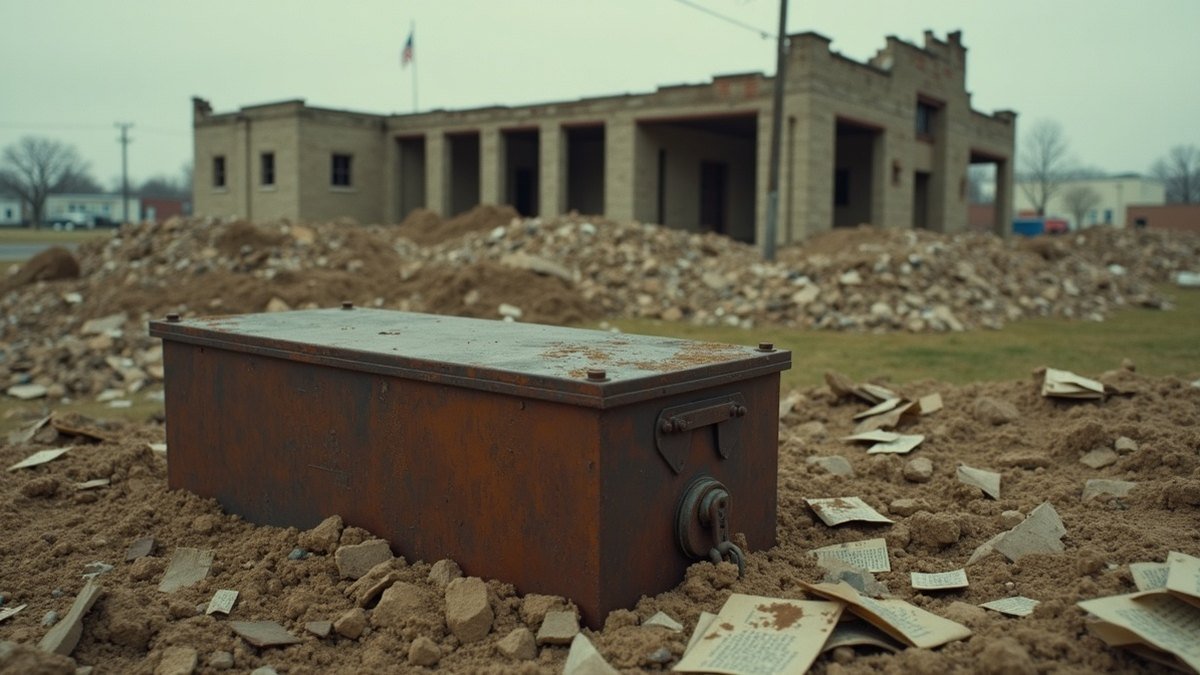
The backhoe operator felt it before he heard it, a hard flat clang up through the machine that meant he had hit steel where the plans promised only dirt. He climbed down to look. It was a welded box, and it had been waiting for him for fifty years.
This was Galesburg, Illinois, last October, on the site where Pershing Elementary School was coming down. Galesburg is a railroad town on the prairie in the western part of the state, the town where Carl Sandburg was born, a place of brick and grain elevators and long flat light. The school had been built in the early sixties and had finally aged past saving, and the district had voted to demolish it and consolidate, and the work had been going on for a week when the backhoe found the box.
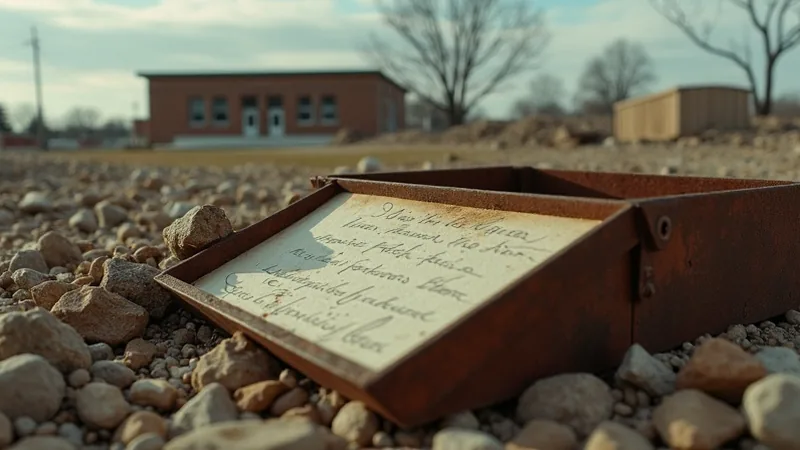
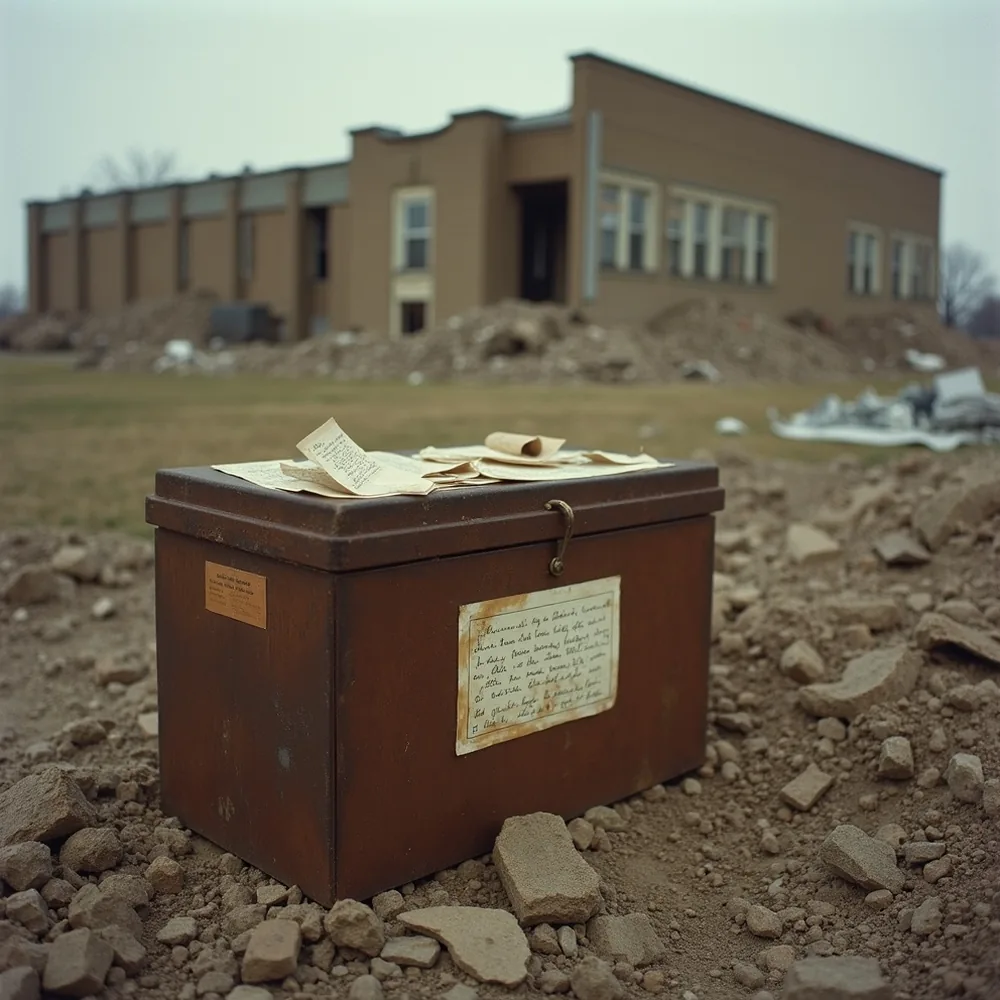
It was a steel box about the size of a footlocker, the seams welded shut, set into the concrete of what had been the gymnasium foundation. There was no plaque. There was no marker. In none of the district’s records, in none of the building’s blueprints, in the memory of not one current employee, was there any mention that something had been buried under the Pershing gym.
The foreman did the right thing, which was to stop, and to call the district office, and to refuse to let anyone take a torch to it until somebody who knew something had a look. The somebody, as it turned out, was a woman named Diane Aldrich, fifty-four years old, the curator of the small Galesburg historical collection downtown, who got the call on a Wednesday afternoon and was standing in the mud beside the box within the hour.
She has told me that her first feeling, looking at the welded seams, was not excitement but a kind of dread, the specific dread of a person whose job is to be responsible for things. Whatever was in there had been put there with intention, and sealed, and forgotten, and now it was hers.
She had handled buried things before, in the way of a small-town curator. A foundation deposit, a coin under a cornerstone, the ordinary leavings builders tuck into walls. But those were known, those were recorded. This box had been put somewhere on purpose and then dropped out of the written world entirely, and the difference between a thing that is buried and a thing that is lost is the difference between a grave and a disappearance. She stood in the cold mud with the demolition idle around her and felt, she said, less like an archivist than like a person who has answered a telephone that has been ringing, unheard, for half a century.
II. The opening.
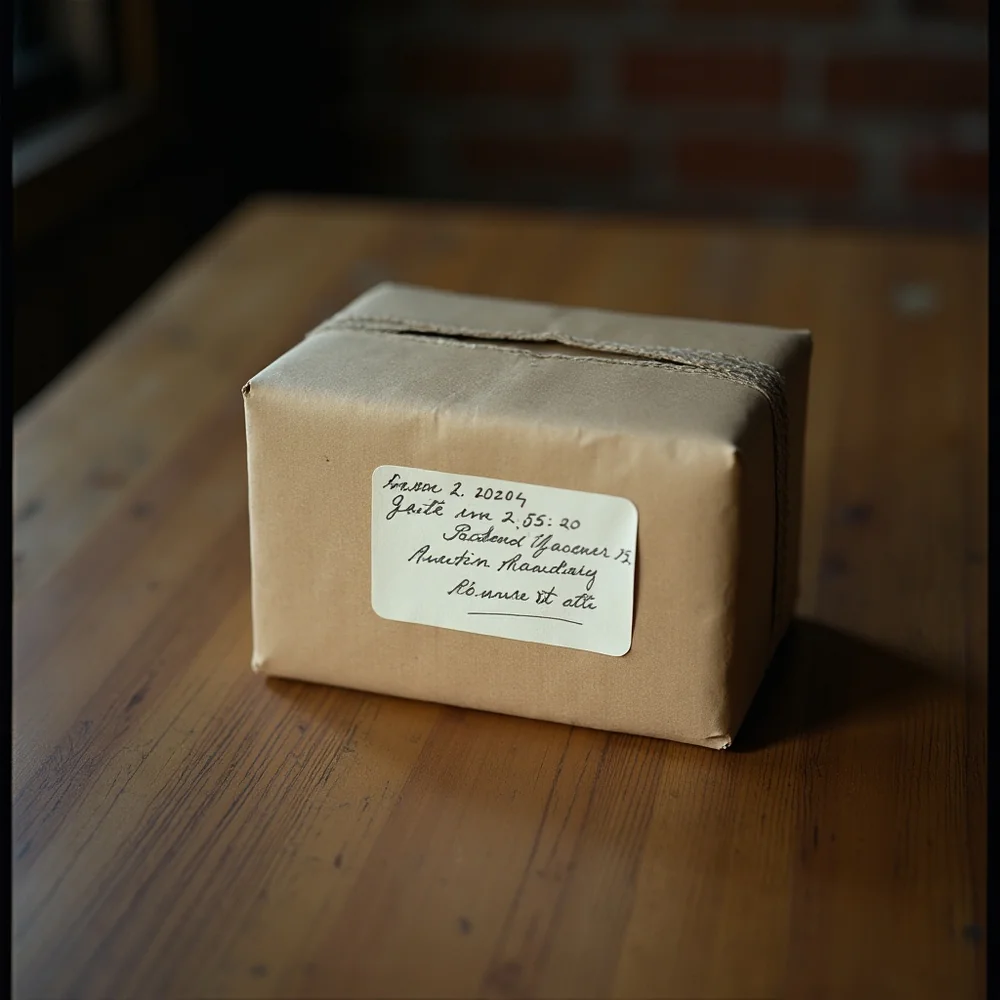
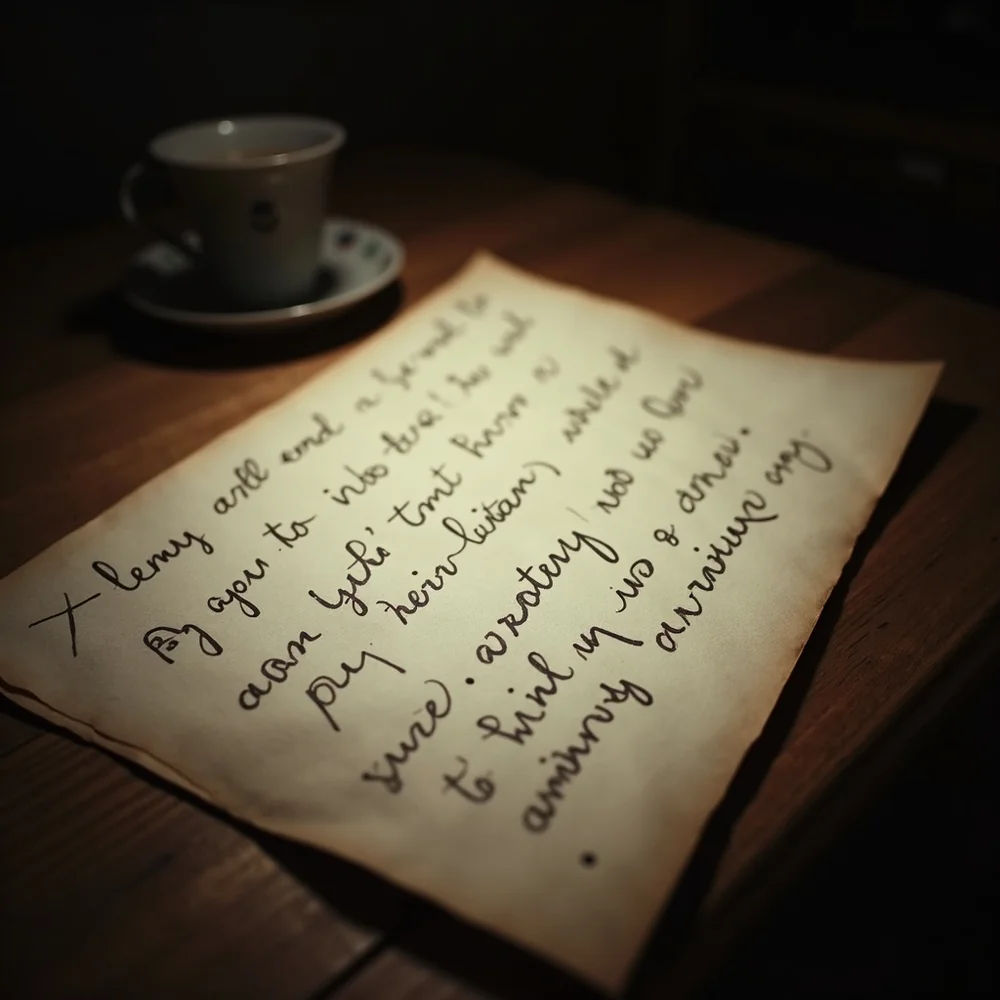
They did not torch it. Diane insisted the box be moved whole to the maintenance garage and opened slowly, with a grinder and patience, in case the contents were fragile. It took the better part of a day. When the lid finally came free, the smell that came out of it was the smell of old paper and metal and time, a smell anyone who has opened a long-shut trunk knows, and inside, packed carefully and wrapped in plastic that had gone amber and brittle, were letters. Twenty-eight of them. Each in its own envelope. Each addressed, in a child’s careful cursive, to a person, with the same instruction written across the front: To Myself, To Be Opened in 2024.
She catalogued each envelope before anything else, the way her training demanded, photographing it sealed, noting the ink and the childish loop of the cursive and the small careful drawings some of them had made in the corners, a baseball, a horse, a rocket ship, the iconography of 1974. Only then did she let herself think of the children as children, twenty-eight ten-year-olds bent over their desks on a spring afternoon, told to write to the strangers they would one day become, having no idea that the strangers would be found by a backhoe and a curator and a town that had managed to forget them.
There was also a single typed sheet, signed by a teacher, and it explained everything the records had lost. In the spring of 1974, a fifth-grade class at Pershing Elementary, twenty-eight children and their teacher, had undertaken a project. They had each written a letter to the person they expected to be in fifty years. They had sealed the letters, and a parent who worked at one of the rail shops had welded the box, and the class had buried it in the foundation of the new gymnasium that was going up that very year, and they had meant to dig it up in 2024 and read what they had written.
And then they had grown up, and scattered, and the teacher had moved away, and the one parent who knew the box was in the foundation and not merely near it had died, and the fifty years had done what fifty years do. The class of 1974 had forgotten its own time capsule. Or rather, the town had. Some of the children, Diane would learn, had remembered the day all their lives and had simply never known, as adults, where exactly the box had ended up, or assumed it was long gone.
The typed sheet ended with a line that Diane read aloud to the maintenance crew, all of them grown men standing around a grinder in a garage, and that she says stopped the room. The teacher had written: If you are reading this, then the children I taught are near sixty years old now. Please find them. They have been waiting longer than they know.
III. Finding twenty-eight.
The teacher who had written that line was a man named Mr. Pelletier. Diane found him first, because a teacher is easier to trace than a fifth grader, and because she half expected to find an obituary. Instead she found a phone number in Davenport, just across the river in Iowa, and she called it, and a clear, old, careful voice answered, and she told him what the backhoe had found, and there was a long silence on the line.
Mr. Pelletier was eighty-eight years old. He had been twenty-eight himself in 1974, a young teacher in his second year. He remembered the project. He remembered, he said, the welding of the box, and the boy whose father did it, and the cold spring morning they had set it in the foundation. He had thought about it, he told Diane, every fifty-year anniversary he could not stop himself from counting, and he had assumed the building would outlast him and the box would be found by strangers long after everyone who wrote a letter was gone.
“You found them in time,” he said to her. “Do you understand what you’ve done. You found them in time.”
The finding took Diane the better part of two months, working evenings, with a list of twenty-eight names that were the names of ten-year-olds in 1974 and that now belonged, if they belonged to anyone, to people near sixty. She used the historical society’s genealogy tools, and the high school alumni rolls, and the patient archival skills that are the real and underappreciated craft of her profession. She is good at finding people who do not know they are lost.
The work was not glamorous, and she wants me to say so, because she is tired of the version of her job that people imagine. It was evenings at a screen, cross-referencing a 1974 class roster against marriage records and obituaries and the long quiet trails people leave through public documents. A name becomes a married name becomes an address three states away becomes a phone number that rings in a kitchen in another life. For each of the twenty-eight she built, slowly, a small dossier, and the dossiers sorted themselves, as she worked, into the living and the dead and the unfindable, and she learned, as everyone in her profession eventually learns, that the dead are easier to confirm than the missing.
IV. The ones who were gone.
I want to be honest about the arithmetic, because the project was not all reunion. Of the twenty-eight children, Diane confirmed that six had died. A car accident in the eighties. A cancer. A war, the first Gulf one. An overdose that the family asked her not to detail and that I will not. The youngest of the dead had been forty-one. The oldest had made it to sixty and missed the opening by a single year, which is the kind of detail that does not bear thinking about too long.
For those six, Diane made a decision that I think was the right one, and that was not obvious. She did not discard their letters, and she did not open them. She found their families, the children and the widows and the surviving siblings, and she asked each of them whether they wished to receive the letter, sealed, to do with as they chose. Most said yes. One mother, in her late eighties, the mother of the boy who had died at forty-one, drove from Monmouth to receive her son’s letter and would not open it in front of anyone, and Diane did not ask her to, and does not know to this day what a ten-year-old boy in 1974 had told the man he would become.
I asked her whether it had been hard, the calls to the families of the six. She said the hard ones were not the ones who grieved. The hard ones were the ones who had made their peace decades ago and whom her telephone call reopened, gently, without meaning to, a door they had carefully shut. A widow who had not heard her husband’s boyhood handwriting described in forty years. A sister who had thought she was the last person alive who remembered her brother at ten. Diane had walked into those rooms carrying a sealed envelope and the unbearable kindness of it, and she had learned to sit quietly while people decided, in front of her, whether a thing returned after fifty years is a gift or a wound, and to accept that for some of them it was both.
Three of the twenty-eight, she could not find at all. Their letters remain in the collection, sealed, catalogued, waiting. Diane keeps them in a climate-controlled drawer, and she told me she still runs a search for the three names every few months, because finding people is what she does, and because the teacher’s line is lodged in her now. They have been waiting longer than they know.
V. Nineteen came back.
Of the nineteen who were living and could be found, every one of them said yes. That is the part that still amazes Diane, and amazes me. Nineteen people in their late fifties and early sixties, with jobs and grandchildren and lives spread across nine states, all agreed to come back to Galesburg, on a Saturday in the spring, to a rented room in the public library, to open a letter a child had written them.
I was in the room. Diane let me sit at the back, and she asked only that I not photograph faces during the reading, and I did not. She had set out folding chairs in a circle, and a table with coffee and a sheet cake, and the nineteen came in slowly, some alone, some with a spouse hovering near the door, and the strange thing, the thing I was not prepared for, was how quickly the room of strangers became a fifth-grade class again. They knew each other. Fifty years fell off them in about ten minutes. Someone remembered who had sat by the window. Someone remembered the kickball rules. Mr. Pelletier was there, in a wheelchair his grandson had pushed across the river from Davenport, and when he came through the door the room stood up.
They read the letters one at a time, those who wanted to, aloud. A woman who was now a retired nurse read the letter in which she had announced, at ten, that she would become a nurse, and she had to stop twice. A man who had written that he hoped he would be brave read it quietly and folded it and said only, “Some years I was.” The barge horns came faintly off the river, and the cake went uneaten for a long time, and the spring light moved across the floor of the library room.
What undid me, sitting at the back of that room, was not the tears. It was the laughter. A class of sixty-year-olds laughing at a joke a ten-year-old had sealed in a box, a joke about a teacher’s necktie, a joke that had been waiting half a century for its audience to reassemble. They laughed the way you laugh at something only you and a few others on earth could possibly find funny, and Mr. Pelletier laughed hardest of all, in his wheelchair, at the joke about his own necktie, and for a moment the fifty years were not a tragedy of distance at all but simply the longest setup to a punchline any of them would ever live.
VI. What the children had known.
I have read, with permission, several of the letters, and I keep returning to how much the children already knew. We tend to think of a ten-year-old as a draft of a person, but the letters do not read like drafts. They read like the same people, younger. The handwriting changed. The voice did not.
One girl had written, in 1974, that she was afraid her parents were going to get divorced and that she hoped that by 2024 they would be okay. They had divorced, within two years. She read this part to the room, sixty years old, and then she said that they had both, in the end, been okay, and that her father had lived to ninety and her mother was still living, and that the fear she had sealed in a steel box had turned out to be survivable, which is most of what a child needs to be told and almost never is.
Another, a boy who had become a high school science teacher, had written that he wanted to teach, like Mr. Pelletier. He read this directly to the old man, across the circle, and Mr. Pelletier, who had spent a career not knowing whether any of it had landed, received it the way you receive a thing you had stopped expecting.
A third letter, from a boy who had grown into a man who drove a delivery route for a living, contained a single sentence and nothing else, and he read it to the room without explanation. I hope I am still here. That was all. A ten-year-old, in 1974, for reasons no adult in the room would ever know, had used his one letter to his future self to express the bare hope of survival, and the man he had become had survived, was here, was reading it, and he folded the page and put it in his shirt pocket over his heart and sat back down, and no one asked him anything, because some sentences are complete.
VII. The curator’s problem.
After the reading, the nineteen did a thing Diane had not planned for. They took up a collection, on the spot, in a coffee can someone emptied, and they asked her to do it again. To start a new capsule. To gather the fifth grade of one of the surviving Galesburg schools and have them write to 2074, and to weld a box, and to bury it, and this time, crucially, to write it down. To leave a record. To make a plaque. To make sure that the next class did not have to be found by a backhoe.
Diane has agreed. The project is underway. She told me the hardest part has been not the logistics but a thing she had not anticipated, which is the weight of designing something whose payoff she will not live to see. She is fifty-four. In 2074 she will be a hundred and four, which is to say, almost certainly gone. She is building, with great care, a gift for people not yet born, to be opened by a curator not yet hired, in a Galesburg she cannot imagine.
She has thought hard, she told me, about how to keep the new capsule from suffering the fate of the old one, and the answer turned out to be almost comically simple, and to contain the entire moral of the thing. She is going to write it down. A plaque on the wall. An entry in the permanent county record. A note in three separate archives. The 1974 class had done everything right except leave a record, and so the box had survived and the memory of it had not, and a thing remembered by no one is, for all practical purposes, a thing that is gone. The whole of her profession, she said, is the long war against that particular kind of forgetting, and she had just watched a backhoe win a battle in it by sheer luck, and she does not intend to leave the next one to luck.
“That,” she said, “is the whole job, actually. I just usually get to pretend it isn’t.”
VIII. Why it stays.
I drove back to Galesburg once more, a few weeks after the reading, to sit with Diane in the historical collection, among the map drawers and the acid-free boxes and the particular hush of a room built to outlast its contents. The three sealed letters of the children she never found were in their drawer. She showed me the catalog entry. Each had a name and a date and the notation unlocated.
I asked her why it mattered so much, the finding, when the simplest thing would have been to open all twenty-eight, read them into the record, and call it a fine local story. She thought about it for a while.
“Because they weren’t writing to the record,” she said. “They were writing to themselves. A letter to yourself is the most private thing there is. My job wasn’t to read them. My job was to get them home.”
A time capsule is not a message to the future. It is a child’s act of faith that the future will exist, and that someone in it will bother to look.
We bury things, all of us, and forget where. The forgetting is not the failure. The failure would be the never going back. A school came down and a machine struck steel and a careful woman spent two months of evenings making sure that nineteen aging strangers, and the families of six who were gone, got home a thing they had handed to themselves across fifty years. For the long human record of how we keep memory, and lose it, and find it again, readers can spend time with the materials at the Library of Congress or the collections of the Illinois State Museum. The Chapbook keeps its narratives clean, human, and responsible, read more in the Editorial Policy.
Mr. Pelletier died this past winter, in Davenport, at eighty-nine. Diane went to the service. His grandson told her that in his last months the old man had spoken often of the Saturday in the library, the day the room stood up, and had said, more than once, that it was the best thing his work had ever done, and that he had only had to wait fifty years to find out.