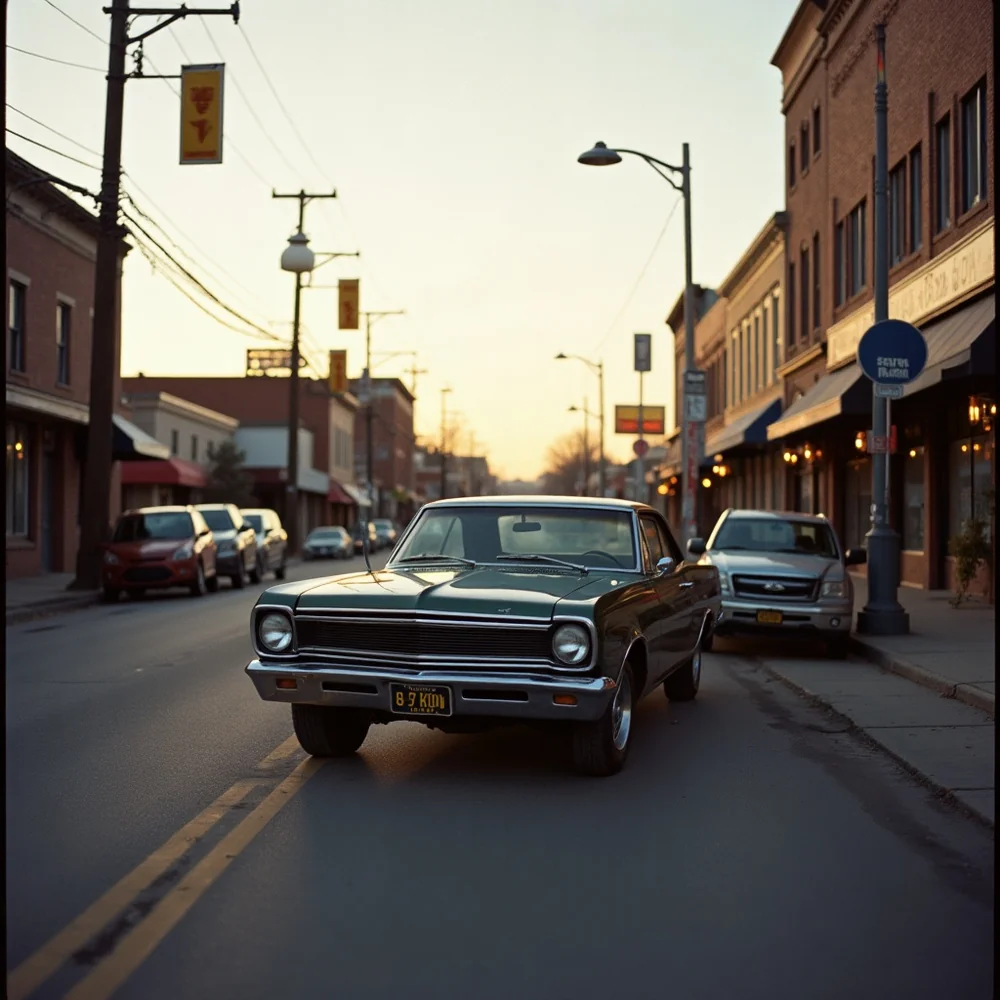
The Five Sisters neighborhood knew the sound of him before they knew the sight of him, the squeak of a satchel strap and the tap of boots on Caroline Street a few minutes past ten. On the last Friday of September 2024, four hundred and twelve people were listening for it for the last time.
Wendell Cardinal parked the white delivery truck at the corner of Caroline and Charlotte Streets at 9:52 that morning, the way he had parked it, give or take eight minutes and two relocated mailboxes, since October of 1991. He was sixty-six. The air off Lake Champlain had the first cold metal smell of October in it, and the maples on Margaret Street had gone orange at the crowns.
The route was the same route it had always been. The Five Sisters, the little grid of streets in Burlington's South End named for the daughters of a long-dead developer, plus the two hill streets that climb toward the ridge, where the porches lean and the winter ice holds until April. Eleven miles of walking, more or less, depending on the parcels. One hundred and eighty-odd households. Four hundred and twelve residents, by Wendell's own private census, which he kept current the way other men keep score in golf.
He knew all of them by first name. He knew most of them by dog. He knew a startling number of them by family tree, which branch had moved to Colchester, which cousin was the one in the Navy, which marriage was the second one and which subjects to leave alone. None of this was written down anywhere. It existed in one place, under a gray winter hat, and on that last Friday in September it was about to walk off the route for good.
People came out as he passed. Not in a coordinated way, not yet. The potluck was scheduled for the next afternoon, and the neighborhood had agreed, in the loose way neighborhoods agree, to let the man work his last day in peace. But the porches filled anyway. A retired schoolteacher on Catherine Street stood at her storm door with her coffee and just nodded at him, and he nodded back, and that was the whole transaction, and both of them understood it completely.
At the top of the hill he stopped, the way he always stopped, and looked back down the street at the lake. He stood there for a moment with the wind moving the flap of his satchel. Then he kept walking. There was still mail in the bag.

II. Wendell, 1991.
He was thirty-three when he got the route. He had grown up across the river in Winooski, the son of a millworker, and he had spent his twenties driving a lumber truck and loading freight before he tested into the Postal Service in 1989. Two years as a substitute carrier, covering whatever route was short a body that day, and then in October 1991 the Five Sisters route came open when the previous carrier retired to Florida.
The previous carrier gave him exactly one piece of advice, delivered in the parking lot of the Elmwood Avenue station on a Friday afternoon. “Learn the names,” the old man said. “The addresses are on the envelopes. The names are the job.”
Wendell took this literally, because he was a literal man. For his first two years he carried a pocket notebook, the spiral kind, and every evening at the kitchen table he wrote down what he had learned that day. Names first. Then the connective tissue. Which children belonged to which house. Who was recovering from what. Whose son had not written in a while. His wife Margaret, who was then a young architect drawing church renovations for a firm on College Street, used to watch him do it and call it his homework.
By 1994 the notebook was unnecessary. By 1997 it would have been an insult. The route had moved into his head the way a language does, and like a language, it kept growing. Babies were born onto it. Names changed at weddings. Old names came off, one funeral at a time, and Wendell attended more of those funerals than anyone at the Elmwood Avenue station ever knew.
It is worth pausing on what the route actually demanded, because the word mailman flattens it. Eleven miles a day on foot, six days a week. Burlington winters that drop to ten below and stay there, the snow squeaking like styrofoam underfoot, the rubber bands going brittle in the cold. Springs when the hill streets ran with meltwater and the bag straps soaked through. He carried dog biscuits in his left pocket and peppermints in his right, and every dog on the route knew exactly which pocket was theirs.
“People think the hard part is the weather,” he told me. “The weather is just weather. The hard part is paying attention for thirty-three years. Anybody can pay attention for a week.”
III. The craft of noticing.
There is a craft inside the job that has no line in any job description, and Wendell practiced it the way other people practice an instrument. He called it noticing. The Postal Service has a name for the formal version, and social workers have another, but on the Five Sisters route it was simpler than either. A walking man who comes to your door six days a week becomes, whether anyone plans it or not, the most reliable instrument in the neighborhood for detecting that something is wrong.
Mail that stops being collected. That is the first signal, and the oldest. Two days of mail in a box belonging to a person who lives alone is information. Three days is a knock on the door. Wendell knocked perhaps a dozen times across thirty-three years, and at least three of those knocks, by the accounting of the people involved, mattered enormously.
In February of 2003 it was Aldous Pratt, eighty-one, a widowed former railroad clerk on Catherine Street, whose Tuesday mail was still in the box on Thursday and whose kitchen shade, which went up every morning at seven, had stayed down. Wendell knocked, got no answer, and called it in. Mr. Pratt had fallen in the back hallway and had been on the floor for two days, conscious, calm, and completely unable to reach the telephone. He lived nine more years. He introduced Wendell at his ninetieth birthday party as “the reason I am at this party.”
In 2011 it was a diabetic veteran on one of the hill streets whose porch light burned at noon. In 2019 it was a young widow whose trash cans never came in and whose curtains never moved, and that knock turned into a cup of tea, and the cup of tea turned into her sister being called in Montpelier, and nobody ever used a clinical word for any of it.
He never called them welfare checks. He bristled, gently, when I used the phrase.
“A welfare check is what you call it when a stranger does it,” he said. “I wasn't a stranger. I was just a man who noticed the shade was down.”
The addresses are on the envelopes. The names are the job. The previous carrier said it once, in a parking lot in 1991, and Wendell Cardinal spent thirty-three years finding out how much the sentence actually contained.
The neighborhood understood the arrangement without ever discussing it. Parents on Charlotte Street told their children that if anything ever went wrong and no adult was home, they should wait for Wendell. He was, for three decades, the one civic institution in the Five Sisters that arrived on foot, knew your name, and asked for nothing.
IV. Mrs. Holcomb.
The house at 14 Caroline Street is a green clapboard two-story with a deep front porch, and the porch belongs, in every sense that matters, to Eleanor Holcomb. She is ninety-one. She has lived in the house since 1957, when she arrived as a bride, and she has watched the street from that porch through every season since, wrapped in a wool blanket from roughly Halloween to roughly Memorial Day, because she does not believe in watching a street through a window.
When Wendell first walked the route in 1991, there were four generations under that roof at various points of the year: Eleanor's mother-in-law Vivian, then in her late eighties; Eleanor and her husband Gerald; their son Thomas, in and out between apartments; and Thomas's young daughter Dana, who spent summers there. Wendell delivered mail addressed to all of them.
Gerald Holcomb died in March of 1998, a heart attack shoveling the end of the driveway. For the next month, Wendell carried sympathy cards up that porch by the dozen, and he noticed that Mrs. Holcomb had stopped coming out to meet him. So he started knocking. Not every day. Tuesdays and Fridays, with the mail in his hand as the official reason, until the morning in May when she opened the door before he reached it, dressed, with coffee on, and said, “You can stop checking now, Wendell. But you may as well sit down.”
He sat down on that porch, by Mrs. Holcomb's estimate, a thousand times over the following twenty-six years. Four minutes, most days. The length of a glass of iced tea in July, the length of the lake steaming in January. She watched him go gray from that porch. He watched her become a great-grandmother in 2004, when Dana's son Eli was born, and a great-great-grandmother in March of 2023, when Eli's daughter Wren arrived.
Count it. Vivian, Eleanor, Thomas, Dana, Eli, Wren. Six generations of one family, at one address, and Wendell Cardinal delivered mail bearing every one of those names. When Wren's birth announcements went out, Mrs. Holcomb held the stack on the porch and had him verify the count before she let him take them.
“Six generations,” she said. “You've carried all of us now.”
“Five and a half,” he said. “Wren hasn't gotten her own letter yet.”
A letter addressed to Miss Wren Holcomb, in Wendell's square handwriting, arrived at 14 Caroline Street eleven days later. Mrs. Holcomb has it still. She would not tell me what it says.
V. The promotions he refused.
Four times in thirty-three years, the Postal Service tried to take Wendell Cardinal off the route. All four times it was meant as a reward.
In 1997 they offered him a supervisor's desk at the Elmwood Avenue station, an indoor job worth about $4,300 more a year. He was thirty-nine, with a mortgage, and Margaret remembers him doing the arithmetic at the kitchen table for two evenings before he turned it down. In 2004 it was a station manager position out toward Essex Junction, worth roughly $9,000 more. In 2012, a district route examiner job, the man who walks other carriers' routes with a clipboard and a stopwatch, worth about $13,000 and a government vehicle. In 2019, a customer service supervisor role that would have added nearly $16,000 a year and fattened the pension he would draw for the rest of his life.
He said no each time, and each time the no got easier. The men offering the jobs were not wrong about the money. Margaret and Wendell have done the full tally since, mostly for the comedy of it: the four refusals cost the Cardinal household somewhere north of $200,000 over the years, counting the pension effects, which is a real number, the kind of number that buys lake frontage.
His reasons did not change between 1997 and 2019, and they were not sentimental, which is the part the supervisors never quite absorbed. Each promotion paid in money and took its price in the same currency: the route. The desk job traded the names for paperwork about names. The examiner job traded one route he knew for forty routes he would visit. He had spent six years building the memory and he understood, earlier than most institutions understand it, that the memory was the asset.
“They kept offering to pay me to know less,” he said. “I never could see the sense in it.”
VI. Margaret, and the eleven miles a day.
Margaret Cardinal is sixty-four, a retired architect, the kind of person who answers a question about her husband by reaching for graph paper. The winter before he retired, she sat down and did the math properly, because she wanted the number to be right before anyone said it at a party.
Eleven miles a day. Roughly 290 delivery days a year, after holidays and the two weeks in August they spent at her sister's place on Lake Carmi. Thirty-three years. It comes to a little over 105,000 miles, walked, on the same eleven miles of pavement. More than four times around the planet, executed entirely within one half-mile square of the South End.
“Architects think about load paths,” she told me, at the same kitchen table where the notebook homework happened in 1991. “Where the weight of a building actually goes, which is never quite where it looks like it goes. I spent thirty-three years married to a load path. The weight of that neighborhood went through him. You couldn't see it on any drawing, but pull him out and you'd have heard the structure groan.”
She is the one who lived with the costs the route never showed the neighborhood. The left knee that announces storms. The forty-one pairs of boots, by the mudroom count she swears is exact. The smell of wet wool drying on the radiator every winter evening for three decades, which she says she misses now and never expected to. The 4:50 alarm. The years when carriers were getting hired away or burned out and Wendell came home quieter than usual, and she would ask, and he would say the route was fine, and she would understand that he meant the route was the thing holding him, not the other way around.
She also refuses, flatly, the suggestion that he sacrificed a career for it. “He had a career,” she said. “Thirty-three years, one client, four hundred and twelve names. Show me the executive with a record like that.”

VII. The potluck in September 2024.
The potluck was held on the last Saturday of September 2024, on the closed-off block of Caroline Street in front of Mrs. Holcomb's porch, under a sky that could not decide between summer and fall. The city permit said neighborhood gathering, estimated attendance 150. The folding tables ran half the block. The actual attendance, by the count of the woman who organized it, was over three hundred, plus former residents who drove up from as far as Brattleboro, plus eleven dogs, several of whom located Wendell's left pocket within the first ten minutes.
There was the food a Vermont street produces when it is serious: casseroles still steaming through their foil, three competing apple crisps, cider pressed that same week in Shelburne. Someone had hung a banner between two maples that read, simply, THANK YOU WENDELL, and someone else had corrected the spacing with tape, and Wendell pointed out that the tape was already peeling, and a man on a ladder fixed it while everyone ate.
The gift came at four o'clock. They had talked, the organizers admitted, about a watch, about a bench with a plaque, about a collection. What they made instead was a book. A clothbound ledger, the old-fashioned kind, with THE ROUTE stamped on the cover, and inside, four hundred and twelve entries, one for every resident, each written in that person's own hand. The toddlers' entries are crayon scribbles with a parent's translation underneath. The oldest entry belongs to Eleanor Holcomb, who went first, in fountain pen.
Each entry is a name, and beside the name, the thing Wendell knew or did that the household wanted written down. He knew our daughter's name before her teacher did. He carried the dog food up when Jim couldn't. He knocked in 2019. Four hundred and twelve lines of evidence, assembled by the people who had been, all along, the route's actual contents.
They had thought, all those years, that the man was delivering parcels. It took his leaving for the street to say out loud what it had always known: the parcels were the smallest thing he carried.
They asked for a speech. Wendell is not a speech man, and the neighborhood knew it, and the request was made anyway because the asking was part of the gift. He stood up by the head table with the ledger under his arm and managed four sentences. He thanked Margaret. He thanked Mrs. Holcomb's porch, the porch specifically. He said the new carrier was a good young man named Devon and that they should give Devon the time they had given him, which was thirty-three years. Then he said he would rather say goodbye properly than say it from a table, and he stepped down, and he spent the next two and a half hours walking the length of the potluck, table by table, saying goodbye by first name.
All 412. Several people followed him, counting, because by then everyone knew the number. He did not miss one.
VIII. Why it stays.
I sat with Wendell and Margaret this past March, eighteen months into a retirement he has filled with grandchildren, the wood pile, and a Tuesday volunteer shift driving elderly neighbors to appointments, which Margaret notes is just the route with a steering wheel. The ledger sits on a shelf in their front room in the South End, between the atlas and the field guides, which is, if you think about it, exactly where it belongs.
The story stays with me for a reason that has little to do with nostalgia. What the Five Sisters lost in September 2024 was not a mailman. Mail still arrives; Devon is, by all reports, conscientious and quick, and his scanner knows things Wendell's notebook never did. What left the neighborhood was a memory. An unwritten, uninsured, thirty-three-year archive of who belonged to whom, who was struggling, who was alone, which shade should be up by seven. Institutions call this institutional memory and mostly notice it, like the neighborhood did, at the retirement party.
There is a phrase for what Wendell practiced, though he would wave it off: the slow service economy. The economy of the same person, on the same streets, at the same hour, for decades, accumulating the kind of knowledge that cannot be onboarded, downloaded, or covered by a substitute. It is the least efficient system imaginable, by every honest accounting except the one the ledger contains.
Wren Holcomb will be four this spring. Mrs. Holcomb, ninety-one, still takes the porch every morning, and reports that Devon has started to wave. It begins that way.
The letter carrier as community keeper is not a Vermont invention, and the record of it runs long and deep in this country; the USPS historian's office has been documenting the walking route and its people for generations. Readers who want the broader story can lose an afternoon in the collections of the Smithsonian National Postal Museum or in the occupational folklife interviews preserved at the Library of Congress, where carriers like Wendell tell it in their own words. The Chapbook keeps its narratives clean, human, and responsible, read more in the Editorial Policy.