The due date stamped on the card was March 28, 1972. The book came home on a Tuesday morning in October 2024, in a padded envelope postmarked Tucson, fifty-two years, six months, and eleven days late.
The Carnegie-Stout Public Library stands at the corner of West Eleventh and Bluff in Dubuque, Iowa, a 1902 Carnegie building with limestone columns out front and a rotunda that smells, on damp mornings, of floor wax and old paper. The mail arrives around nine. It is mostly catalogs, interlibrary loans, and the occasional envelope from a publisher, and it gets sorted, most weekday mornings, by whoever reaches the circulation office first with a cup of coffee.
On the Tuesday in question, that was Dolores Kavanagh.
The envelope was the heavy kind, double-taped at both ends, the lettering on the front done in careful block capitals. There was no business name in the return address. There was only R. ETTINGER and a street number in Tucson, Arizona. The package weighed about a pound. Dolores slit it open with the brass letter opener that has lived on the circulation desk since before she was hired, folded back two layers of bubble wrap, and then, slowly, sat down.
Inside was a hardcover copy of The Old Man and the Sea, navy boards, the Scribner edition, its spine label typed on a manual typewriter by some cataloger who had almost certainly been dead for decades. The mylar jacket had yellowed to the color of weak tea. The card pocket was still glued inside the back cover. The card was still in the pocket. The last date stamped on it, in the slightly drunken purple ink of a hand stamp, read MAR 28 1972.
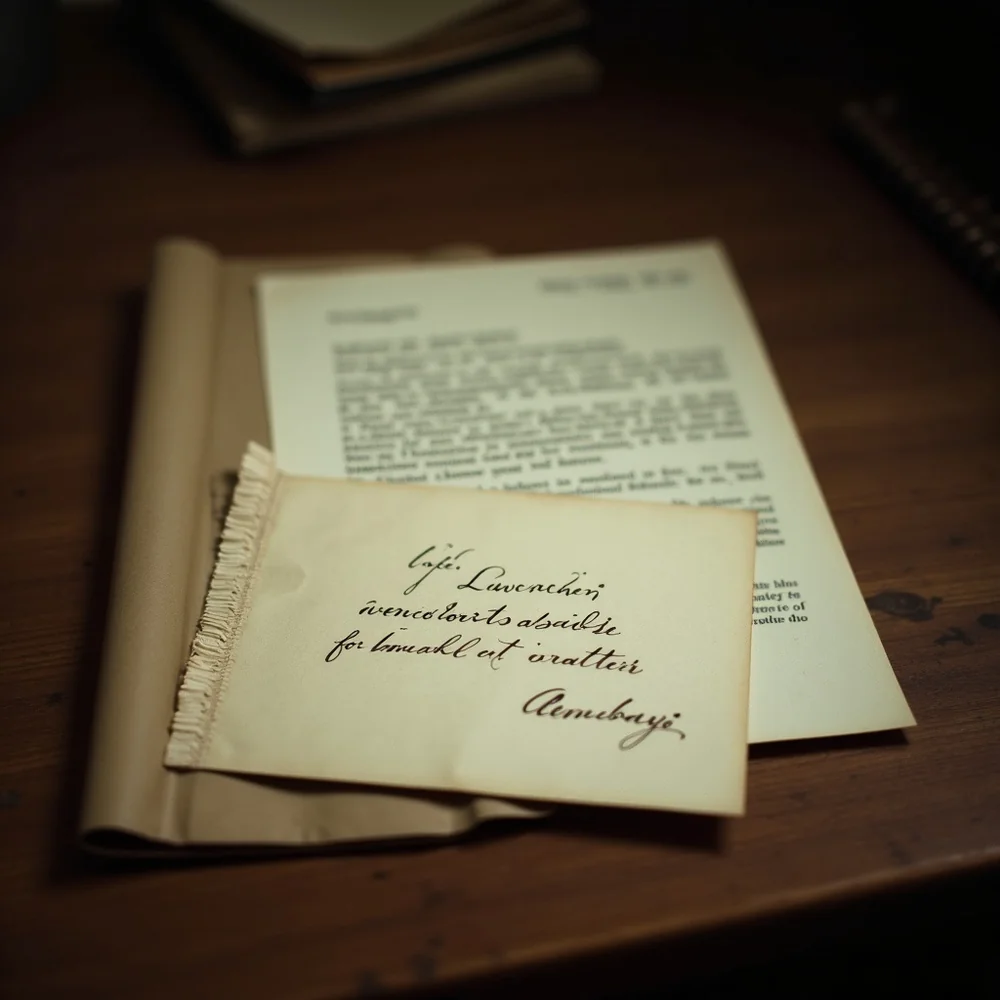
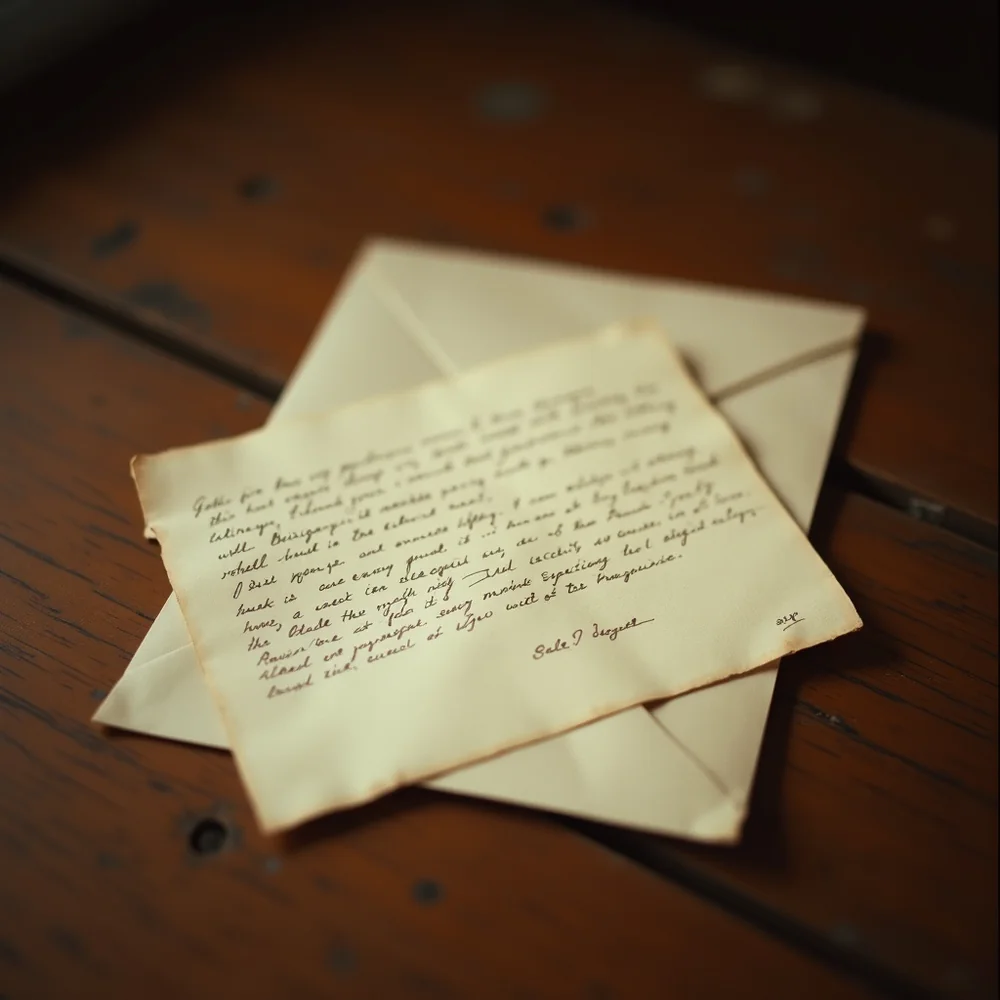
Under the book were two more things. The first was a letter, four pages, handwritten in blue ballpoint on yellow legal paper, folded in thirds. The second was a personal check, made out to the Carnegie-Stout Public Library in the amount of $224.38, with a note on the memo line in the same blue ink: overdue fine, adjusted for inflation.
Dolores read the name printed on the check twice. Then she read it a third time, slower, the way you reread a word that has wandered in from another part of your life. Ettinger. She knew that name. She had heard it, more than once, across a chain-link fence on Ainsley Street, in the voice of her neighbor Joan.

II. Dolores.
Dolores Kavanagh was fifty-eight that October. She had worked at Carnegie-Stout for thirty-one years, the last nineteen of them at the circulation desk, a post she preferred to every other job in the building because the desk was where the library actually touched people. Books came back damp, dog-eared, smelling of cigarettes or cedar closets or somebody’s kitchen, and every one of them was a small report on a life she would otherwise never see.
She had been hired in 1993, back when the due-date cards were still stamped by hand and the building still kept a card catalog it no longer needed, out of what she suspected was pure sentiment. She had outlasted four directors, two renovations, and the long migration of everything into the computer. She knew which patrons read westerns and hid it, and which child in the after-school crowd needed a granola bar more than a book.
She lived a mile north of the library on Ainsley Street, a short block of postwar bungalows up on the bluff side, with her husband Gene, a retired millwright from the John Deere works across the river. Their backyard ran up against the backyard of a white house with green shutters where a widow named Joan Pruitt had lived for over forty years.
Joan and Dolores had conducted, over the chain-link fence between their tomato beds, a friendship of the unhurried Iowa kind, twenty minutes at a time, two or three times a week, May through October, for going on three decades. Joan talked about her late husband Earl, her grandchildren in Cedar Rapids, the deer that ate her hostas. And once or twice a summer, never more, she talked about her brother.
“I had a brother went to Vietnam,” Joan had said one evening, years back, snapping a sucker off a tomato plant. “He came home. Just never came home here.”
His name, Dolores remembered her saying, was Raymond. The family name, before Joan married Earl Pruitt, had been Ettinger.
Dolores stood at the circulation desk that Tuesday morning with the check in one hand and the card in the other, the radiator behind her ticking as it warmed, and felt the two halves of her life click together like a book dropping into the return chute.
III. The letter.
The letter was dated September 30, 2024. It began without preamble.
To the librarians of Carnegie-Stout,
My name is Raymond Ettinger. In March of 1972 I checked out your copy of The Old Man and the Sea, on the card of a twenty-one-year-old, which I was. I am seventy-four now. The book is sitting on my kitchen table in Tucson, Arizona, and I have run out of excuses for why it is not sitting on a shelf in Dubuque.
I took it because it was the shortest great book I knew of and I had been told to pack light. My induction notice had come in February. I reported to Fort Polk in April, and the book went into the duffel between two pairs of socks, which is more or less where it stayed for the next half century. I want to be clear that I always intended to return it. I intended it in 1973, when I came back through Oakland and did not get on the bus to Iowa. I intended it in 1981, when I was home four days for my father’s funeral and left angry. I intended it every time I packed it, and I packed it more times than I can count.
It went to Long Binh with me and sat wrapped in a poncho liner at the bottom of a footlocker through the wet season, which is why the cover looks the way it does. I read it by flashlight maybe a dozen times over there. It is a good book for a young man who is far from home and being asked to think of himself as lucky. It is about an old man who loses the thing he fought for and is somehow not ruined by that, and I did not understand the ending then. I understand it now.
After the Army the book followed me to Phoenix, where I was married and then not, and to Amarillo, where I was married and then not, and went bankrupt the first time, and to Tucson, where I was married a third time, to Cecilia, who pulled me out of the bottle and then let me bury her in 2021, which I will not write about here. I went bankrupt again in 2003 when my transmission shop failed. Through all of it, every apartment and every storage unit and every borrowed garage, the book got packed first. A man who has lost as much as I have learns to keep one thing on purpose, and the one thing I kept was, by every honest accounting, never mine.
I got sober on April 11, 2009. My granddaughter Aleah got me a library card in Tucson in 2019, mostly as a joke. It did not feel like a joke to me. This spring a cardiologist told me some things a man my age gets told, and I went home and saw your book on the shelf and understood I had exactly one debt left that I could still pay in full.
The fourth page was not prose at all. It was a ledger.
IV. Fifty-two years.
Raymond Ettinger was born in 1950 in a rented half of a house on Rhomberg Avenue, on Dubuque’s north end, where his father worked the kill floor at the Dubuque Packing Company and his mother took in sewing. Joan came two years later. The two of them grew up within smelling distance of the Pack, riding the Fenelon Place Elevator on nickel Sundays, and the first air-conditioned room either of them ever sat in was the reading room at Carnegie-Stout.
He graduated from Dubuque Senior High in 1968, drew an unlucky number in the draft lottery, and worked at a filling station on Central Avenue while he waited for the letter everyone told him might not come. It came in February 1972. He walked up the hill to the library in March, the gutters running with snowmelt, and checked out one slim novel, and never set foot in the building again.
He spent eleven months at Long Binh post as a wheeled-vehicle mechanic, came home in 1973 to an Oakland airport that he later described to Joan as “quiet in the wrong way,” and decided, somewhere between the gate and the curb, that he could not face Iowa yet. Phoenix had jobs and nobody who remembered him. Yet became a year. A year became a marriage, then a divorce, then Amarillo, then another marriage and another divorce and a bankruptcy filed in 1987, the worst of his drinking years. The 1981 funeral was his one trip back. He and Joan, raw with grief and no good at saying so, fought in the funeral home parking lot about what to do with their mother, and he drove south that same night. After 1985 the Christmas cards stopped. Each was certain the other wanted it that way.
And through every one of those years, in every footlocker and moving box, rode a navy hardcover with a Dubuque call number on its spine. He could have mailed it back at any time. He has thought about why he did not, and his answer is the closest thing the story has to a confession.
“As long as I still had it,” he told me later by phone, “I still owed Dubuque something. A man hangs on to a debt like that. It was the last string. You don’t cut the last string.”
A debt does not expire just because the lender stopped counting. It waits, patient as a card in a pocket, for someone willing to do the arithmetic.
V. The check.
The ledger on page four was the part the library staff photocopied and passed around the break room, because it was, in its way, a small masterpiece. Raymond had remembered, correctly, that the fine at Carnegie-Stout in 1972 was two cents a day. He had then done what almost nobody on earth would think to do. He computed the fine year by year, fifty-two lines in a draftsman’s neat hand, and adjusted each year’s total for inflation, carrying every line forward into 2024 dollars. At the bottom, double-underlined, sat the figure: $224.38.
“He showed his work,” Dolores said. “Like a kid hoping for partial credit. Except he wanted full blame.”
There was a problem, and the problem was almost funny. Carnegie-Stout, like most American libraries, had gone fine-free in 2021. There was no longer any such thing as an overdue fine for the check to pay. The director read the letter twice in her office overlooking Eleventh Street and then called the number Raymond had included, and the two of them settled it the way such things get settled in Iowa, politely and in about four minutes.
The check was cashed, with his blessing, as a donation. The money bought twenty-four paperback copies of The Old Man and the Sea for the summer reading giveaway, a roll of mylar, and a small glass-fronted case that now stands by the circulation desk. Inside the case sit the navy hardcover, open to the back pocket, the purple-stamped card, and the first page of the letter. The brass plate beneath them says only: Returned, October 8, 2024. Fifty-two years late. Paid in full.
Teenagers stop in front of the case more than anyone expected. The light from the tall windows hits the glass in the late afternoon, and the old jacket glows like parchment, and they stand there reading a stranger’s apology.
VI. Joan.
Dolores carried the news home the way you carry a full cup, slowly, both hands. It was a cold evening for October. Woodsmoke was on the wind, and Joan Pruitt was out back in a barn coat, pulling the last of her dead tomato vines, when Dolores came to the fence and said she had something to tell her and that she ought to maybe set the vines down first.
She told her about the envelope. The book. The check. The name.
Joan, seventy-two, stood absolutely still with one glove on and one glove off. “Raymond,” she said. It was not a question. Then she said it again anyway. “Raymond? My Raymond is alive?”
“Alive and in Tucson,” Dolores said. “And good at math.”
Joan went into the house without another word and came back out five minutes later with a photograph, black and white, scalloped edges. Two kids on the Fenelon Place Elevator, squinting downhill at the river, the boy’s arm around the girl’s shoulders. 1958, by the date on the back. She held it over the fence so Dolores could see it, and her hand was not steady.
“I told Earl for forty years that he was probably dead,” she said. “I think I said it so it would stop hurting that he wasn’t writing. You make a person dead so the silence makes sense.” She looked at the photograph for a while. The streetlight came on at the corner. “Did he say he was sick?”
“He included a phone number,” Dolores said.

VII. The phone call.
It took Joan four days to dial. She wrote out what she wanted to say on the back of a grocery receipt, and then on a fresh sheet of paper, and then she threw both away. On Sunday afternoon she sat at her kitchen table with the photograph propped against the napkin holder and the furnace humming in the floor, and Dolores sat with her for the first minute, because Joan had asked her to, and then let herself out the back door.
The phone rang twice in Tucson.
“Raymond. It’s Joan.”
There was a long silence, the kind with breathing in it.
“I figured the book would get there before I worked up the nerve,” he said. “That was sort of the idea.”
“You sent a check to a library,” she said, “before you sent a word to your own sister.”
“The library was easier,” he said. “I owed them less.”
They talked for an hour and forty minutes. They talked about the parking lot in 1981, and each of them tried to take all of the blame and neither would allow it. They talked about their mother’s last years, which Joan had carried alone and which Raymond had spent twenty minutes apologizing for until she told him to stop. They talked about Cecilia, and Earl, and Aleah, and the grandchildren in Cedar Rapids, trading the whole missing half-century like cards across a table. Near the end he told her about the cardiologist, and she told him that was fine, that hearts could be managed, that he was not allowed to be done yet because he owed her, by her own arithmetic, fifty-two Thanksgivings.
“Adjusted for inflation,” he said.
“Adjusted for inflation,” she said.
The fine was never the point. The point was that a man wanted, once in his life, to pay back exactly what he owed, to the penny, and be welcomed home anyway.
He flew into the little Dubuque airport the following May, for her birthday, the first time he had stood in Iowa in forty-four years. Joan and Dolores both went to meet him. Joan brought the photograph. Raymond, coming through the one-room terminal with a cane he clearly resented, took one look at it and said the elevator ride used to cost a nickel, and that he supposed somebody had adjusted that too.
VIII. Why it stays.
I went to Dubuque in the fall, almost a year after the envelope arrived. I stood in front of the glass case at Carnegie-Stout on a gray afternoon while the radiators ticked, and read the brass plate, and watched two high school kids read the letter page with their backpacks still on. Then I walked up the hill to Ainsley Street and sat at Joan Pruitt’s kitchen table, with Dolores on one side of me and a plate of molasses cookies in the middle, and Raymond on the speakerphone from Tucson because the doctors had him on a short leash that month.
I asked him the question I had driven there to ask, which was why the book, why all those years, why carry the evidence instead of burning it. The line was quiet for a moment. I could hear a swamp cooler running somewhere behind him, two states and a desert away.
“Everything else I lost, I lost by accident,” he said. “Marriages, money, the town. That book was the one thing I was holding on purpose. I think I always knew that whenever I finally gave it back, the rest of it would have to come with it. The whole story. You can’t return the book without returning the man.”
Joan looked at the speakerphone the way you look at a fire. “He always did need a deadline,” she said.
There is a ledger reading of this story, and the ledger reading says a library got back a $4 book and $224.38, fifty-two years late, which is a terrible rate of return. By any honest reading, that is not what happened. What happened is that an institution kept a door open for half a century without knowing it, and a man walked back through it, and a sister got her brother returned to her in the same envelope. Raymond has a Carnegie-Stout card now, a non-resident card he insisted on paying for. The first thing he borrowed, last May, was one of the twenty-four paperbacks his own check had bought. He returned it four days early. Anyone who wants the larger context for what these quiet buildings hold can wander the open stacks of the Library of Congress or the public-library research gathered by the American Library Association. The Chapbook keeps its narratives clean, human, and responsible, read more in the Editorial Policy.
The card from 1972 is still in the case, purple stamp facing out. Dolores passes it every working day. She says the lesson of the desk has not changed in thirty-one years: everything comes back eventually, and the late ones have the best stories. You just have to keep the pocket glued in, and the light on, and the fine small enough to forgive.
Fifty-two years is a long time to keep a book. It is, it turns out, exactly long enough.