The realtor said the house had no basement. The wall behind the pantry said otherwise.
Daniel Reyes had bought the house in late September, the kind of late September Asheville is famous for, when the leaves on the ridges had just started to turn and the air had the dry papery smell of a season getting ready to change. The house was small, a 1926 craftsman bungalow on a quiet street called Maplewood, set back behind two enormous tulip poplars whose roots had been quietly destroying the front walk for forty years. He had paid less for it than anyone he knew thought he should have, which was both the appeal and the warning.
He was thirty-four. He had moved to Asheville from Charlotte after a long unspecified bad year that had ended in a quiet, mutual divorce, and the house was, in his own private accounting, a way of starting over without making a big deal about it. He had bought it from an estate. The previous owner had been a woman in her late eighties named Eleanor Whitcombe, who had died in the front bedroom in February. Her two grown children, both of whom lived in Texas, had sold the house furnished. Daniel had not understood, at the closing, exactly what furnished meant. He understood, a week later, when he opened the dining room sideboard and found seventeen sets of monogrammed napkin rings.
II. The pantry.
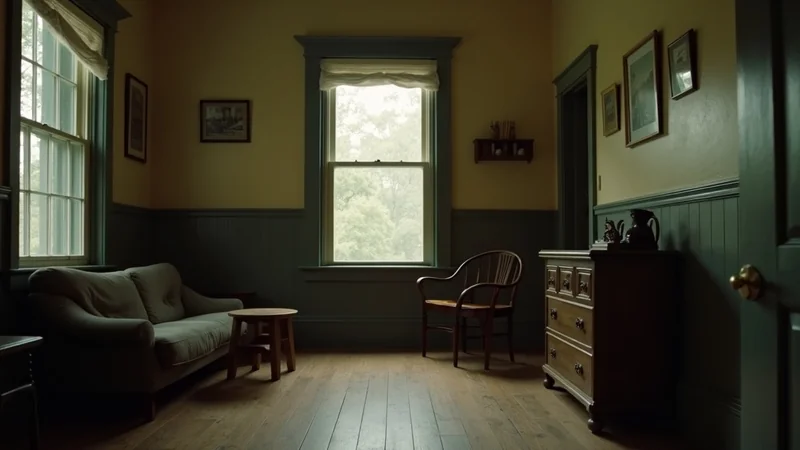
The pantry was the smallest room in the house. It was tucked between the kitchen and what had once been a back porch and was now an awkward enclosed mudroom. The shelves were the original pine, painted over so many times that the corners had become soft. There was a hook on the back of the door for an apron that was no longer there.
Daniel had been emptying the pantry for three days. Eleanor Whitcombe had been the kind of woman who kept things, paper grocery bags folded into triangles like flags, rubber bands looped around old jar lids, a metal coffee tin full of bread tabs going back forty years. He had filled six trash bags and was beginning to wonder, with a tired half-amused feeling, whether buying a house from an estate had been one of his better decisions.
The neighbors had begun introducing themselves by then, one casserole at a time. The woman two doors down, a retired schoolteacher named Frances Odom who had lived on Maplewood since 1971, told him that Eleanor had swept her front walk every morning at seven, in all weather, and had never once, in fifty years, invited anyone past the front room. “She wasn’t unfriendly,” Frances said. “She was a closed door that said good morning.” Daniel thought about that later, after the pantry.
He noticed the floorboard on Tuesday.
He had stepped on it dozens of times by then, hauling out boxes, and it had always given a little under his weight. He had assumed it was the age of the house. But on Tuesday morning, with the pantry mostly empty, he stepped on it and heard a small distinct thock, the sound of wood resting on air, not wood resting on a joist.
He stood very still. He stepped on it again. Thock.
He stepped a few inches to the left and the floor was solid. He stepped back. Thock. He moved the small step stool, which was the last thing in the pantry, and crouched down, and put his palm flat on the board. He pushed.
The board lifted at one end, the way a hinged thing lifts.
He did not lift it all the way. Not yet. He knelt there with his hand on the raised edge and listened to the house, the refrigerator humming in the kitchen, a car passing two streets over, and under all of it a faint cool exhalation coming up through the gap, air that had not been part of the weather upstairs for a very long time.
III. The stairs.
I have been editing The Chapbook for almost nine years, and I have learned that the moment when a person realizes a house is keeping a secret is a moment that almost nobody describes accurately afterward. They say things like I couldn’t believe it or my heart was pounding, which is true but is not what they were actually feeling. What they were actually feeling, in the moment, is a strange flat curiosity. The drama comes later. In the moment, you just want to know what is under the board.
Under the board was a hinged opening about the size of a serving tray. Under the opening was a wooden ladder going down into the dark.
Daniel stood up. He went to the kitchen drawer where Eleanor Whitcombe had kept her flashlights, there had been four of them, in various states of working order, and he had tested them on his first day and put them in a row on the counter. He took the brightest one. He came back to the pantry. He pointed the beam down through the opening.
The beam fell on a packed-dirt floor about seven feet below. The ladder was hand-hewn pine, the rungs darkened with age. The room beyond the bottom of the ladder was small, maybe eight feet by ten, and the walls were rough stone, the kind of fieldstone that small Appalachian farmhouses used to be built on, before concrete had become a normal thing in 1926.
He would learn, later, that the stonework had a name. A mason from the historical society, looking at his photographs months afterward, identified it as dry-laid fieldstone with a lime repointing, the same technique used in the springhouses and root cellars that dot the coves west of the city. The work was good. Whoever had laid those walls had not been improvising. The mason guessed two men, working most of a summer, hauling stone by wagon from a creek bed, quietly enough that no neighbor ever mentioned a cellar that was not supposed to exist.
The realtor had told him, very firmly, that the house had no basement. The realtor had been wrong.
IV. What was in the room.
He went down the ladder slowly. The wood creaked but held. The air at the bottom was about ten degrees cooler than the kitchen above, and it smelled the way old root cellars smell, dry earth, very faintly mineral, a hint of something like cedar.
The room was not empty. There was a small wooden bench along one wall. There was a cast iron oil lamp on the bench, the glass globe still intact. There were three shelves built into the opposite wall, hand-carpentered, slightly uneven, and on the shelves there were thirteen mason jars, dust-coated but intact, full of what looked, in the flashlight beam, like dried herbs and small bundles of paper.
He looked at the jars for a long time before touching anything. The paper bundles inside them, he found out later, were seed packets and folded recipes. The herbs were tansy and boneset and mullein, the ordinary medicine chest of a mountain household before drugstores. Whoever had stocked these shelves had been planning for guests who might arrive sick, or hungry, or hurt, and unable to see a doctor under any circumstances at all.
There was an iron strongbox under the bench, padlocked, about the size of a shoebox.
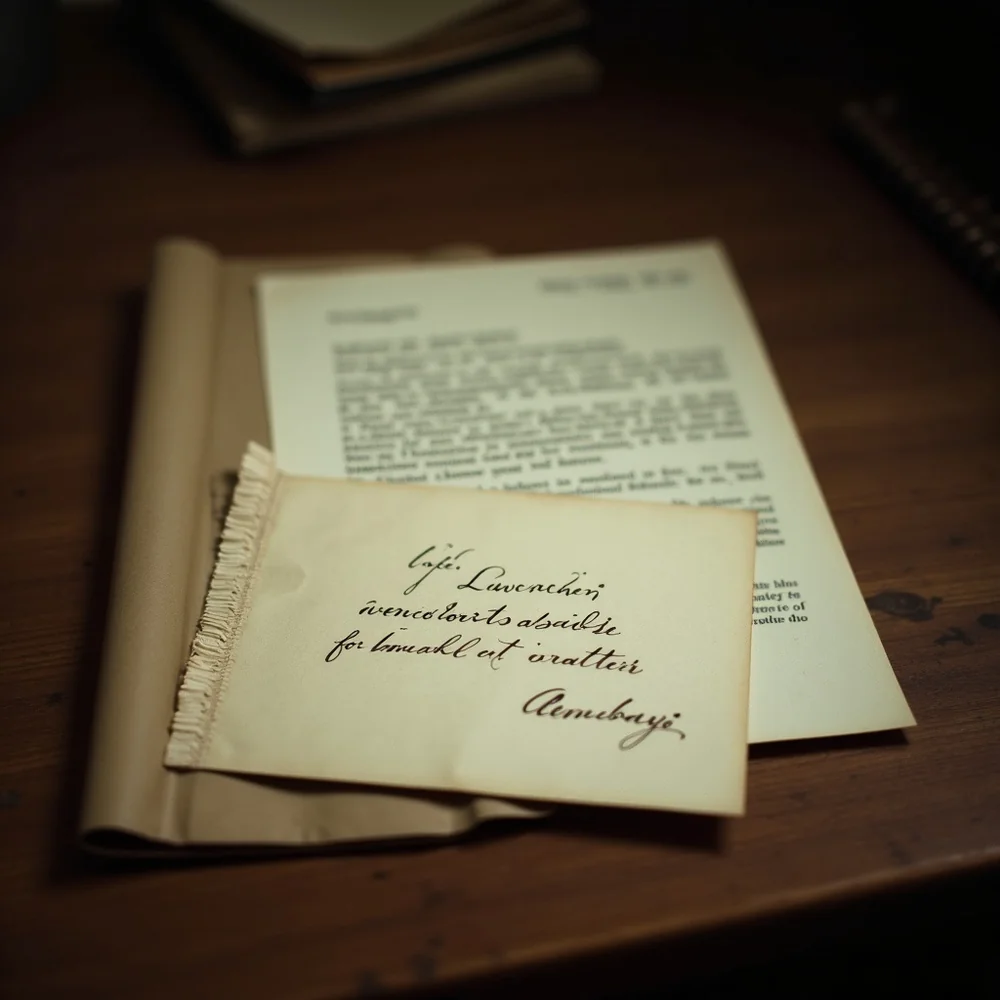
And there was, taped to the wall at eye level, a yellowed envelope with the words Whoever Finds This written on the front in pencil.
Daniel sat down on the bench. He had to. His knees had quietly informed him that they were no longer interested in standing. He held the envelope in his hands for a long moment without opening it. The handwriting was old, not Eleanor Whitcombe’s, he was almost certain, because he had been going through her papers for a week and her handwriting had a particular slant to it that this one did not have. This handwriting was older. It belonged, he could tell, to someone who had been dead for a long time.
He opened the envelope.
V. The letter.
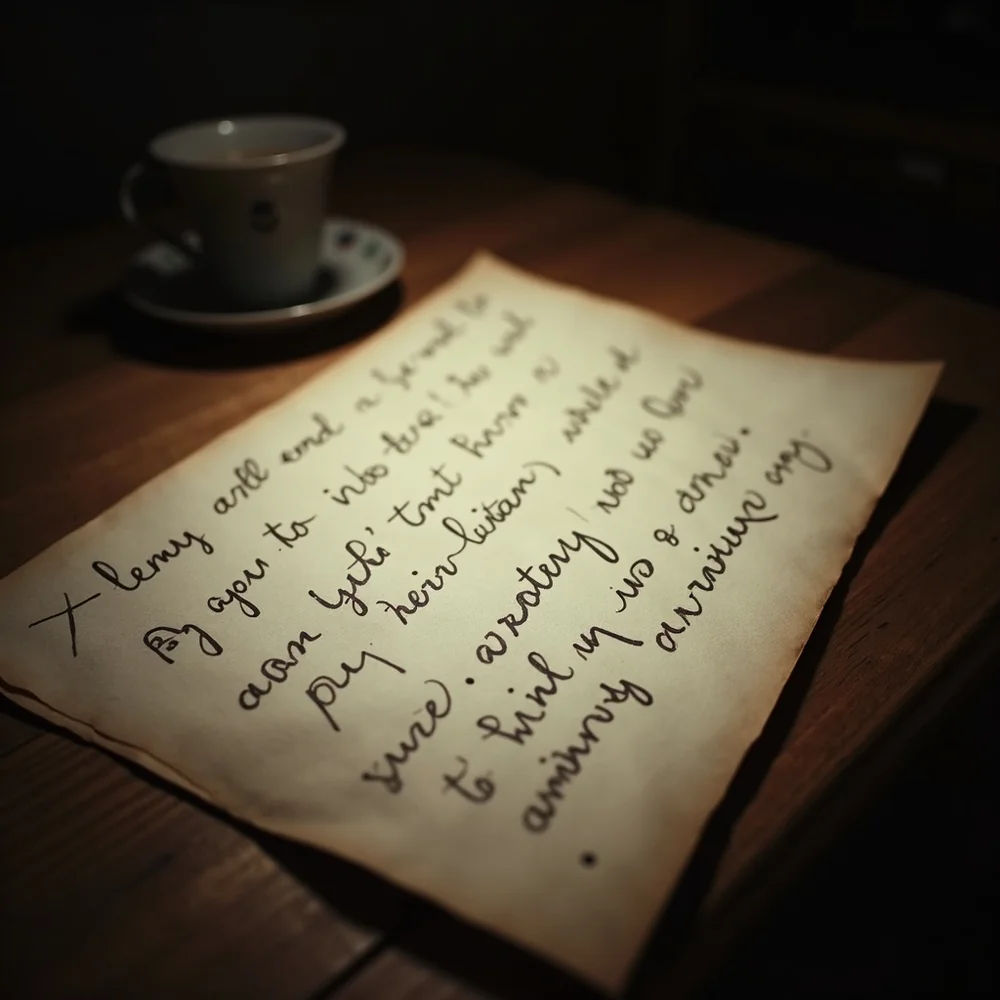
The letter was written on the kind of paper that comes out of the back of a household ledger, the lined cream-colored stock that nobody had used since about 1955. The ink was black. The hand was careful, but not formal, the way a person writes when they are taking their time but are not trying to impress anyone.
To whoever opens this room next.
My name is Ada Whitcombe Pellegrini. I was born in this house in 1908. My father built it the year I was born. The room you are sitting in was the room he built first. It was not the cellar of the house. The house was the cover for it.
My father was a Quaker. He came to Asheville from southeastern Pennsylvania in 1905, with my mother and my older brother. He worked at the tannery on the river for two years and saved his wages, and in 1907 he bought this lot. He built the stone room first, into the side of the slope, and he covered it with the house. He did this because he intended for it to be used.
Between 1908 and 1924, my father and my mother and, later, my brother and I, helped a small number of people who needed a safe place to be for one or two nights before they continued north. Most of them were colored people who had walked out of places in South Carolina and Georgia where they could not stay any longer. A few were women who had left husbands they could not stay with. My father did not call this any particular thing. He said only, when I asked him once, that there are some rooms a house must contain whether it is convenient or not.
By the time I was old enough to help, the worst of the need had passed, but the room was still used from time to time. I helped my mother lay out blankets and bread. I learned the names of seventeen people in this room between the ages of eleven and sixteen. I will not write the names here because some of them have children and grandchildren who might prefer the names to stay private.
My father closed the room formally in 1939. My mother died in 1947. My father died in 1953. I lived in this house until 1962, when I married a man from Atlanta and moved away. My younger sister Eleanor, who was born in 1936 and is too young to remember the room being used, took over the house. I am leaving this letter because I do not know whether Eleanor will tell anyone about the room. She has always been a private person. If she has died, and you are the next person to find this floor, please understand that you are sitting in a room that was built for the purpose of being a small useful kindness in a country that has not always been kind.
The strongbox under the bench holds my father’s record. He kept a careful list of every person who passed through here, with the dates and as much of their story as he was told. I would ask you to leave the strongbox closed unless you have a reason to open it. If you open it, please honor the people in it.
With all good wishes from a person who is no longer here, Ada Whitcombe Pellegrini Written in this room, June 1969.
VI. What he did about it.
Daniel sat in the cool stone room for a long time. He read the letter three times. He folded it back into its envelope. He did not open the strongbox.
He climbed the ladder. He sat at Eleanor Whitcombe’s kitchen table for the rest of the afternoon, with the unfolded letter beside him, and he made himself a strong cup of coffee, and he thought about what Ada Pellegrini had written.
There are a number of things he could have done. He could have called the local paper. He could have called the historical society. He could have called the university up at the state campus, which has a small but serious archive on the history of the African American experience in western North Carolina. He could have called a lawyer.
He did, eventually, do one quiet piece of homework. The county deed records confirmed the bones of Ada’s letter. Lot purchased in 1907 by Josiah T. Whitcombe. House recorded the following year. The tannery on the river had employed several hundred men in those days, and the city directory for 1906 listed Josiah as a hide handler, boarding on Lyman Street. The records said nothing about the room. That was, Daniel understood, exactly how Josiah had wanted it.
Some rooms a house must contain whether it is convenient or not.
What he did, in the end, was simpler. He waited a week. He thought about it. Then he wrote a long letter (handwritten, on a yellow legal pad, because he was a person who, after eight years in tech, had begun to mistrust the speed of email for important things) to the two grown children of Eleanor Whitcombe in Texas. He told them what he had found. He sent them a photograph of Ada’s envelope, of the bench, of the shelves with the mason jars. He told them he had not opened the strongbox. He told them he would not, unless they wanted him to. He told them the room was theirs, in any meaningful sense of the word, and that he was only the current keeper of a house their family had built.
He sent the letter on a Wednesday. He did not hear back for almost three weeks.
VII. The phone call.
The call came on a Sunday evening in October. The voice on the other end belonged to a woman named Linnea Whitcombe Davis. She was Eleanor’s daughter. She was sixty-one years old. She lived in San Antonio. She had not known about the room.
She told Daniel, in a slow careful voice that was very obviously trying not to break in the middle of words, that her aunt Ada had died in 1981. That her mother had never spoken about the room. That she had read his letter twice and then she had sat in her own kitchen for a long time. That she did not know what she wanted to do about it. That she did not want to do anything fast.
She talked about her mother for a while, the way people do when a parent has been gone just long enough to become a question instead of a presence. Eleanor had been twenty-eight years younger than Ada, a late surprise of a child, raised in a house where the great work was already finished and never discussed. Linnea remembered her as exact, frugal, devoted to her tomato plants, and silent about the past in a way the family had read as plainness. “We thought there was nothing to tell,” Linnea said. There was a radio playing low somewhere behind her, a kitchen sound. “It never occurred to us she was keeping something. She didn’t keep things. She kept bread tabs.” Then she laughed, and the laugh broke in the middle.
She asked him, near the end of the call, whether he would consider keeping the room as it was. Not as a museum. Not as a tour. Just as the room. Just as it had been left.
He said yes. He said he had not been thinking of doing anything else.
She told him, before she hung up, that her mother had once mentioned, late in life, that the house had been bought “out from under a story.” Linnea had not known what her mother had meant. She thought, now, that she did.
VIII. The room today.
Daniel still lives in the house on Maplewood. The pantry has been put back together. The floorboard sits where it has sat for almost a hundred years. He does not show the room to visitors. He does not, when people ask about the house, mention it.
About once a season, he goes down the ladder with a small lantern and sits on the bench for half an hour. He does not open the strongbox. The strongbox is for Ada’s father and the seventeen people whose names he keeps, and Daniel is not the right person to read those names.
Linnea flew out the following spring. She came to the house on a Saturday morning and went down the ladder by herself while Daniel waited in the kitchen with the coffee on. She was down there for forty minutes. When she came up, her eyes were red and her voice was steady, and she asked whether she could leave one thing on the shelf beside the jars, a photograph of her mother at nineteen, squinting into the sun on the front steps of the house. It is still there.
The strongbox question is not closed, only resting. Linnea has since spoken with an archivist about what it would mean to open the record properly, with descendants traced and notified first, and the names handled by people trained to handle them. It may happen in a few years, or not in Daniel’s lifetime. He has decided he is comfortable either way, which surprised him, because he had spent most of his thirties believing that every question deserved an immediate answer.
What Daniel does, when he sits in the room, is think about what Ada wrote, that there are some rooms a house must contain whether it is convenient or not. He has been thinking about this in his own life. He has been thinking about which rooms, in the metaphorical sense, he has been quietly refusing to keep.
Across the United States, there are houses built before living memory that still contain the choices of people who made them. Some of these choices are small and ordinary, a hidden compartment for the family silver, a forgotten letter behind a baseboard. Some of them are larger and quieter and shaped by the long honest history of the country. For broader context on American houses and the lives they were built to hold, readers can spend time at the Smithsonian Magazine or the long-form archives of PBS NewsHour. The Chapbook keeps these narratives clean, human, and responsible, read more in the Editorial Policy.
The house on Maplewood looks, from the street, like every other 1926 craftsman in Asheville. That, Ada’s father had once decided, was the whole point.