The teacher kept the drawing in her desk for two months before showing it to anyone. When she finally did, it changed three families.
The Sunny Acres Day School on East 38th Street in Savannah was the small private preschool that Sara McKee had been teaching at since 2011. She was forty-three. She had two grown daughters, a house in the Ardsley Park neighborhood, and the kind of steady professional weather that Savannah preschool teachers in their early forties sometimes develop after a decade in the same building. She knew, by face, the parents of three hundred and forty children. She knew, by the private accounting of any veteran preschool teacher, which families were doing well and which families were quietly not.
The drawing had been made by a four-year-old boy named Theo Whitmore. He had been in her four-year-old class since September. He was the kind of boy who never raised his voice, never pushed in line, and produced, in the art corner of the room, drawings with the precise adult-like detail that some unusual four-year-olds produce. His drawings always included accurate things, the right number of windows on a house, a clock face with hands at the correct angle for the time he was drawing, recognizable details that suggested a child whose internal attention to the visual world was, by any reasonable standard, several years ahead of his speech.
He had handed her the drawing on a Wednesday morning in late September. He had walked up to her desk with the piece of construction paper held flat in both hands, in the formal way he did everything, and he had set it down in front of her without saying anything. He had then walked back to his chair at the art table.
She had picked the drawing up.
It showed a small house. A house with a green door, a brown roof, and three windows. There were two figures in front of the house, a tall figure in a long dress, and a smaller figure with curly hair, presumably Theo himself. Behind the house, partly visible through one of the windows, there was a third figure.
The third figure was a man.
He was sitting in a chair at what appeared to be a kitchen table. He had been drawn in black pencil. He had a beard. He was holding a coffee cup. He was not, by any visible sign, looking out the window. He was looking down at the table.
Sara stared at the drawing for almost a full minute.
Theo’s father, by every piece of school documentation she had on file, had died in March of the previous year.
II. The school file.
She had walked, that afternoon at three-thirty, to the front office of the school. She had pulled Theo Whitmore’s enrollment file from the cabinet behind the receptionist’s desk.
The file confirmed what she had remembered. The emergency contact section listed only the mother, Mrs. Vanessa Whitmore, with a home phone number and a cell phone number. The father’s name, Daniel Whitmore, was crossed out in the pencil hand of the school’s office manager, with the date 3/14/2024 written beside the crossing-out, and the italicized notation deceased.
Vanessa Whitmore had enrolled Theo at the school in June of the year before, three months after the death of his father. She had explained, at the initial enrollment interview, that she and Theo had recently moved to Savannah from Charleston after the loss of her husband to a sudden cardiac event at the age of thirty-seven. She had not provided extensive details. The school, by long preschool protocol, had not asked for any.
Sara had liked Vanessa. She had liked her in the specific way she liked all the single parents in her four-year-old class, the soft kind of liking that came from having been, herself, briefly a single mother in her late twenties before her second marriage, and from understanding, by direct experience, the private exhaustion of getting a four-year-old out the door every morning while also holding down the long arithmetic of being the only adult in the household.
Theo had been with her in the four-year-old class for almost four weeks.
He had not, in those four weeks, ever mentioned his father.
He had also not, in those four weeks, drawn a picture with three figures in it.
She put the drawing into the top drawer of her desk that afternoon. She did not, in any way, intend to keep it from anyone. She intended, by her own private professional judgment, to think about it for a few days before doing anything.
III. The slow weeks.
She thought about it for almost two months.
This was, by her own later honest admission, longer than she should have. The drawing, in the private hours of the late evenings when she sat at her kitchen table at home with a cup of tea and looked through the folder of notes she had been keeping on Theo, became the particular object she could not quite figure out how to act on. It was, on its face, a picture by a four-year-old boy who had recently lost his father, of his mother and himself, with the imagined ghost of his father visible in the kitchen window behind them. It was, by every reasonable interpretation, a piece of grief work by a child whose visual memory was, by reasonable parental standards, unusually strong.
It was also, by the slow private accumulation of details Sara was now noticing, more specific than an imagined ghost should have been.
The man at the kitchen table in the drawing had a beard. Theo’s father, by the family photograph that Vanessa had shared at the initial enrollment interview, had not had a beard. He had been clean-shaven in the photograph. He had been clean-shaven in the framed photograph Sara had glimpsed, once, in the Whitmore household at the birthday-party drop-off she had attended for Theo’s classmate Maya in October.
The man in the drawing was holding a coffee cup. The cup had a small logo on it. The logo was, by Sara’s inspection under a lamp at her kitchen table at home, recognizable as the logo of a local Savannah coffee shop called Foxy Loxy on Bull Street.
Theo, by every piece of school documentation, had only lived in Savannah since the previous June. His father had died in Charleston in March. His father had never, by any reasonable timeline, been to a coffee shop in Savannah.
The man in the drawing was sitting at a kitchen table. The kitchen table in the drawing had a pattern of small circles drawn in pencil along the edge. The pattern matched, by Sara’s private observation at the October birthday party, the pattern on the edge of the kitchen table in the Whitmore household.
The man in the drawing was, by every visible sign, a real man, sitting in a real chair, at the real kitchen table in the Whitmore home in Savannah.
He was not, by every visible sign, Theo’s deceased father.
IV. The conversation she did not want to have.
I want to be careful, in writing this section, about the weight that private suspicions of this kind carry for preschool teachers. Sara McKee had been a preschool teacher for fourteen years. She had been trained, in the annual professional development sessions that the Sunny Acres Day School required, in the protocol of mandatory reporting. She knew, by the long muscle memory of those trainings, that any suspicion of child welfare concerns had to be reported to the Georgia Division of Family and Children Services.
She did not, in the private hours of the late evenings, believe that the drawing pointed to any child welfare concern.
She believed, in those private hours, that it pointed to something subtler. The drawing was, by her best private interpretation, the work of a four-year-old boy who was, in his own quiet visual way, processing something he had not yet been told. The man in the kitchen in the drawing was a man who was, by every sign, currently present in the Whitmore household, but who had not, by any school documentation or by any conversation with Theo’s mother, been disclosed as such.
This was not, in itself, a child welfare concern.
This was, however, a piece of family information that the mother of a four-year-old boy might want to know was being depicted, in construction-paper crayon, in the art corner of her son’s preschool classroom.
She decided, finally, on the second Tuesday of December, to speak to Vanessa.
She arranged it carefully. She did not, in the way that some teachers might have, send an email. She caught Vanessa, at the morning drop-off on Tuesday, and asked if she could find fifteen minutes to come back at four in the afternoon, before pickup, to talk about something related to Theo.
Vanessa, by every visible sign, did not know what to expect. She had agreed.
Sara had spent the intervening hours rehearsing.
V. The conversation at four.
Vanessa Whitmore arrived at three-fifty-five. She was thirty-six. She was small, dark-haired, with the steady professional weather of a woman who worked in the insurance industry, by Sara’s private understanding, she was a claims adjuster at one of the Savannah-based regional insurance firms. She was, by every visible sign, the loving mother that Theo had described, in the fragments of classroom storytelling that he had offered Sara over the previous four weeks.
They sat at the round teacher’s table in the corner of the empty classroom.
Sara had the drawing in a manila folder in her lap. She had been, in the private hours of the previous evening, trying to decide whether to begin with the drawing or to begin with the conversation that the drawing was, by her best interpretation, attempting to start.
She decided, in the moment, to begin with the conversation.
“Vanessa,” she said. “I am sorry to take your time at the end of a long day. I want to say first that Theo is doing wonderfully. He is thoughtful, he is kind to the other children, and his visual attention is, by any reasonable standard, unusual for a four-year-old.”
Vanessa nodded. She had, by every visible sign, been bracing for bad news. The weather of her shoulders shifted, slightly, downward.
“Thank you,” she said.
“I wanted to ask you about something else. I wanted to ask, gently, whether there has been any recent change in the household. Anything that Theo might be working through, in his private four-year-old way.”
Vanessa looked at her for a long moment. She did not, by every visible sign, respond immediately. She looked, in the slow way of a mother who was deciding how much to share, at the manila folder in Sara’s lap.
“Why do you ask?” she said.
Sara took the folder. She opened it. She set the drawing on the table between them.
“Theo gave me this drawing on the Wednesday morning of the third week of September,” she said. “I have been keeping it in my desk while I have been thinking about it. I have not, by any honest accounting, been certain what to do with it. I would like, if you are willing, to talk through it with you.”
Vanessa looked at the drawing.
She looked at it for almost a full minute.
She did not, in that minute, cry. She held herself, by every visible sign, in the steady weather she had been holding herself in for what was clearly a long time.
“Oh, Theo,” she said quietly, to the drawing.
VI. The third figure.
The man in the drawing was a man named Calvin Holloway.
Calvin Holloway was, by Vanessa’s private explanation in the empty preschool classroom at four-fifteen on a Tuesday in December, the man she had begun dating in late June, about a month after she and Theo had moved to Savannah, and about fifteen months after her husband Daniel’s death in Charleston.
Calvin was a kind unassuming forty-one-year-old man who taught eighth-grade math at a Savannah public middle school. He had been, by Vanessa’s description, the first adult relationship she had begun since Daniel’s death. He had been, by her description, slow and patient and respectful of the particular grief that she and Theo were still carrying.
He had begun, in late September, to spend the occasional evening at the Whitmore household.
He had not, by any plan or by any explicit instruction, hidden himself from Theo. He had been, on the evenings when he had been at the Whitmore home, present in the living room and the kitchen. He had read Theo a bedtime story on two occasions. He had cooked Vanessa and Theo a pasta dinner on the first Saturday of October.
He had been, by every description, a new presence in the household.
He had also been, by Vanessa’s private decision, not yet an officially introduced presence. She had been, in her private mind, waiting to have the conversation with Theo about who Calvin was, about how he fit into the household, and about whether he was going to fit into the household in a long-term way.
She had been, by her private estimation, planning to have that conversation in early November.
She had not, by every honest accounting, had it yet.
She had not realized, until the moment she had seen the drawing, that her four-year-old son had been having the conversation himself, on his own four-year-old terms, since the third week of September.
The smallest moment in any single-parent home is the moment a child notices a new adult before the parent has explained him.
VII. The next month.
I am going to be careful here about what I do and do not say. The private conversations that Vanessa Whitmore had with her son Theo over the subsequent month, and the private conversations she had with her partner Calvin Holloway, are not, in any sense, mine to relate. They are the private interior of a blended family that was, in the weeks after the drawing surfaced in a Savannah preschool classroom, beginning the long work of being a blended family.
What I can say, by the kind permission of Vanessa, is that the conversations went well.
Theo had not, by every subsequent indication, ever been confused about who Calvin was. He had been, by every subsequent indication, simply waiting for his mother to be the one to introduce him properly. The drawing in late September had been, by every interpretation, his four-year-old way of letting his mother know that he was, in his own private interior, ready.
Calvin moved into the Whitmore household in early February, three months after the Tuesday-afternoon meeting in the empty preschool classroom. He moved in with the explicit agreement of Theo, who had, in the conversation Vanessa had with him in early January, said only: Yes, Mama. I have been wanting Calvin to live with us. He makes you laugh.
The Whitmore household is now, by every sign, a Whitmore-Holloway household. Theo, by the gentle agreement of the three of them, has continued to use his original last name. Calvin, by every description, has not, in any sense, attempted to fill any of the spaces that Daniel Whitmore once filled. He is, by every sign, simply a third adult in the household.
VIII. Why it stays.
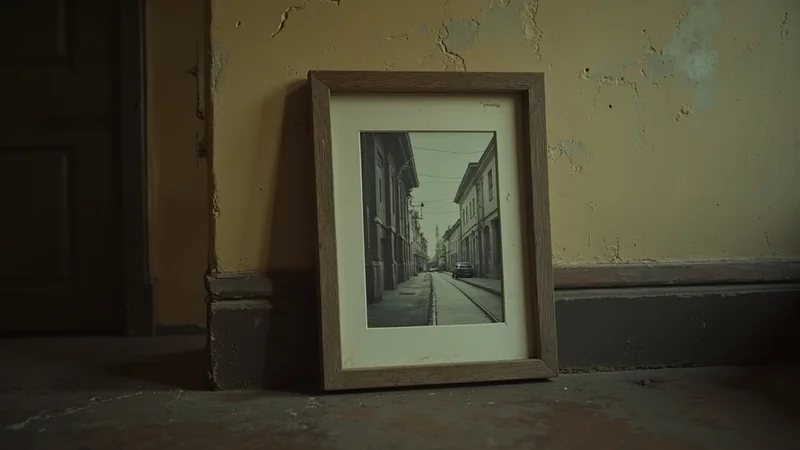
I sat with Sara McKee in the empty classroom on a Tuesday afternoon in April, almost six months after the Tuesday in December when she had finally shown the drawing to Vanessa Whitmore. The drawing was, by Sara’s private decision in agreement with Vanessa, framed in a simple frame on a wall of the Whitmore-Holloway household. It hung, by Theo’s own request, in the kitchen, on the wall above the kitchen table at which Calvin Holloway had, in the drawing in late September, been depicted sitting.
Sara did not, in our conversation, characterize what she had done in any heroic terms. She characterized it as something a fourteen-year preschool teacher would do. She had received a piece of four-year-old visual information. She had thought about it for too long. She had finally, by her own honest admission, done the right thing.
“I should have done it sooner,” she said. “I should have, in the honest accounting of my fourteen years, trusted my private instinct more quickly. The drawing was, by every sign, asking me to do something. I delayed because I was afraid that the drawing was telling me something dark. It was not. It was telling me something tender. The long lesson, for me, is that four-year-old visual information is, in the long arithmetic of family life, almost always small and tender.”
Across the United States, in preschool classrooms and art corners and pieces of four-year-old construction-paper crayon drawings, children are quietly working through the weather of their households in ways that their loving parents have not, in any sense, yet had the conversation about. For broader context on the long American tradition of early childhood development and the visual processing of private grief, readers can spend time with the materials at the National Institutes of Health or the long-form reporting at PBS NewsHour. The Chapbook keeps its narratives clean, human, and responsible, read more in the Editorial Policy.
The drawing, in its simple frame, hangs in the Whitmore-Holloway kitchen. It is, by every sign, exactly where it ought to be.
The four-year-old who drew it is, this spring, in his five-year-old class. He has, by Sara McKee’s gentle private knowledge, continued to draw detailed pictures.
His most recent drawing, by Sara’s last private knowledge, depicts a family of three figures, standing at a kitchen door, with the sun rising behind them.
There are, in the drawing, no windows.