She bought the coat for sixteen dollars. The ring was sewn into the lining of the left pocket.
The Salvation Army thrift store on East Washington Avenue in Madison was the kind of small upper-Midwest second-hand store that had been quietly absorbing the donations of three generations of Wisconsin homes. The clothing section took up most of the back half of the floor. The men’s coats were on a long rack by the loading door. The women’s coats were on a slightly shorter rack against the east wall, organized loosely by length and then, within each length category, by no clear principle at all.
Elise Brandt had walked into the store on a Saturday in early November. She was twenty-seven. She was a graduate student in art history at the University of Wisconsin, in her third year of a five-year program. She lived in a small one-bedroom apartment on Spaight Street, three blocks from the lake. She had a small budget that did not, in any usual sense, accommodate a new winter coat, she had been wearing the same down jacket for four winters, and the jacket had, by the end of October, developed a small tear along the left seam that her mother in Wauwatosa had recommended she replace before December.
The coat she was looking for, by the careful budget she had set herself that morning, was going to cost between twelve and twenty dollars. The coat she found, after almost forty minutes of searching, was a long camel-colored wool coat from the late nineteen-sixties, single-breasted, with large bone buttons and a careful satin lining that had begun to fray at the cuffs. The label said Marshall Field’s · Chicago. The size was right. The price tag said sixteen dollars.
She bought it.
She did not, in the moment, find anything in the pockets. She checked them at the register, the way her mother had taught her to check the pockets of any thrift-store coat. They were empty.
The ring was not in the pocket. It was sewn, by hand, into the lining of the left pocket, in the small private place where the lining seam meets the side seam of the coat, in a small pouch that someone, at some careful point in the coat’s history, had made by hand.
She found it three weeks later.
II. The discovery.
She had been wearing the coat for almost three weeks by then. The November weather in Madison had turned cold faster than she had expected. She had been walking to campus every morning in the coat. She had grown, in those three weeks, fond of it in the small particular way one grows fond of a thrift-store object that has unexpectedly worked out, the coat fit better than the down jacket, kept her warmer, and made her feel, in the small private way that old wool coats sometimes make their wearers feel, slightly more adult than she actually was.
She found the ring on a Thursday evening. She had been sitting on the small couch in her apartment, reading a small library book about the Wisconsin painter John Wilde, with the coat draped over the arm of the couch beside her. She had, without thinking about it, put her hand in the left pocket. Her fingers had touched the lining at the bottom of the pocket. The lining had been, in one small particular spot, harder than it ought to have been.
She had taken her hand out. She had looked at the pocket. She had felt the spot from the outside of the coat. There was, by careful touch, a small hard object the size of a penny inside the lining at the very bottom of the pocket, sealed in by what appeared to be a small section of hand-stitching.
She had walked into the kitchen. She had taken out the small sewing scissors her mother had given her for her twenty-first birthday. She had returned to the couch. She had carefully, very carefully, snipped the small section of hand-stitching.
A ring fell out into her palm.
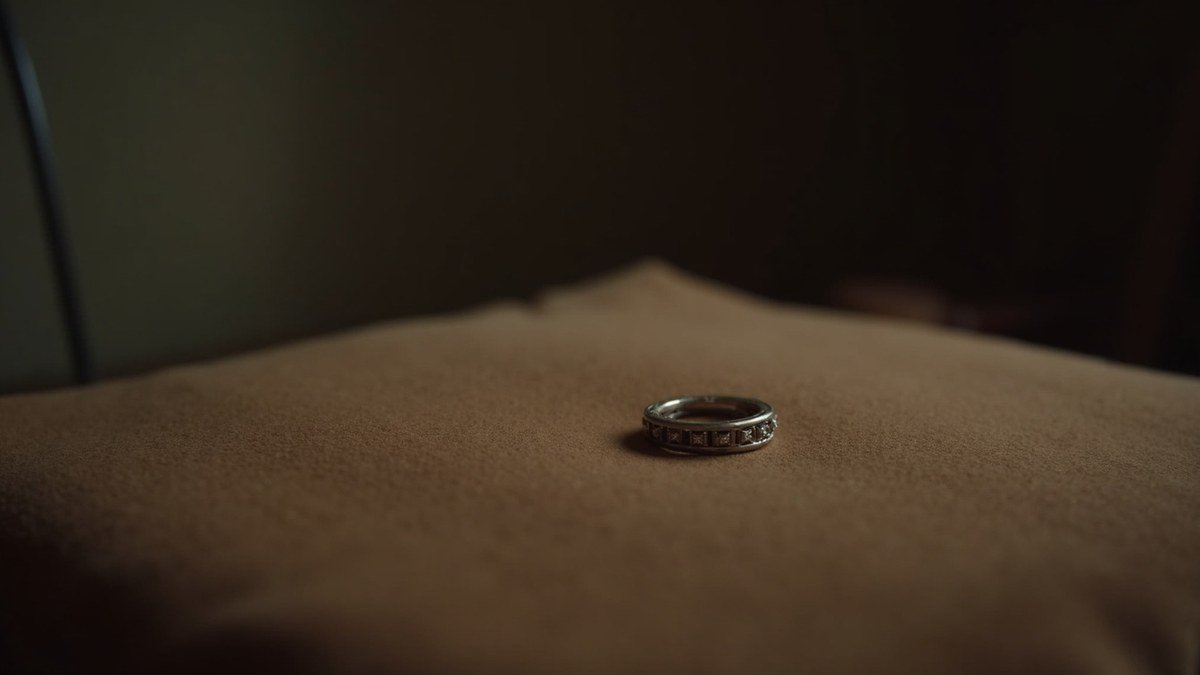
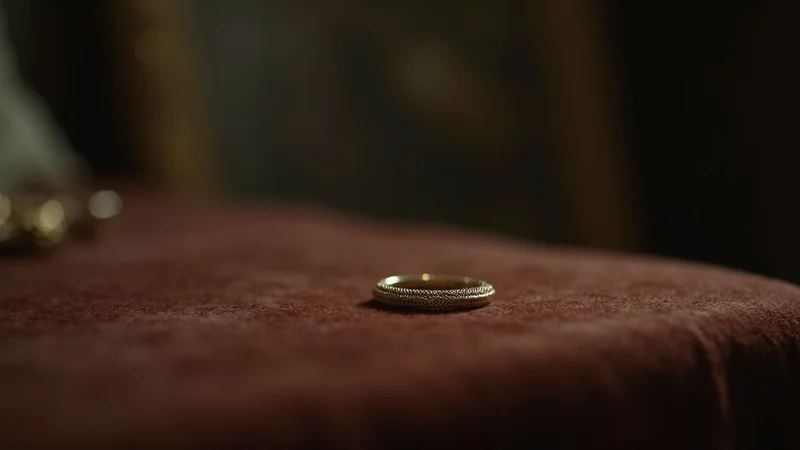
It was a woman’s wedding band. It was gold (by the soft warm color, almost certainly fourteen-karat. There was a small simple band of three tiny diamonds set into the front. The ring was, by every visible test, old) the careful slightly worn metal of a ring that had been worn daily for many decades.
Inside the band, in tiny careful engraving, were two sets of initials and a date.
E.M. & H.M. · 1957
III. The private hour.
She sat on the couch with the ring in her palm for a long time. She turned it over. She held it up to the lamp. She read the engraving twice.
The coat had come from the Salvation Army on East Washington. The Salvation Army had received it, by the small generic protocol of thrift-store donations, from someone, a donor or a family, who had passed it on for any of the small ordinary reasons that careful wool coats pass through such stores. The coat had a Marshall Field’s label, which meant it had probably been purchased in Chicago, although Chicago shoppers had often brought their Marshall Field’s coats home to Wisconsin and Iowa and Minnesota for decades. The coat was probably from the late nineteen-sixties, by the cut and the button style.
The ring had been sewn into the lining. The engraving was dated 1957, eleven or twelve years before the coat had probably been purchased.
The ring did not, by any usual accounting, belong with the coat. The coat was simply, by the small evidence of the hand-stitched pouch, where the ring had been hidden.
Elise Brandt was, by her own honest account, not, in any conventional sense, a sentimental person. She had been, for almost three years of graduate work, trained in the small skeptical analysis of old objects. But she had also been, for twenty-seven years, the daughter of a Wisconsin family that had, by long tradition, valued the small unremarkable kindnesses of returning things to their owners.
She did not, that Thursday evening, do anything immediate. She put the ring carefully into a small ceramic dish on her bedside table. She made herself a cup of tea. She sat back on the couch with the John Wilde book.
She did not read another page that night.
IV. The first leads.
She walked back to the Salvation Army the following Saturday. She asked, at the small counter near the back, whether they kept any records of the people who had donated specific items. The young man at the counter, a kind man in his early twenties with a small staff badge that said MICHAEL, looked at her with the small polite expression of a thrift-store employee who had been asked the same question many times before.
“I am sorry,” he said. “We do not. The donations are dropped off at the loading dock. They are sorted into the floor inventory by category. We have no records of which item came from which donor.”
“I understand,” she said. “Could you tell me, approximately, when the coats on the women’s rack tend to be put out? I am trying to figure out when this particular coat might have been donated.”
He thought about it. He looked at the small wool coat she was wearing.
“That coat was on the floor by the second week of October,” he said. “Probably. We rotate the seasonal racks at the beginning of October. If it was on the floor when you bought it on the first Saturday of November, it was probably brought in at some point in late September or October. We do not, however, keep records of what came in when.”
She thanked him. She walked out of the store.
She had, by that point, three small pieces of information. The coat was from the late nineteen-sixties. The coat had a Marshall Field’s label. The ring had been hidden in the coat at some careful point between approximately 1957 and the present. The coat had been donated to the East Washington Salvation Army in late September or October of the current year.
She did not, in the days that followed, do anything dramatic. She did not put up flyers. She did not take the ring to a jeweler to identify it more precisely. She did not call the Madison police, because the ring did not, in any conventional sense, appear to be stolen. She did, instead, the small research thing that art historians do when they have a small object they want to identify the provenance of. She began, in the small way that art historians begin these things, to ask questions slowly.
She put up a small post on a Madison community Facebook group, the kind of small local group that had thirty thousand members and where people occasionally posted lost-and-found items of historical interest. The post said only:
Found in a thrift-store coat from Madison: a woman’s wedding band engraved with the initials E.M. & H.M., dated 1957. Trying to return it to the family. If you have any information, please send me a private message.
She did not, in the post, mention the coat brand. She did not mention the Salvation Army. She wanted, by private preference, to receive responses only from people who would have specific information.
V. The response.
She received seventeen responses over the next four days. Most of them were small well-wishes from strangers. Three of them were small guesses about the initials, Edgar and Helen? Elaine and Henry? Edward and Hannah?, that did not, in any specific way, identify a family.
The eighteenth response, on the morning of the fifth day, was different.
It came from a woman named Marjorie Halverson, who lived in a small house in the Schenk-Atwood neighborhood of east Madison. The message said only:
I think the ring may be my mother-in-law’s. Her name was Helen Maris, married to Edmund Maris in 1957. She died in August. We donated her coats to the Salvation Army in October. Could we meet?
Elise read the message three times. She wrote back. They arranged to meet on Saturday afternoon at a small coffee shop on Atwood Avenue.
She arrived at two. Marjorie was already there. She was a careful woman in her late fifties, with the small steady presence of a woman who had been a Wisconsin elementary school principal for thirty-one years. She had a small manila folder on the table in front of her.
Elise sat down. She took the small ceramic dish out of her tote bag. She had transferred the ring, that morning, into a small velvet bag a roommate had once given her with a small pair of earrings.
She set the bag on the table.
Marjorie opened the manila folder.
Inside the folder was a single small photograph, faded but careful, a black and white photograph from approximately 1957, showing a young couple at what appeared to be a small simple wedding ceremony. The woman was wearing a careful simple white dress. The man was wearing a dark suit. On the woman’s left hand, clearly visible in the careful black and white print, was a small wedding band with three small diamonds set into the front.
“That is my mother-in-law Helen and my father-in-law Edmund,” Marjorie said. “They were married on the fourteenth of June, nineteen fifty-seven. Helen wore that ring every day for sixty-six years. We could not find it when she died. We thought she had taken it off and put it somewhere safe before her last hospital stay. We had been looking for it, off and on, for two months.”
She paused.
“My husband, Henry Maris, their son, has been a wreck about it. He is a careful man. He has been searching the house in small pieces for two months.”
Elise opened the velvet bag. She took out the ring. She set it on the table beside the photograph.
Marjorie picked it up. She held it carefully. She read the engraving. She looked at Elise.
She did not, for several seconds, say anything.
She cried.
VI. The pouch.
I sat with Marjorie and Henry Maris in the small kitchen of their house in the Schenk-Atwood neighborhood, two weeks after the Saturday at the coffee shop. Henry was sixty-six. He was a retired engineer. He was, by every visible sign, the kind of Wisconsin man whose private life had been, for almost seven months, quietly held together by the small steady weather of his wife.
He had the ring on the kitchen table in front of him. He had been, since Marjorie had brought it home from the coffee shop, the small custodian of it. He was not, by his own private description, wearing it. He had been trying to decide what to do with it.
The ring, he told me, had not been lost.
It had been hidden.
His mother Helen had, in the last six months of her life (when her steady mind had begun to fade in the small particular way that minds in their late eighties sometimes fade) developed a small private habit of hiding small objects in unusual places. The hiding had not been malicious. It had been, by every subsequent indication, a small private protective instinct of a woman who had begun, in the slow careful way of late dementia, to fear that the small valuable things of her long life might be taken from her without her knowing.
The pouch in the lining of the coat had been, by every sign, sewn by his mother herself. The hand-stitching had been recognizable. His mother had been, in her long careful life, an accomplished home sewer. She had, in the small private confusion of her final months, sewn the pouch into the lining of her own wool Marshall Field’s coat in the summer of the previous year and tucked the ring into it for what she had, at that careful moment, considered safekeeping.
She had not, by any subsequent family knowledge, ever told anyone she had done it.
The coat had been donated, with seventeen other coats, by Henry and Marjorie in October, six weeks after Helen’s careful passing, in the small slow domestic work of clearing out her belongings.
The private hiding of a small object by an aging mind is, in the slow tender arithmetic of an American family’s grief, one of the most painful kinds of small private theft to discover after the fact.
Henry sat at the kitchen table for a long careful moment. He looked at the ring. He looked at Marjorie. He looked at me.
“My mother had been carrying that ring on her finger for sixty-six years,” he said. “She did not, in any way, intend to lose it. She intended, in her last summer, to keep it safe. The pouch she sewed was, by her private understanding at that moment, the safest place she could think of to put it. The coat had been her favorite coat for many years. She wore it in the fall and in the winter.”
He paused. He held the ring carefully in his hand.
“I am not going to wear it,” he said. “But I am going to put it back where she put it.”
Marjorie nodded.
“He has been thinking about this for two weeks,” she said to me, in the small tone of a wife who had been quietly waiting for her husband to arrive, in his own slow way, at his own decision.
VII. The small pouch in the new coat.
I do not know, the morning I am writing this piece, exactly which coat Henry Maris finally chose. He told me, near the end of our conversation, that he had been considering several options. He had been considering his own old wool coat, from his careful career years. He had been considering a small winter jacket that his mother had given him for Christmas in 2018. He had been considering the camel-colored Marshall Field’s coat itself, which Elise had returned to the family in the spirit of letting the ring be where Helen had placed it.
He told me, finally, that he had decided to use the camel coat.
He had asked Marjorie, who was an accomplished home sewer like his mother had been, to re-sew the pouch in the lining of the left pocket. Marjorie had done it, in a careful hour at her sewing table in the small back room of their house, using the careful same stitch his mother had used. Henry had then taken the ring and placed it back into the pouch.
He had hung the coat in the front closet.
He had not, by his own private description, decided yet whether he was going to wear the coat himself, or whether the coat would simply hang in the closet as a small piece of his mother’s life that the family had now, by the slow work of an art history graduate student in Madison, recovered.
The decision, he told me, was going to take time.
He was, by his own careful admission, in no hurry.
VIII. Why it stays.
I sat with Elise Brandt at a small coffee shop near her apartment on Spaight Street in January, two months after the Saturday at the coffee shop on Atwood Avenue. She had been wearing, by her private decision, a different coat that winter, a small borrowed coat from her older sister, which had given her the careful budget room to give the camel coat back to the Maris family without any awkward financial conversation.
She did not, in our conversation, characterize what she had done in any heroic terms. She characterized it the way an art-history graduate student in her late twenties would characterize it. She had found a object. She had identified the object. She had returned the object to its proper place.
“It is what art historians do,” she said. “Provenance is a small private act of kindness. You find a thing. You ask where it came from. You return it, if you can, to the people whose grief or whose joy or whose small story it actually belongs to. I happen to do it, in my professional life, with paintings. I did not, in this case, expect to do it with a ring.”
She paused. She drank her coffee.
“But it is the same work.”
Across the United States, in small thrift stores and small coat closets and small donation pouches sewn into old linings by careful aging hands, small objects are quietly waiting to be returned to the families who do not, in any usual sense, yet know to be looking for them. Most of these objects will, in any conventional sense, never be returned. A small handful of them will. For broader context on the long American tradition of small material history and the recovery of objects, readers can spend time with the long-form material at the Smithsonian Magazine or the careful archives at the Library of Congress. The Chapbook keeps its narratives clean, human, and responsible, read more in the Editorial Policy.
The camel-colored Marshall Field’s coat is, this winter, hanging in the front closet of a small house in the Schenk-Atwood neighborhood of east Madison. The ring, by Henry Maris’s private decision, is sewn back into the pouch in the lining of the left pocket. Marjorie’s careful stitching is, by every description, indistinguishable from Helen’s careful original stitching.
The careful place Helen Maris chose, in the small confusion of her final summer, has been, by the slow work of an art-history graduate student in Madison, returned to her.
She is, in the small private sense that Wisconsin families understand these things, still wearing it.