The delivery slip was authentic, the carrier was real, the address was exact. The sender line was blank, and the Fitchetts had not ordered a piano.
The truck came up Bench Street in Galena, Illinois, a little after nine on the morning of Tuesday, October 17, 2023. It belonged to a specialty moving firm out of Dubuque, twenty minutes across the Mississippi, the kind of outfit that moves gun safes and church organs. Two men in back braces consulted a clipboard, then knocked on the door of the white frame house where Gene and Marlys Fitchett had lived since 1979.
Gene answered in his cardigan, holding his coffee. The foreman, a polite heavyset man named Russ, said they had a delivery for this address. Gene said they had not ordered anything. Russ turned the clipboard around. The slip carried the company’s logo, a job number, the date, and the Fitchetts’ exact address. The line marked shipper was blank. Not smudged, not torn. Blank, the way a line is blank when somebody has decided it will be.
What came off the truck, wrapped in quilted gray pads, was an upright piano. When the pads came off in the living room (the men kept moving, with the unstoppable courtesy of professionals, while Gene followed saying versions of now hold on a minute), it stood revealed as a Steinway, ebonized black, restored and French polished, the brass pedals bright as church candlesticks. It was, the paperwork inside the bench would confirm, built in New York in 1921.
Marlys came in from the back garden with dirt on her gloves. She stopped in the doorway. The morning fog was still burning off the Galena River below the town, and the light through the front windows was the color of weak tea, and in that light the piano looked less like a delivery than an apparition that had decided to be patient about it.
“Gene,” she said, “what did you do?”
“I didn’t do anything,” Gene said. “Nobody did anything. That’s the problem.”
Gene tried to refuse it. Russ was sympathetic and immovable. The haul had been paid in full, in cash, weeks earlier. The contract was closed. There was, he explained, no one to send it back to: no return address, no account, no name. His instructions, typed on a single sheet, specified the address, the date, a morning delivery window, and one sentence at the bottom that Gene would repeat to me, word for word, two and a half years later. Place the instrument against the north wall of the front room, if the residents permit.
The residents, bewildered, permitted. The men set it against the north wall, shimmed it level on the old pine floor, and left. The whole visit took forty minutes, and at the end of it a quarter ton of mystery stood in the living room, smelling faintly of lemon oil and old felt.
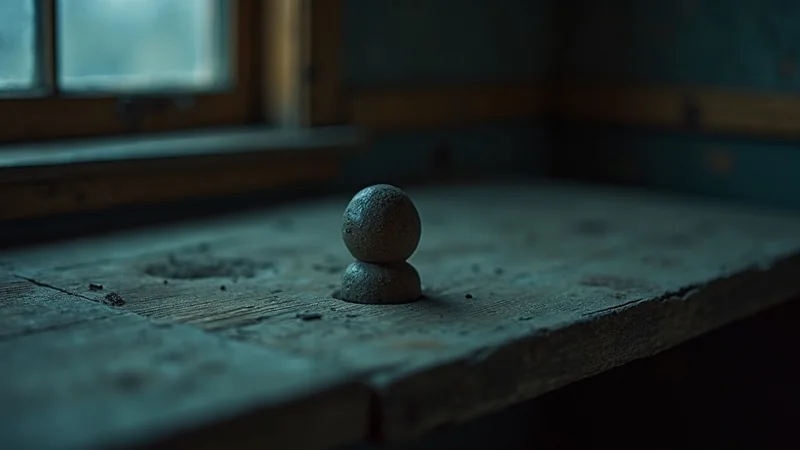
II. Gene and Marlys.
Gene Fitchett was seventy-six that October. He had spent thirty-one years as a machinist at the John Deere works in Dubuque, crossing the river every morning in the dark and recrossing it every evening in the dark for about four months of every year, and he is the kind of man who owns a micrometer and uses it. Marlys was seventy-five. She had taught elementary music in the Galena schools for twenty-eight years and had played the organ at the Presbyterian church on Bench Street for longer than that, and she is the kind of woman who can hear a wrong note in another room and decide, consciously and visibly, to let it go.
They had married in 1970 and come to Galena in 1979, when the town was still mostly itself and not yet a weekend postcard. They raised two children in the white frame house. The children grew up and moved away, to Rockford and to St. Paul, and called on Sundays. The Fitchetts’ life, by the autumn of 2023, was the settled, unhurried life of people who have done their work: garden, church, coffee at the kitchen table, the scanner radio Gene kept on the porch out of old habit.
There had been a piano in the house once, a battered spinet the kids had practiced on, sold in 1996 when the last child left. Since then Marlys had played only the church organ. She had not owned a piano in twenty-seven years and had never in her life owned a good one.
And one more thing, which matters to this story and which neither of them thought to mention for months because it seemed like ancient history: Marlys had not always been a Fitchett, and she had not always been an Illinoisan. She had grown up Marlys Hoyt in Richland Center, Wisconsin, a hardware merchant’s daughter, and between high school and her teaching certificate she had spent two winters giving piano lessons in the back room of her father’s store.
She did not connect any of that to the black Steinway standing against her north wall. Why would she? It had been fifty-six years. The brain files some things so deep that the file cabinet itself gets forgotten.
“I thought somebody had made a beautiful mistake,” she told me. “I kept waiting for a phone call from whoever was missing a piano.”
The phone call never came. Something better did, but it took its time.
III. The dead ends.
Gene went at the mystery the way he had gone at thirty-one years of seized bearings: methodically, and with a notebook. The notebook, a yellow legal pad that now lives in the piano bench, records every dead end in his blocky machinist’s capitals.
Dead end one: the carrier. Gene drove to Dubuque the following Monday and sat in the moving company’s office, which smelled of burnt coffee and diesel, until the owner saw him personally. The owner was courteous. He was also, Gene realized, nearly as curious as Gene was. The job had come in by mail: a typed instruction sheet, no letterhead, and an envelope of cash covering the haul, the insurance, and a tip the owner described as respectful. The instructions were precise about everything except identity. The owner had assumed, reasonably, that it was a surprise gift from family. He showed Gene the file. The postmark on the envelope said Milwaukee. That was all Milwaukee would say for a long while.
Dead end two: the serial number. Gene found it stamped on the cast iron plate, five digits and a comma’s worth of dust, and wrote to Steinway & Sons in New York, who keep ledgers going back to the 1850s. The reply, when it came, was courteous and useless. The instrument had been completed in 1921 and shipped to a retailer in Chicago, and sold the following spring to a buyer whose trail evaporated somewhere around the Eisenhower administration. The ledger could not say where the piano had spent the last seventy years. It had been recently and expertly rebuilt, new strings, new hammers, the action regulated by someone who knew what they were doing. Whoever restored it had left no card. One key, middle C, had a slight tendency to stick in damp weather. The Steinway people, in a postscript Gene admired, suggested that a technician could correct this in an hour.
Dead end three: the neighbors. On Bench Street, a piano delivery is an event. Three households had watched the truck. Nobody had seen anything except the truck itself, and nobody had been asked to sign for anything or hold a key or keep a secret. The Galena Gazette ran a small item that November, four inches under the headline WHO SENT THE PIANO?, which produced two casseroles, one offer to buy the instrument sight unseen, and no information. The police chief, whom Gene knew from church, observed that it is not a crime in the state of Illinois to give a man a Steinway, and that if it were, he would want to know more about the criminal.
The receipt proved everything about the delivery except the only thing that mattered: who on earth had wanted them to have it.
By Christmas, the legal pad had filled eleven pages and concluded nothing. The piano stood against the north wall, black and patient. Marlys dusted around it. She did not play it. She was not ready, she said later, to touch a thing she might have to give back.
IV. Living with the piano.
Here is what nobody tells you about an unexplained piano: it does not stay furniture. A mystery you can walk past every day stops being a question and becomes a presence, the way a houseguest who stays long enough stops being company and becomes family, or a problem, or both.
Through January the piano simply stood there, breathing its faint smell of felt and old glue into the room, the cold pine floor ticking under it at night as the furnace cycled. Gene caught himself saying good morning to it, silently, the way you nod at a neighbor. Marlys caught him once with the dust rag, about to wipe the lid, and stopped him with a word. She wiped every other surface in that room herself, weekly, with Presbyterian thoroughness. The piano lid she left alone. The dust on it grew soft and even, like frost.
“It wasn’t ours to polish,” she said. “Not yet. You don’t polish what you might have to return.”
In February she began lifting the fallboard, not to play, just to look at the keys, which were new ivories the color of candle wax. In March, on a wet afternoon when Gene was in Dubuque at the dentist, she sat down on the bench and played a hymn, Abide with Me, very quietly, as if the house might object. Middle C stuck on the second verse. The damp had gotten into it. And Marlys did something she did not even notice herself doing, which Gene noticed three weeks later when she finally played in front of him: without looking down, without breaking the phrase, she voiced the melody around the sticking key, refingering on the fly, the way you step over a loose stair tread in a house you grew up in.
“You’ve done that before,” Gene said. It was not quite a question.
“Done what?” Marlys said. She honestly did not know.
By summer the piano had a vase on the floor beside it, never on it, and a metronome on the side table, and the room had quietly rearranged itself the way rooms do, with every chair angled slightly toward the north wall. The Fitchetts had stopped expecting an answer. The piano had outlasted the question. It got played most evenings now, hymns and Schumann and the easy halves of things, and if a visitor asked where it came from, Gene would say, “That’s a longer story than I have,” which was the plain truth.
V. The letter from Milwaukee.
The envelope arrived on July 19, 2024, nine months and two days after the truck. Cream paper, heavy stock, the kind of stationery that has outlived three generations of office equipment. The return address read KOWALCZYK & LAWLER, S.C., ATTORNEYS AT LAW, MILWAUKEE, WISCONSIN. Inside was a single page, typed on an actual typewriter, the letters pressed into the paper so you could read them with a fingertip.
It was addressed to Mrs. Marlys Fitchett. It said, in full:
“Dear Mrs. Fitchett. I write concerning an instrument delivered to your address in October of last year. The delivery was lawful, was paid for in full, and was made at the written instruction of a client of this firm, now deceased. My client’s instructions required that the gift be anonymous and unexplained. They further provided that if, after a decent interval, you wished to ask one question, I am authorized to answer it. You may telephone me at the number below on a Tuesday or a Thursday. I am sorry for the length of the interval. Some of that was the instructions. Some of that was me. Respectfully, Albert J. Kowalczyk.”
Marlys read it twice at the kitchen table while the coffee went cold. Gene read it once and reached for the legal pad and then put the legal pad down, because eleven pages of dead ends had just been answered by a man apologizing for them.
They spent two days deciding on the question. Gene wanted to ask who. Marlys overruled him, gently, at the kitchen table, in the way of a woman who has been overruling him gently since 1970.
“Whoever it was is dead,” she said. “A name would just be a name. I want to know why.”
She called on a Tuesday, at ten in the morning, with the letter flat on the table in front of her and Gene on the porch pretending not to listen through the screen door.
VI. Albert Kowalczyk and the will.
Albert Kowalczyk was eighty-one years old that summer, the last name on the door of a two-man firm on the south side of Milwaukee, mostly retired, still keeping office hours on Tuesdays and Thursdays for the handful of old clients whose affairs he had promised to see through personally. His voice on the phone, Marlys said, was slow and exact, with the flat Lake Michigan vowels of a man who had argued probate in the same county courthouse for fifty years.
His client was Walter Prybylski. He had died in March of 2012, at sixty-nine, of heart failure, in Milwaukee. He had owned a machine parts company, built up from a rented garage over forty years and sold when his health went. He had never married. He had no children. His estate had gone, in orderly pieces, to a parish, a trade school scholarship, two cousins in Florida, and Article Seven.
Article Seven of the last will and testament of Walter Prybylski set aside funds for a single purpose: to locate Marlys Hoyt, formerly of Richland Center, Wisconsin, wherever she might be and under whatever name, and to deliver to her one Steinway upright piano, built in the year 1921, restored to full playing condition, anonymously, with no note and no explanation.
“I asked Walter why anonymous,” Kowalczyk told Marlys on the phone. “I told him anonymous gifts make work for lawyers. He said the gift wasn’t the point of the gift.” The will itself put it more plainly. If the recipient asked why, the lawyer was to tell her everything, because, Article Seven said, in words Walter had dictated and initialed: she will know.
He did not want thanks. He wanted the piano standing in her front room. Those are different things, and he knew the difference.
Then Kowalczyk apologized, formally, the way men of his generation apologize, for the eleven years. Finding her had genuinely been hard: a maiden name, a marriage two counties over, a move across a state line, fifty years of quiet life. But that accounted for three years, maybe four. The rest, he said, was an old lawyer burying his last instruction at the bottom of the pile because executing it meant Walter would be finished, and he had not been ready for Walter to be finished. They had known each other since the parish grade school on Becher Street. The 1921 requirement had not made things faster either. Walter had been specific about the year, and pianos of a specific year do not simply present themselves. Kowalczyk had waited two years for the right instrument to surface at an estate sale in Waukesha and had then given the restorer no deadline at all, on the theory, he told Marlys without embarrassment, that the only thing left to do for his friend should be done slowly and done right.
“Mr. Kowalczyk,” Marlys said, “I don’t remember anyone named Walter Prybylski.”
There was a pause on the line, and a sound she took for a chair creaking, and the old lawyer said, “He thought that might be so. I’m instructed to mention a hardware store. And a middle C.”
VII. Marlys remembers 1967.
It came back to her standing up. She had to put a hand on the kitchen table.
Richland Center, the winter of 1967. The back room of Hoyt’s Hardware, where her father kept the stove going and let her teach lessons after close on a 1921 upright, a workhorse piano with chipped ivories and a middle C that stuck whenever the thaw came, bought third-hand from a shuttered movie theater. She was nineteen, saving for her teaching certificate, charging a dollar and a quarter an hour to farm kids and shopkeepers’ daughters.
And to one grown man. Walter, he was, a Polish name she had never been able to keep hold of, twenty-four years old, come up from Milwaukee to do a contract year at the dairy equipment plant. Big hands, two fingers already scarred from machine work, a wool coat that smelled of cold air and cigarettes when he hung it by the stove. He wanted to learn one piece of music. His mother had died the spring before, and there had been a hymn at the funeral, the old Polish one, Serdeczna Matko, and he wanted to be able to play it himself, once, properly, rather than depend on memory and other people’s funerals.
He could pay for November and December. In January the plant cut the contract crews’ hours and he came to his lesson and told her, standing, coat still on, that he would have to stop. Marlys, nineteen, said something she had completely forgotten and Walter Prybylski had evidently spent fifty-six years not forgetting. She said the stove was lit anyway, and the piano didn’t charge, and he should sit down and take off his coat.
He came every Thursday through the end of the thaw and paid in what he had. He shoveled the walk in front of the store. He rebuilt the hinge on the stockroom door so it stopped screaming. He trued the wobble out of her bicycle wheel with a spoke wrench in April. By then he could play the hymn, slowly, both hands, around the sticking middle C, which she had taught him to step over without breaking the phrase, because that is what you do with a fault you can’t fix: you learn it, and you play the music anyway.
In May the contract year ended and he stopped in to say he was going back to Milwaukee. There were no speeches. He shook her hand at the door of the back room, looked at the old upright, and said, “Someday I’m going to buy you a Steinway.”
She laughed. Not at him, she would insist to me, sixty years of kindness in the correction, but at the size of it. “I told him I’d hold him to it,” she said. “I was teasing. You understand. I never saw him again. I never thought of it again. It was a thing a young man says at a door.”
Kowalczyk, on the phone, read her the sentence from the file, Walter’s own dictation, initialed in the margin in 2009: She taught me on a piano with a middle C that stuck, and she never once apologized for the piano, or made me feel I was being given charity. She will know.
“And I did,” Marlys told me. “The moment he said middle C, I knew. Fifty-six years, and the first thing that came back wasn’t his face. It was the smell of that stove, and the snow melting off his coat.”
VIII. Why it stays.
I sat with Gene and Marlys Fitchett in the front room on Bench Street this spring, on a cool morning with the fog still standing in the valley, and I will tell you what the room is like. The piano holds the north wall the way an altar holds a church. The lid carries a thin, even coat of dust, and Marlys still will not let Gene touch it, though her reason has changed. It is hers now, settled and certain, and she wipes the lid herself, every Saturday, with a chamois cloth, slowly, the way you’d wipe a headstone you were fond of. The middle C still sticks in damp weather. A tuner from Dubuque offered twice to fix it in an hour. Marlys declined twice. The third time she told him why, and he put his tools away and didn’t charge for the visit.
She played the Polish hymn for me. She had gone and learned it that first August, ordered the sheet music up from a church supply house in Chicago, because somebody on this earth ought to still be playing it, and the somebody, by every honest accounting, ought to be her. Outside, a delivery truck went by, downshifting on the hill, and nobody in the room so much as turned a head. The Fitchetts are done being startled by trucks.
Walter Prybylski could have sent the piano in his lifetime, with a card, and collected the thanks. He chose otherwise, and the choosing is the strange, patient heart of this story. He turned a promise into an instruction, an instruction into an estate, and an estate into a black upright standing in a room he would never see, trusting a slow lawyer and a sticking key to say everything he had decided not to say. The object was the message. It usually is. Museums know this better than anyone: the Smithsonian keeps whole halls of pianos and lunch pails and wedding coats at si.edu precisely because things carry what people meant, long after the people are gone, and the American Folklife collections at the Library of Congress are full of ordinary voices that waited decades for someone to ask. The Chapbook keeps its narratives clean, human, and responsible, read more in the Editorial Policy. Marlys Fitchett, for her part, keeps a 1921 Steinway, a chamois cloth, and a Thursday habit of playing one old hymn slowly, both hands, around the middle C, the way a young man with scarred fingers was taught to do in the back room of a hardware store, in the winter of 1967, by a girl who never apologized for the piano.