She had bought the painting at an estate sale for forty dollars. The message tucked behind the canvas had been waiting since 1968.
The estate sale on Coffee Pot Boulevard in St. Petersburg had been on a Saturday morning in late March. Carmen Delgado had been forty-one. She had been a gallery assistant at a contemporary-art gallery in the Warehouse Arts District, and she had been doing the Saturday-morning estate-sale circuit in St. Petersburg for almost six years, in the slow careful way of a Florida art-and-objects person who had developed, by patient practice, an eye for what got under-priced at estate sales.
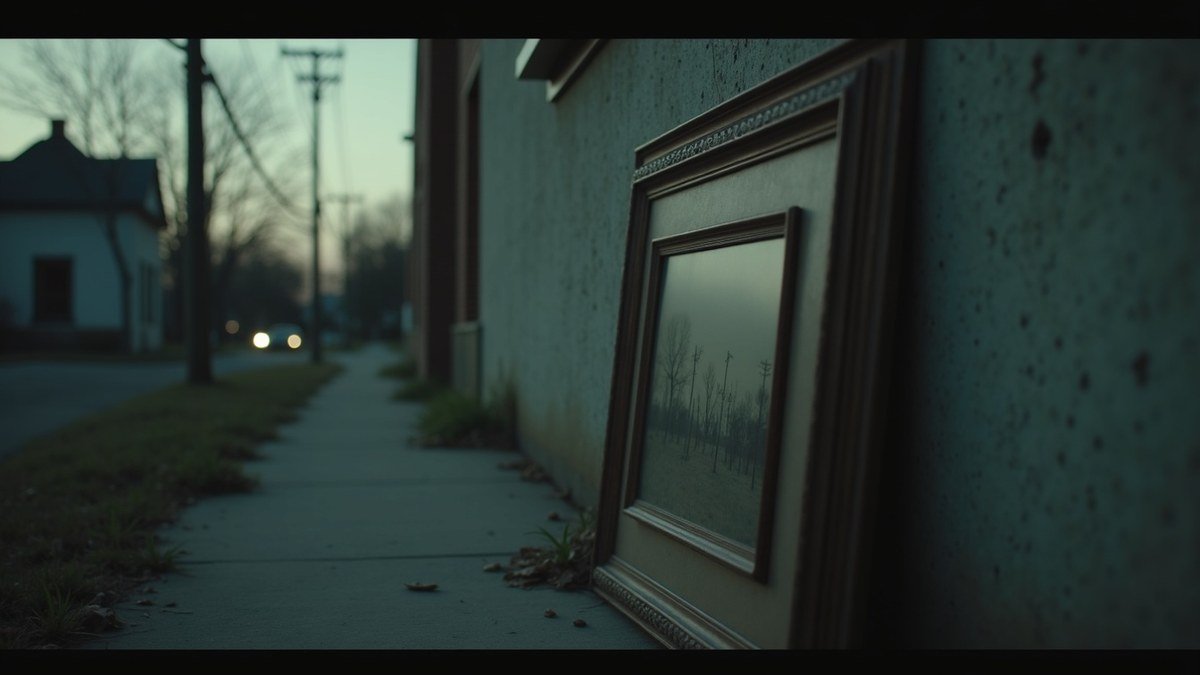
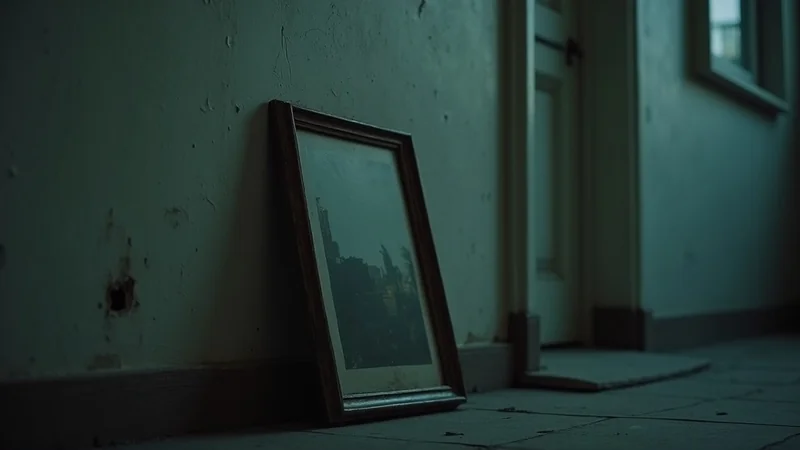
The painting had been hanging in the upstairs hallway of the house. It was a oil-on-canvas landscape, perhaps eighteen by twenty-four inches, in a gilded wooden frame. The painting showed a Florida coastal scene (a stretch of mangrove, a tidal flat, a flight of pelicans) in the style of the mid-twentieth-century regional Florida painters whose work had been quietly appreciating in the Florida art market for the past decade.
The signature in the lower right corner read, in blue cursive: E. Whitcombe · 1968.
Carmen recognized the name immediately. Eulalie Whitcombe had been a St. Petersburg painter who had been working in the Florida regional tradition from approximately 1955 until her death in 1979. Her work had been, in the local art market, modestly collected, pieces selling, by Carmen’s careful informal knowledge, in the range of four to seven hundred dollars at regional auction.
The price tag on the painting read forty dollars.
Carmen had carried it to the estate-sale checkout in the kitchen. She had paid in cash. She had loaded it into the back of her Honda CR-V.
She had not, in the moment, opened the frame.
II. The frame.
She had opened the frame the following morning in her apartment in the Old Northeast neighborhood.
She had been planning, by her own honest later description, to do the standard frame check that careful estate-sale art buyers always did, confirming that the canvas was sound, that the stretcher bars were not warped, that there were no surprises on the back of the canvas or under the frame liner.
She had unscrewed the eight retaining points that held the canvas in the frame. She had carefully lifted the canvas out.
She had then turned the canvas over and discovered, between the canvas and the original 1968 backing board, a folded piece of paper.
The paper had been folded into a four-inch square. It had been tucked into the narrow space between the canvas stretcher and the backing board, where it could not, by any reasonable estate-sale viewing of the front of the painting, have been seen.
She had unfolded it carefully.
The paper was a single sheet of onion-skin typing paper, approximately eight by ten inches. The typing had been done on a manual typewriter, by every visible reading of the faded ink and the slight irregularities of the letterforms, an actual mid-twentieth-century manual. The date typed at the top of the page read: October 12, 1968.
The message had been short, about a hundred and twenty words.
She had read it three times.
She had then placed the paper carefully on her kitchen counter. She had walked out onto her Old Northeast balcony. She had stood for a moment in the Florida morning air.
III. The message.
The message had read:
To whoever finds this,
My name is Eulalie Whitcombe. I am a painter. I live in St. Petersburg. I am writing this on the back of a painting I have just completed, which I have decided will be the painting in which I hide this message.
I am asking the person who finds this to please do the following thing for me.
Please find my daughter. Her name is Catherine Whitcombe-Pearce. I was forced to give her up for adoption in 1949, when I was nineteen. I have spent the nineteen subsequent years trying to find her, by every careful means available to a single Florida woman in the 1950s and 1960s, without success. The adoption was sealed. The agency that handled it has refused to provide any information.
If you find this, please understand that my daughter would now, in the year you are reading this, be of an age to be located by careful modern means that I do not yet have available to me. Please find her. Please tell her that her mother painted, that her mother loved her, and that her mother hid this message inside a painting in the hope that one day, by careful patient accident, the right person would find it.
I have signed and dated this painting. The signature will allow you to verify my name. I trust you.
With my deepest hope, Eulalie Whitcombe · October 12, 1968.
Carmen had stood on the balcony for almost an hour.
She had then walked back into the apartment. She had picked up the piece of onion-skin paper. She had carried it carefully into her office. She had opened her laptop.
She had begun, by her own honest later description, the work of trying to find Catherine Whitcombe-Pearce.
IV. The fourteen weeks.
I want to be careful, in writing the next part, about the fourteen weeks of careful patient research Carmen Delgado did between late March and the first week of July. She has, by her gentle permission, allowed me to summarize the general shape of the research without describing the specific genealogical methodology in detail.
The research had been more difficult than she had initially expected.
Eulalie Whitcombe’s 1949 pregnancy had been, by every available reading of the sealed-adoption records of the late 1940s Florida system, handled by a Tampa-based Catholic adoption agency that no longer existed in any contemporary administrative form. The agency had been dissolved in 1983. Its records had been transferred, by state law of the period, to the Florida Department of Children and Families. The records had been, by the slow careful state of Florida adoption-record law, sealed against general public access.
Carmen had spent the first four weeks attempting to access the records through the standard state-level requests. The requests had been denied.
She had then spent, by her own honest later description in our conversation in September, the subsequent ten weeks doing the patient genealogical work that the sealed-record process had forced her to do.
She had submitted a DNA test to one of the major consumer genealogy services in April. She had identified, by the slow patient matching of the subsequent eight weeks, a potential second cousin once removed who had been an active user of the platform and who had been, by the family tree the cousin had publicly posted, a descendant of one of Eulalie Whitcombe’s first cousins.
She had reached out to this second cousin in mid-May. The second cousin had been, by every honest reading of the gentle subsequent correspondence, careful and curious and willing to help.
By late June, the collaborative work between Carmen and the second cousin had identified, with the additional help of a subsequent DNA match, a woman in her late seventies living in Gainesville, Florida, who was, by every available reading of the patient genealogical work, almost certainly the Catherine Whitcombe-Pearce of the 1968 message.
Her name, by every official current record, was Catherine Drennan.
She had been adopted in 1949 by a Tampa couple named John and Mary Drennan. She had been raised in Tampa, had attended the University of Florida, had married a University of Florida professor named Howard Drennan in 1971, and had been a retired schoolteacher in Gainesville for the previous fifteen years.
Carmen had called her on the first Monday of July.
V. The phone call.
The phone call had lasted ninety-four minutes.
Carmen has, by her gentle permission, allowed me to describe its broad shape. She has asked me not to quote it.
She had told Catherine, in the slow direct way she had rehearsed for several days, who she was and what she had found behind the painting. She had read Catherine the 1968 message, slowly, with the onion-skin paper in front of her on her kitchen table.
Catherine had been quiet for a long moment at the end of the reading.
She had then told Carmen, in the direct way of a retired Florida schoolteacher in her late seventies, what she had known and what she had not known about her birth mother.
She had known, by the explicit explanation her adoptive parents had given her when she had been sixteen, that she had been adopted. She had known, by their gentle subsequent explanation when she had been twenty-three, that her birth mother had been a young Florida woman who had been nineteen at the time of the birth and who had been a painter.
She had not known the birth mother’s name.
The Tampa adoption agency that had handled the 1949 adoption had been, by the policy of the period, careful to protect both parties from any identifying information.
Catherine had attempted, by her own honest description in our subsequent September conversation, to find her birth mother in approximately 1995, after her adoptive parents had both passed. She had submitted, by the procedures then available, a request to the Florida Department of Children and Families. The request had been declined. She had submitted a subsequent request in 2003. It had also been declined.
She had not, by her honest description, attempted any subsequent DNA-based search. She had been, by 2010 when consumer DNA testing had become widely available, sixty-one years old. She had been, by her own honest internal accounting, in the slow patient stage of late-life acceptance that the sealed adoption was going to remain sealed.
The phone call from Carmen Delgado on the first Monday of July had been, by Catherine’s gentle later description, the arrival of the piece of information she had given up on receiving twenty-two years earlier.
VI. Eulalie.
I want to be careful, in writing the next part, about what I do and do not say about Eulalie Whitcombe.
She had died in 1979, at the age of forty-nine, of breast cancer. She had never married. She had lived, for her entire adult life, in a apartment in St. Petersburg, where she had supported herself through a combination of painting sales and a part-time job as a gallery assistant at a local gallery on Central Avenue.
She had, by every available reading of her estate records (which Carmen had carefully accessed through the Florida state probate system after the first July phone call) left no surviving family.
The house on Coffee Pot Boulevard where the painting had been hanging had been, by every careful subsequent research Carmen had been able to conduct, the home of one of Eulalie’s gallery patrons, a woman named Theresa Vance, who had purchased the painting directly from Eulalie in late 1968 and who had displayed it in the same upstairs hallway of the house for fifty-six years until her own passing in February of this year.
Theresa Vance had not known about the message behind the painting.
She had been, by every available reading of every careful subsequent inquiry Carmen had made of her surviving family, simply a Florida art patron who had liked the painting and who had hung it on her wall for fifty-six years.
The 1968 message had been, by every available reading, simply waiting.
Some messages are placed inside paintings not because the painter believes the message will be found in any reasonable timeframe, but because the painter believes the message ought to exist somewhere even if it is never found.
VII. The meeting.
I sat with Carmen Delgado and Catherine Drennan at a coffee shop on Beach Drive in St. Petersburg on a Saturday morning in mid-September. The painting was on the chair beside Catherine, in the gilded wooden frame Eulalie Whitcombe had chosen in October of 1968. The piece of onion-skin paper had been carefully placed, by Carmen’s gentle careful decision in late July, into a archival sleeve.
Catherine was seventy-six. She had been, by her gentle later description, slow to fully process the new piece of information she had received from Carmen in July. She had spent the subsequent two months sitting with it. She had told her surviving husband (Howard Drennan, who was seventy-eight and who had been supportive) about the message. She had told her two adult children. She had begun, by gentle private decision in late August, to do the work of integrating the new piece of her own family history into the long arc of her own life.
She did not, in our conversation, characterize the integration as easy.
She characterized it as ongoing.
“Sweetheart,” she said to me at the coffee-shop table. “I am seventy-six. I have had, by every honest reading of my own slow careful life, a good life. I was raised by careful kind parents. I had a good marriage. I had careful good children. The information that my birth mother was a painter named Eulalie Whitcombe is the information I had stopped looking for. The arrival of the information, at seventy-six, is the arrival of a piece of myself that I had, by every honest reading, made peace with not knowing.”
She paused. She looked at the painting.
“What I am working on,” she said, “is the gentle work of receiving the piece without rearranging the peace. The piece is a gift. The peace is also a gift. The work is to hold both.”
Carmen looked at her gently.
“And I want to say,” Catherine said, turning to Carmen, “that I am grateful to you. I am grateful that you opened the frame on the Sunday morning in March. I am grateful that you spent the fourteen weeks doing the patient research. I am grateful that you called me on the first Monday of July. I am grateful, sweetheart, that you were the person who finally found the message.”
She paused.
“My birth mother,” she said carefully, “trusted you. By the direct words of the 1968 message, I trust you, she had decided, in October of 1968, to trust whoever happened, by careful patient accident, to find the painting. You turned out to be that person. You honored the trust.”
VIII. Why it stays.
The painting is, by gentle joint decision between Carmen and Catherine in late August, going to be hung in the living room of Catherine and Howard’s house in Gainesville. The gilded wooden frame is going to be preserved in the state Eulalie Whitcombe had chosen in October of 1968. The archival sleeve containing the 1968 onion-skin message is going to be displayed, by Catherine’s gentle private decision, in a small adjacent frame on the same wall.
The Florida art market value of the painting itself is, by Carmen’s gentle professional estimate in our September conversation, approximately seven hundred and fifty dollars.
The market value is, by every honest reading of the situation, not the value of the painting.
The value of the painting is the 1968 message and the slow careful fifty-six-year wait the message did in the hallway of a Coffee Pot Boulevard estate until the right person finally took the frame apart.
Across the United States, in estate-sale paintings and onion-skin pieces of paper folded into four-inch squares between canvas and 1968 backing boards, the patient messages of older American painters are still slowly waiting to be received by the subsequent careful people who pay forty dollars on Saturday mornings for paintings that are, by their surface description, regional Florida landscapes. Most of these paintings will, in any practical sense, contain no hidden messages. A handful of them will. For broader context on the long American history of mid-century regional painting and the available work of careful sealed-adoption research, readers can spend time with the materials at the Library of Congress or the long-form material at the Smithsonian Magazine. The Chapbook keeps its narratives clean, human, and responsible, read more in the Editorial Policy.
The painting is, this autumn, on the living-room wall of the house in Gainesville.
Catherine Drennan is, by her gentle private description in our September conversation, in no hurry to do anything else with the information she has received. She has, by her gentle private decision, decided that the continued slow patient work of being herself (the seventy-six-year-old retired Florida schoolteacher she has been for many years) is the work that the new information will fit into.
She is, by her gentle private description, glad to have been found.