The garage had four feet of bayou water still standing in it when Earl Thibodeaux bought it for eleven hundred dollars. The man who sold it to him did not bother to mention the snake.
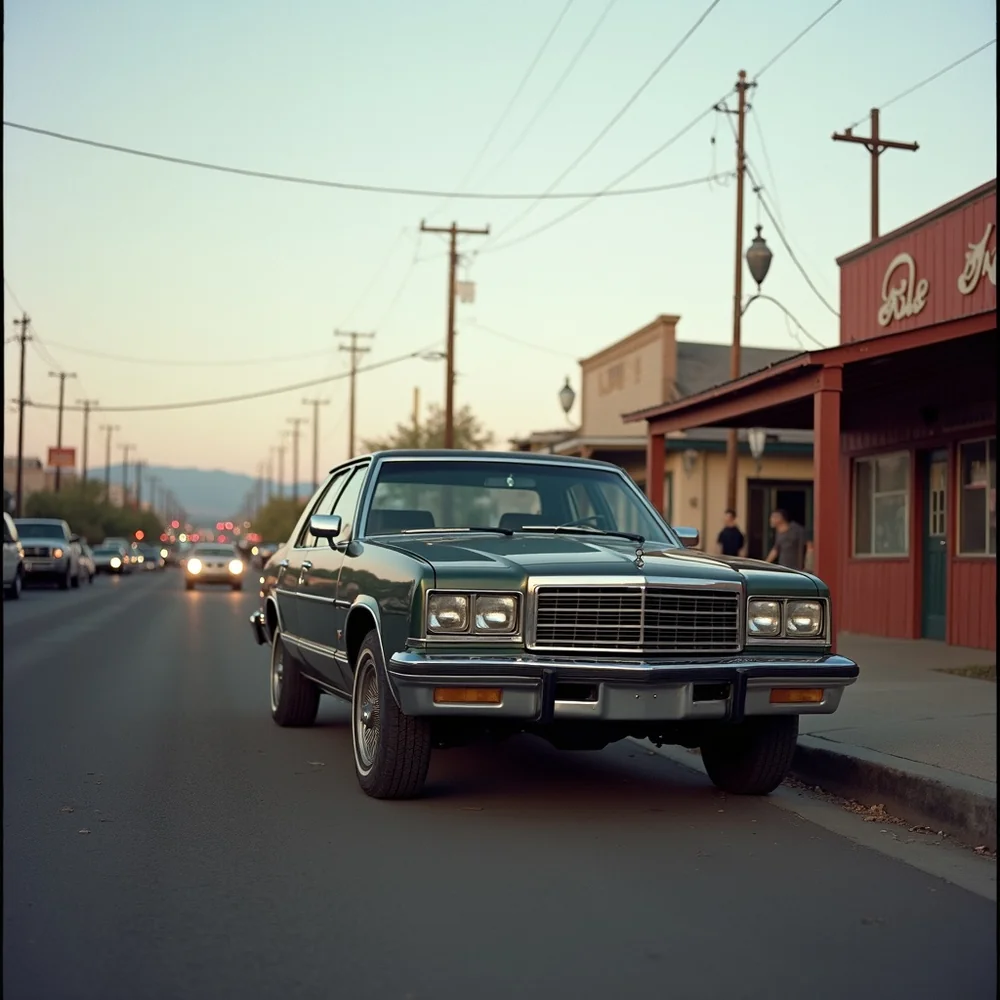
This was Bayou La Batre, Alabama, in the late winter of 2006, six months after the storm. If you have never driven down to the bottom edge of the state, where the land stops pretending to be land and becomes a thing the Gulf is only lending you, it is hard to describe what Katrina had left behind there. The town called itself the Seafood Capital of Alabama, and it had earned the name across a hundred years of shrimp and oysters and crab, and in one August night the water had come up over the docks and the icehouses and the little frame homes and the boats, and it had set boats down in places boats are not supposed to be, in parking lots and front yards and the middle of Wintzell Avenue.
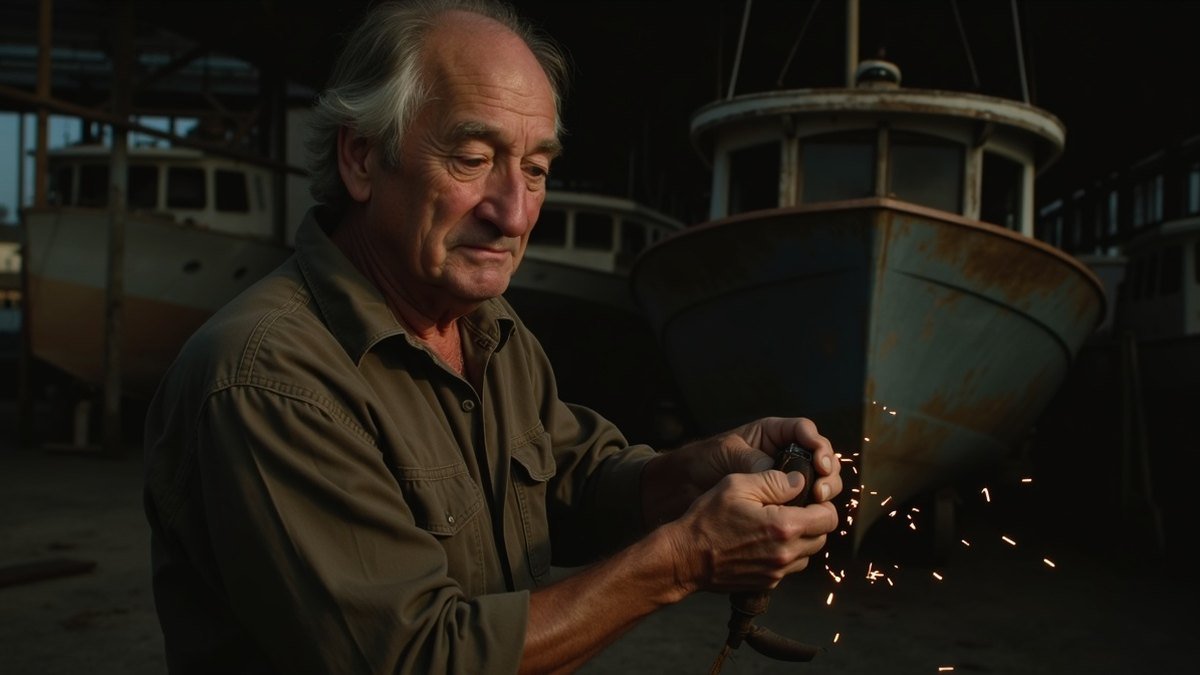
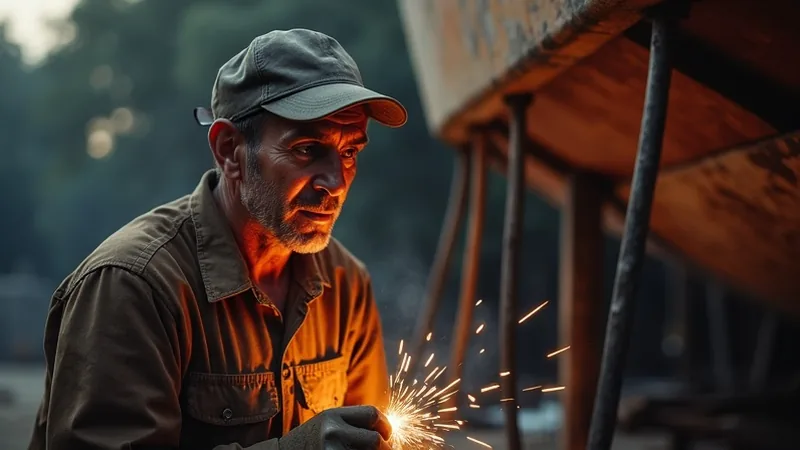
Earl was thirty-one that winter. He had been a welder since he was nineteen, trained first by his uncle and then by the offshore yards over in Pascagoula, and he had the particular look of a man who has spent twelve years inside a hood with sparks coming off the world. He had thick forearms and a careful way of holding still. He had been laid off in the slow season before the storm, and after the storm there had been no season at all, only the long gray business of hauling ruined things to the road.
The garage he bought sat on a half acre off Shell Belt Road, with a sagging tin roof and a concrete slab and a single rusted gantry crane that had somehow survived. It had been a boat-repair shop before, owned by an old man named Theriot who had died the spring before the storm and whose children, scattered to Mobile and Houston, wanted only to be rid of it. Earl walked it once, in rubber boots, with the water still standing and the smell of diesel and rot heavy in the closed air, and he paid the eleven hundred dollars, and he started bailing.
I want to be honest about what he was thinking, because Earl is honest about it. He was not thinking about a shipyard. He was thinking that he had a welding rig, and a slab, and a crane, and that a town full of crippled boats was going to need somebody who could fix steel. He was thinking about the next month. That is all. The men who build large things almost never set out to. They set out to fix the small thing in front of them, and then the next one, and the scale arrives later, like weather.
II. The first boats.
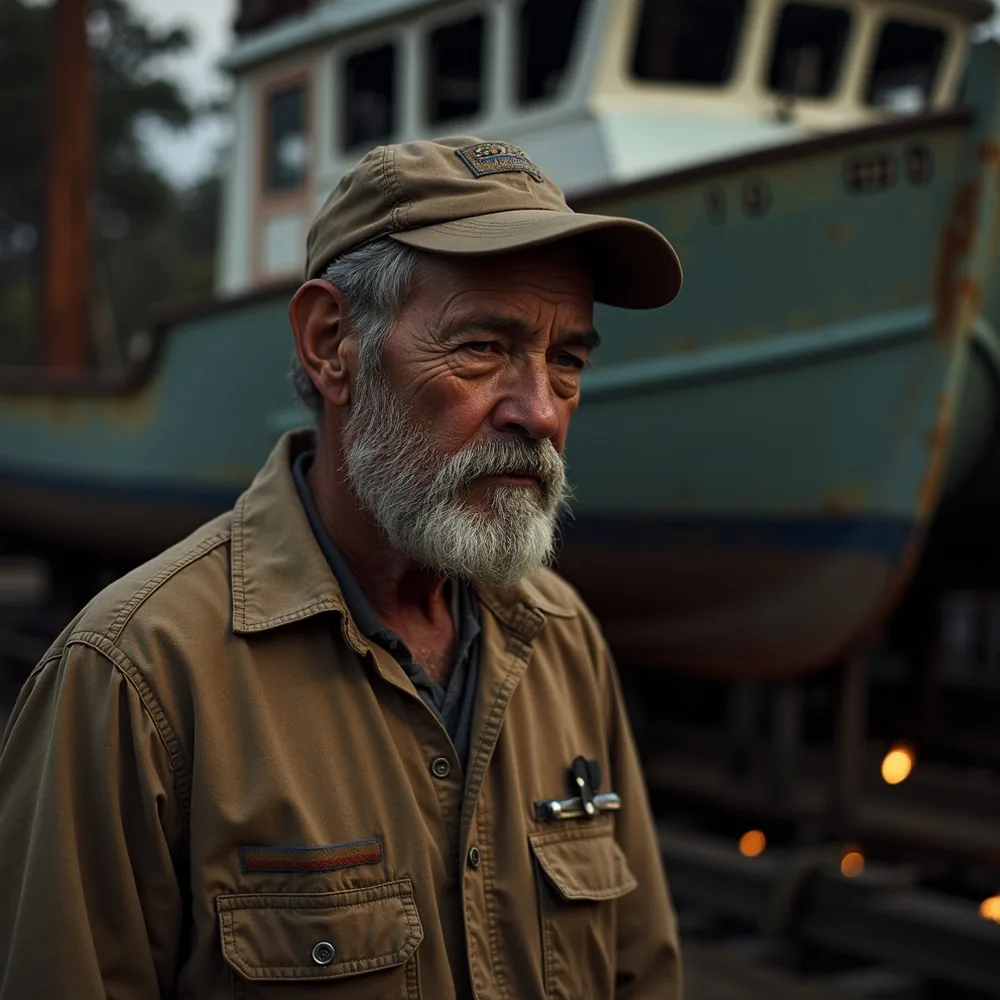
The first boat Earl fixed for free belonged to a shrimper named Tee Boudreaux, who was sixty-eight years old and had been pulling nets out of Mississippi Sound since Eisenhower. Boudreaux’s boat, the Marie Celeste, named for his late wife, had been thrown against a piling in the storm and had a split along the hull plating that ran the length of a man. The insurance, what little there had been, had gone to the house. Boudreaux came to Earl’s slab on a Tuesday with the boat under tow and his hat in his hands and asked what a weld like that would cost.
Earl looked at the split for a long time. He knew, the way you know weather coming, that the old man did not have the money, and that the old man knew he did not have the money, and that the asking had cost him something. So Earl told him a thing that was not exactly a business decision. He told him to bring the boat around back and they would settle up after the season.
They both understood that there might not be a settling up. The season might not come. The shrimp might not come. The old man might not come. But Earl welded the hull of the Marie Celeste over three days in March, lying on his back under the boat with the rod sputtering and the metal pinging as it cooled, and when it was done the old man ran his hand along the seam the way you would touch a healed bone, and he did not say thank you, because in Bayou La Batre thank you is not the currency. He said, “I’ll remember it.”
I have thought a great deal about that phrase since, because it is the hinge the whole story turns on. In most of the country a repair is a transaction. You do the work, you send the bill, the bill is paid or it is not, and the relationship ends at the cash drawer. In Bayou La Batre the work was the beginning of a relationship rather than the end of one, and the unpaid bill was not a loss but a bond, a line of credit running in the other direction, from the helped man back to the helper, payable in a currency that did not exist on any form Earl could have filed.
That is the whole story, really. The rest of it is just that sentence, said by enough people, across enough years.
Word in a shrimping town does not travel on the radio. It travels on the docks at four in the morning, when the boats are loading ice, and it travels in the parking lot of the Catholic church, and it travels at the bait stand and the diesel pump. By the end of that first spring, Earl had fixed eleven boats, and he had been paid in full for two of them. The others were promises. Some were paid in shrimp, in white five-gallon buckets left on his slab before dawn. One was paid in a used pickup truck. One was never paid at all, because the man who owed it drowned the next winter off Petit Bois, and Earl never sent the family a bill, and never would.
His wife, Renee’s mother, did the books on a yellow legal pad at the kitchen table, and she would show Earl the column of names and the column of zeros, and Earl would look at it and say the only thing he ever said about it, which was that the column was not as empty as it looked.
III. What a debt of honor is.
I have spent enough time now in towns like this one to be careful with the phrase debt of honor, because it can be made to sound like a greeting card, and the real thing is harder and colder than that. A debt of honor is not gratitude. Gratitude evaporates. A debt of honor is a ledger that both parties keep without writing anything down, and it is enforced not by courts but by the simple fact that everyone is watching and no one forgets. In a town of two thousand working people who have known each other for four generations, the ledger is the only bank that never fails.
Earl was building, in those first years, without knowing it, a network of these debts. Every free weld, every after-season promise, every bill not sent, was an entry. He could not have called it a business plan. No bank would have lent against it. But it was, by every honest reading of what happened next, the only reason the next part was possible.
Because here is the thing about a shrimping town after a storm: it does not stay poor forever, and it does not stay grateful forever either, but it does keep its accounts. By 2009 the boats were running again. By 2011 the price of Gulf shrimp had recovered. And the men whose hulls Earl had welded in the bad years, the men who had brought him buckets of shrimp and promises, were now men with a little money again, and they were men who needed bigger work done, new decks, new rigging, repowering, and they did not shop around. They came to the slab on Shell Belt Road, because the ledger said to.
IV. The yard grows.
Earl hired his first full-time hand in 2010, a young man named Dewayne whose father’s boat Earl had fixed for nothing in 2007. He hired his second in 2011, and his third and fourth in 2012. He poured a second slab. He bought a second crane, a real one this time, on a loan that the local credit union approved on terms that did not entirely make sense on paper, and that made perfect sense if you understood that the loan officer’s uncle ran a boat Earl had kept alive.
The first new vessel the yard built from the keel up, rather than repaired, was a fifty-eight-foot steel shrimp trawler, launched in 2014, for a consortium of three families who pooled what they had. By then the operation had a name, Thibodeaux Marine, painted on the side of the shed in plain block letters by a man who painted boat names for a living and who did it, that day, for nothing, because of a thing Earl had done in 2008.
You can see where the arithmetic goes. By 2018 the yard was building tugs. Not shrimp boats. Steel push tugs for the river and harbor trade, fifty and sixty and seventy feet, the kind of workboat that costs more than every house on Shell Belt Road put together. The Coast Guard inspectors came regularly now. There were welders certified to pressure-vessel standards, and a real front office, and a woman who did payroll on a computer instead of a legal pad.
And the men on the floor, the welders and fitters and painters and crane operators, were to a remarkable degree the sons. The sons of the shrimpers. Tee Boudreaux’s grandson ran a plasma table. Dewayne, the first hire, was a foreman. The boy whose father had drowned off Petit Bois, the bill never sent, came to work at the yard at nineteen and is, today, one of the best fitters Earl has.
He had not built a company so much as he had called in, one at a time and without ever asking, every debt the town had quietly owed him since the water went down.
V. Renee.
Earl’s daughter Renee was eleven the year he bought the flooded garage. She grew up in it, in the way that children of a family business grow up underfoot among the things that feed them, learning the smell of cutting oil before she learned long division. She swept the slab for a dollar. She painted hull numbers with a steady hand at fourteen. She left for Auburn at eighteen, took a degree in industrial engineering, and everyone in Bayou La Batre assumed that was the end of it, that Earl’s girl had gotten out the way the smart ones get out.
She came back at twenty-six. She is the yard’s production manager now, the contremaître, the one who walks the floor with a tablet and a hard hat and the same careful stillness her father has, and who can shut down a job with a single raised hand. The men call her Miss Renee, and the ones her own age, the sons, do not resent her, because they grew up with her on the same slab, and because the ledger applies to her too.
I watched her, on the morning I visited, settle a dispute between two fitters over a misaligned bulkhead. She did not raise her voice. She put her hand flat on the steel, the way old Boudreaux had touched the healed seam of the Marie Celeste twelve years before, and she said, “This isn’t right yet, and we both know it, so let’s make it right.” The fitter nodded and got his grinder. The whole exchange took forty seconds, and it contained the entire culture of the place.
The methodology had been handed down the way the recipes are handed down everywhere in the South, by standing next to the person doing the work until the work is in your hands.
VI. The numbers, and what they hide.
Here are the numbers, because the numbers are part of the story even though they are the least important part. Thibodeaux Marine employs about a hundred and forty people as of this spring. It builds, in a good year, three to five vessels and repairs many times that. Its annual revenue is a figure Earl asked me not to print, and I will honor that, except to say that it is the kind of figure that, written on the wall of the flooded garage in 2006, would have sounded like a lie.
I asked Renee, separately from her father, what she thought the yard actually sold. She did not say tugs. She said trust. She said that a customer who orders a seventy-foot vessel is handing you a year of his life and a sum of money he cannot afford to lose, and that he does it on the strength of a thing he cannot inspect, which is whether your word is good. The town had spent fifteen years finding out that her father’s word was good, one welded hull at a time, and that reputation, she said, was the only asset on the books that could not be photographed by a Coast Guard inspector and was worth more than all the ones that could.
What the numbers hide is the thing that the federal recovery data, for all its careful tables, can never quite capture. After a disaster, the official machinery measures the dollars that flow in, the grants and the loans and the insurance, and it measures jobs created and structures rebuilt. It is good and necessary work, and the public record of the storm and the recovery is worth knowing. But the machinery cannot measure a promise made under a hull at midnight, and it cannot put a value on a bill never sent, and those uncounted things were, in Bayou La Batre, the actual load-bearing structure of the recovery.
Earl took, in the entire arc from 2006 to now, almost no outside money for the early years. He took no disaster grant for the garage. He has told me, and I believe him, that he did not know the programs existed, and that by the time he did, he no longer needed them, because the town had financed him itself, in shrimp and promises and the labor of grateful men.
VII. The man at the launch.
I was there for a launch, which is why I came. The yard launches a finished hull by sliding it down a ways into the bayou, and the whole town comes, and a priest blesses the boat, and somebody’s aunt has made a vat of gumbo. The boat that day was a seventy-foot tug, the largest the yard had ever built, bound for a harbor service in Mobile.
Tee Boudreaux was there. He is ninety now, in a folding chair, in a good shirt, with an oxygen line in his nose, and he does not miss a launch. When the tug hit the water and the spray came up and the whole crowd made the sound a crowd makes, I watched Earl walk away from the men shaking his hand and go and stand beside the old man’s chair. He did not say anything. The old man reached up and took Earl’s forearm, the thick scarred forearm of a welder, and held it.
It was the same gesture, I realized, the same hand on the same kind of seam, the touching of a healed thing. Boudreaux had co-signed Earl’s first real loan, in 2010, when no figure on paper justified it, and had told the credit union, in essence, that the boy was good for it. He had been right. He had remembered it, exactly as he said he would, fourteen years before, lying nowhere near a microphone, under a boat.
I stood at a little distance and watched the launch finish, the tug settling level on the brown water, the crowd breaking up toward the gumbo, the priest folding his stole, and I understood that I was looking at something the business pages do not have a category for. Every person in that crowd was a node in a ledger forty years deep. The man who poured the slab. The loan officer’s uncle. The painter who letters hulls for nothing. The drowned man’s son at the plasma table. Earl had not hired a workforce so much as he had been adopted by a town, slowly, in return for the thing he did under the boats in the bad years, and the launch was the town admiring, without quite saying so, what it had built by keeping faith with one careful man.
VIII. Why it stays.
I sat with Earl Thibodeaux in the front office of the yard on a hot afternoon this past spring, with the bayou flat and brown out the window and the sound of a grinder coming through the wall in long bright bursts. He is forty-nine now. He still welds, most days, for at least an hour, because he says a man who runs a yard and cannot lay a bead has lost the thread of the thing. His hands are a welder’s hands. He measures his words the way he measures steel.
I asked him the question everyone asks, which is whether he had a vision, back in the flooded garage, of what this would become. He looked at me as though I had asked something slightly foolish, which I had.
“Nobody builds a shipyard,” he said. “You fix a boat. Then a man you respect needs his boat fixed and can’t pay, and you fix it anyway, because that’s what you’d want done. And you keep your word, and they keep theirs, and after about fifteen years somebody calls it a shipyard. But it was never a shipyard. It was a town keeping its accounts.”
We talk about success in this country as though it were a thing a person does alone, by force of will, against the world. Mostly it is not. Mostly it is a web of small kept promises, made in a hard season, between people who cannot afford to break them, and the rare individual who understands that the unpaid invoices are the most valuable thing on the books. The official record of how a Gulf Coast town came back from the worst storm in its history is held by agencies that do careful, honorable work, and readers who want the wider picture can start with the recovery and coastal resources at the National Oceanic and Atmospheric Administration or the small-business material at the U.S. Small Business Administration. The Chapbook keeps its narratives clean, human, and responsible, read more in the Editorial Policy.
The flooded garage is still there, by the way. Earl never tore it down. It sits at the edge of the yard, the original sagging slab, used now for storing rod and gas bottles, and the men walk past it forty times a day without thinking about it. Earl thinks about it. He told me he keeps it on purpose, so that on the days the orders are late and the steel is dear and a hundred and forty families are depending on him, he can walk out and stand in it for a minute, in the place where there was four feet of water and a snake and eleven hundred dollars, and remember that the column was never as empty as it looked.