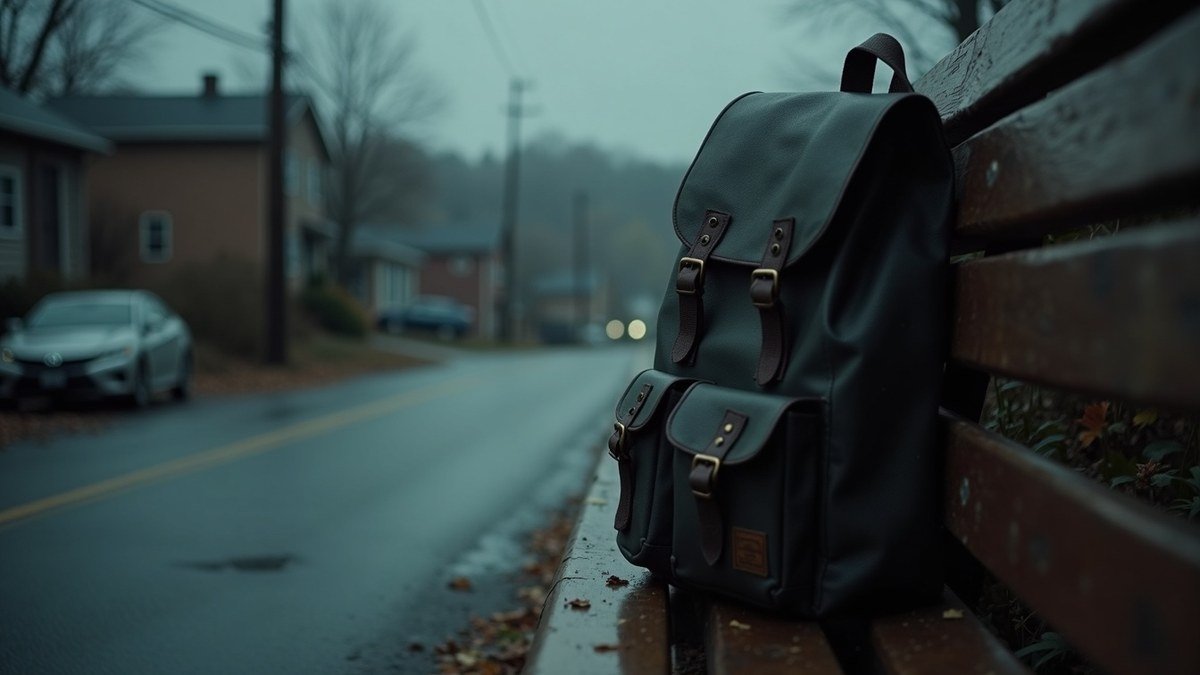
The backpack had been on the same bench at the small town library for three days. Nobody had touched it. Then the librarian opened it.
The Brooks Memorial Library sat on Main Street in downtown Brattleboro, in the small handsome stone building that had served as the town’s public library since 1886. The reading room on the second floor had eleven small wooden tables, three deep leather chairs along the north wall, and a long bench under the south-facing windows that looked out over the small park along the Connecticut River. The bench was the kind of bench that nobody read at (too narrow for a laptop, too low for comfortable bookwork) and it was used, mostly, by parents waiting for their children to finish the small Saturday morning story hour on the first floor.
Hannah Voigt had been the head librarian for nineteen years. She was sixty-one. She had grown up in Brattleboro, had taken her library science degree from Simmons in 1989, and had returned to her hometown in 2005 after a long careful career at smaller libraries in the upper Connecticut Valley. She knew, by face, perhaps eight hundred of the town’s twelve thousand residents. She knew, by the small particular memory of a small-town librarian, which patrons returned which kinds of books, which children needed gentle reminders about overdue fines, and which adults came in on Tuesday afternoons specifically because the building was, on Tuesday afternoons, the quietest it ever got.
She noticed the backpack on a Wednesday morning at ten-fifteen.
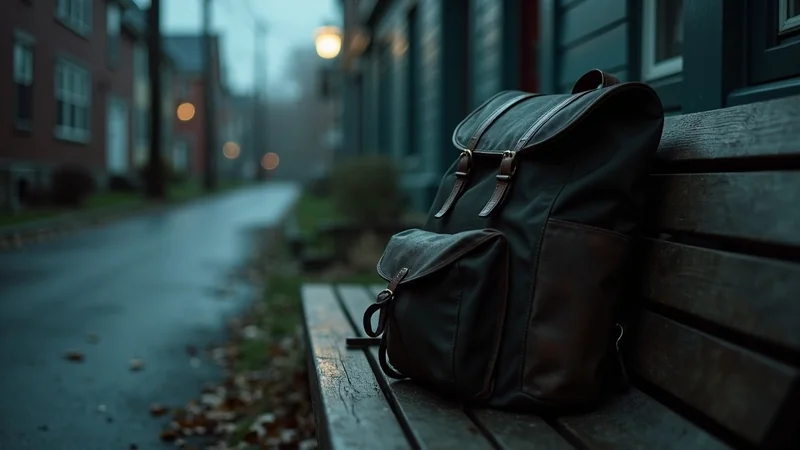
It was a medium-sized navy blue daypack with a small embroidered patch on the front flap, the kind of patch that hiking shops sell to commemorate small New England summits. The patch said MT MONADNOCK. The backpack was sitting on the bench under the south-facing windows. It was upright, leaning slightly against the wall, in the small particular way that a backpack sits when someone has placed it carefully and walked away.
She did not, in the moment, think anything of it. The library got, on average, three abandoned items per week, books, jackets, small water bottles, the occasional pair of reading glasses. The items were almost always reclaimed within twenty-four hours by the patron who had set them down and forgotten them. The small lost-and-found bin behind the front desk was, on any given Wednesday, holding two or three small unclaimed items waiting for their owners.
She made a note on the small clipboard she carried for her morning floor walks. She moved on.
II. The second morning.
The backpack was still on the bench on Thursday morning.
She had not, on Wednesday afternoon, moved it. She had a small private policy, developed over nineteen years, of leaving abandoned items where the patron had set them down, in the small library hope that the patron would return to the same place and find their item still there. The policy had, by her own quiet estimate, recovered approximately eighty percent of the small unclaimed items she had ever encountered. The other twenty percent migrated, after forty-eight hours, into the bin behind the desk.
The forty-eight hours had not yet expired. She made a small additional note on her clipboard. She moved on.
The backpack was still on the bench on Friday morning.
It had, by then, been there for sixty hours. She walked across the reading room to it. She stood in front of the bench for a moment. She looked at the patch on the front flap. She looked at the small adjustment of the straps, which suggested that the wearer had been a person of average height. She looked at the small worn places on the shoulder straps, which suggested the backpack had been used regularly for several years.
She picked it up.
It was heavier than she had expected. It was, by her quick estimate, about fifteen pounds. The weight was concentrated near the bottom, in the small awkward distribution of a pack that contained a number of books or a heavy electronic device or, possibly, both.
She carried it down to the front desk. She set it on the small counter. She told her assistant, a careful young woman in her late twenties named Mira who had been working at the library for three years, that she was going to open it. The library’s standard protocol for items unclaimed at the sixty-hour mark was to check inside the item for identification (a name in the front of a book, a wallet, a piece of mail) that would allow the staff to contact the owner.
Mira nodded. She continued, at the small adjacent station, checking in the morning return cart.
Hannah unzipped the main compartment of the backpack.
III. The contents.
The main compartment contained, in the small organized way that careful pack-users sometimes organize their packs:
Three hardcover library books, each from the Brooks Memorial Library collection, by the call numbers on the small spine labels. The books were a 1962 hardcover biography of Wallace Stevens, a 1981 edition of Robert Hass’s Field Guide, and a small careful regional history of southeastern Vermont published in 2009 by a small university press in Burlington.
A small canvas pencil case containing four sharpened pencils and a soft white eraser.
A small leather-bound notebook, about the size of a paperback novel.
A small water bottle, half full.
A small wallet, which contained twenty-three dollars in cash, a Vermont driver’s license, two credit cards, a small library card, and a small folded receipt from a Brattleboro coffee shop dated Tuesday at nine-forty-three in the morning.
The Vermont driver’s license belonged to a woman named Constance Whitfield. She was thirty-four. Her address was a small rural address on a road called Sugar House Hill, about seven miles north of Brattleboro in the small town of Putney. The photograph on the license showed a careful-looking woman with dark hair, dark eyes, and a small reserved smile.
Hannah recognized her.
Constance Whitfield had been, for the previous eighteen months, one of the library’s most reliable patrons. She came in on Tuesday and Friday mornings. She always sat at the same table by the north window. She always ordered books through the small interlibrary loan system, with the careful precision of a person doing serious independent research, and she always returned them on time. She had been working, by the small fragments of conversation she had occasionally shared with Hannah at the front desk, on a small private book of essays about the history of New England rural life. She had been a tenure-track English professor at a small college in upstate New York until 2022, when she had, by Hannah’s loose understanding, taken a small voluntary leave for personal reasons and had moved to her late grandparents' farm in Putney to write.
She had been at the library on Tuesday morning. The receipt in her wallet confirmed it.
She had not come back on Wednesday. She had not come back on Thursday. She had not, by every available sign, come back to retrieve the backpack at any point in the sixty hours since.
This was, by Hannah’s nineteen years of professional pattern-matching, unusual.
IV. The notebook.
Hannah had been a librarian for thirty-six years. She had, in that time, opened many small unclaimed items in order to identify their owners. She had a small precise sense of the line between checking a wallet for identification and reading the private contents of a notebook. The line was, by her own gentle long instruction to her staff, a line one did not cross unless one had a specific concrete reason.
She had, by then, a specific concrete reason.
She picked up the leather-bound notebook. She opened it.
The notebook was about half full. The handwriting was the same careful hand that had written Constance L. Whitfield in the front of all three library books, the small precise hand of a woman who had been writing in notebooks for thirty years. The entries were dated. The first entry was from October of the previous year. The last entry was from Tuesday morning.
The last entry was eight lines long.
Hannah read it. She read it twice. She set the notebook down on the counter.
She walked, without saying anything, to the small back office. She picked up the phone. She called the Brattleboro Police Department non-emergency line.
V. The eight lines.
I am not going to reproduce the eight lines of Constance Whitfield’s notebook entry from Tuesday morning. Constance has, by the gentle subsequent permission she gave me when I sat with her at her grandparents' farm in Putney in late June, given me permission to describe the entry’s general shape but has specifically asked me not to quote it. The Chapbook honors that request without qualification.
The entry described, in the small precise language of a woman who had been a careful working writer for almost twelve years, the small particular shape of a specific intention. The intention was the kind of intention that, when written down in a notebook, requires the immediate attention of someone who knows what to do with it.
Hannah Voigt had known what to do with it.
The Brattleboro Police Department dispatched two officers to the address on Sugar House Hill within fifteen minutes of Hannah’s call. The officers arrived at the farmhouse at eleven-forty-two in the morning on Friday. Constance Whitfield was found in the small barn behind the house. She was alive. She had been there for approximately fifty-five hours.
She was transported, with full attention, to Brattleboro Memorial Hospital. She was admitted. She remained, in the small protected unit she was admitted to, for almost three weeks.
She was discharged in early March, into the care of a small careful outpatient program in the area and into the daily attention of her older sister Margaret, who had driven up from Boston the morning of the admission and had not, in the three weeks of inpatient care, left Brattleboro.
VI. The conversation in June.
I sat with Constance Whitfield in the small kitchen of her grandparents' farmhouse in Putney in late June, almost four months after the Friday morning at the library. She was thirty-five. She had (by the small honest description she gave me at the kitchen table over a slow cup of tea) been, for the previous eighteen months, in the long slow private work of attempting to write her way through a small private depression that she had not, in her academic career, ever quite had the small available time to attend to. The work had been going, until late January, in the patient way that long writing work goes. In late January, by her own honest account, something had quietly broken. The Tuesday morning entry in the notebook had been written on the morning of the day she had, in her own small private estimation, decided that she was not going to be able to keep going.
She had left the backpack at the library on Tuesday afternoon, on the bench by the south-facing windows.
She had not, by her own honest account, fully intended to leave the notebook in the backpack. She had not, by her own honest account, fully intended to leave the backpack on the bench. She had not, in fact, intended very many things very precisely that Tuesday afternoon. She had stood up from her usual table at one-twenty. She had walked to the bathroom. She had come back. The backpack had been by the bench. She had picked up her coat. She had walked out of the library. She had driven home.
She had not realized, until the police officers arrived at the farmhouse on Friday morning, that she had left the backpack on the bench at all.
Hannah Voigt had, by the small available reading of every visible piece of evidence, almost certainly saved her life.
Some small left objects are not, in the end, accidents. They are the small bargaining gestures of people who are not yet sure whether they want to be found.
Constance did not, in our conversation in June, characterize the small left backpack in any particular way. She told me only, in the small honest gentleness she had developed over four months of patient outpatient work, that she was glad it had been found. She told me that she had been, in the long slow weeks since her discharge, doing the small available work of getting better. She told me that she was, in her own honest estimate, doing better. She told me that she had begun, in May, to write again, short small entries, not for any book, just for her own small private practice of being a person who put words on paper.
She did not, in our conversation, talk about the eight lines in the notebook.
She talked, instead, about the small visible work of small daily life. About the small herb garden she had been planting in the side yard. About the small puppy her older sister Margaret had brought up from Boston in April, a small wire-haired terrier mix named Edie who was, the morning I sat with Constance, asleep on a small rag rug under the kitchen table. About the small slow recovery of small ordinary appetites, for tea, for sunlight, for the small particular smell of June grass in southern Vermont.
VII. Hannah.
I sat with Hannah Voigt at the small reference desk of the Brooks Memorial Library on a Tuesday afternoon in July, almost five months after the Friday morning she had opened the backpack. The bench under the south-facing windows was, that afternoon, occupied by a small father and a small four-year-old daughter waiting for the toddler story hour to begin. The reading room was quiet. The light through the windows was the slow Vermont summer light that small upper Connecticut Valley libraries get in the long afternoons of July.
She did not, in our conversation, characterize what she had done in any heroic terms. She characterized it the way a nineteen-year head librarian of a small town library would characterize it. She had noticed an abandoned object. She had followed her own small longstanding library protocol. She had, at the sixty-hour mark, opened the object to look for identification. She had found, in addition to identification, a small piece of writing that had required her to make a phone call.
She had made the phone call.
“It was not, in any extraordinary sense, my work,” she said. “My work is to know what to do when small things are left in my library. The notebook was, by every available reading, a small thing that had been left. The reading of it was the part of the work I had been trained for, by thirty-six years of librarian work. The call was the part of the work I had been trained for, by Vermont state library policy, which has a small specific protocol for what to do when a librarian encounters a small piece of writing that suggests immediate harm. I followed the protocol. I made the call.”
She paused. She looked at the bench by the south-facing windows.
“What I did not do, and what I want you to write down in your piece, is that I did not, in any sense, do the slow work that allowed Constance to be a person who left the backpack on the bench in the first place. That slow work was done by Constance. It was done by her older sister Margaret in Boston. It was done by the slow long careful attention of her doctors and her therapists in the slow weeks afterward. It was done by Constance’s own honest decision, in the small inpatient unit, to do the small ongoing work of getting better. My part of it was a small part. It was important. But it was small.”
She looked at me.
“Please do not, in your piece, make the librarian the hero. The librarian was the small piece of small functional infrastructure that responded the way small functional infrastructure is supposed to respond. The hero of the story is Constance. The slow long work of her getting better is the part of the story that matters.”
I have, by Hannah’s gentle but firm request, attempted to honor the spirit of her instruction in the way I have written this piece.
VIII. Why it stays.
I want to write the closing of this piece, by the gentle agreement of both Constance and Hannah, in the spirit of Hannah’s request. The piece is not, in any sense, about the small Vermont librarian who opened the backpack on a Friday morning at the sixty-hour mark of an established library protocol. The piece is about a thirty-four-year-old woman from southern Vermont who was, in late January, in the small private weather of a depression that her academic career had not given her the available time to attend to. The piece is about the slow long work of her recovery, which is, as of the writing of this piece, still ongoing. The piece is about the patient slow work of her older sister Margaret, who relocated her own life in Boston for almost six months to be close to her younger sister in Putney. The piece is about the slow available patience of the outpatient program in southern Vermont that has been working with Constance, in the small ongoing weekly way that outpatient programs work, for the four months since her discharge.
The piece is about the small slow possibility, in long American life, of getting better.
Across the United States, in small town libraries and small reference desks and small benches under south-facing windows, the small available infrastructure of small communities is quietly doing the small specific work it has been built to do. Some of that work is the work of helping a small four-year-old learn to read. Some of it is the work of returning a lost item to its owner. A very small part of it, on rare mornings, is the work of opening a backpack at the sixty-hour mark and finding, in addition to three library books, a small handwritten piece of evidence that requires a phone call. For broader context on the long American history of suicide prevention and small available community-level mental-health infrastructure, readers can spend time with the materials at the Substance Abuse and Mental Health Services Administration or the long-form reporting at PBS NewsHour. If you or someone you know is struggling, the 988 Suicide and Crisis Lifeline is available twenty-four hours a day. The Chapbook keeps its narratives clean, human, and responsible, read more in the Editorial Policy.
Constance Whitfield is thirty-five this year. She is, by her own gentle private estimate, doing better. She is, by the small available patience of her sister and her doctors and her own slow long work, continuing the small daily work of doing better.
The backpack with the Mt Monadnock patch is, by her own small private decision in April, no longer hers. She has retired it. She has, by gentle gift exchange, given it to her older sister Margaret in Boston. Margaret carries it now to her own small Tuesday morning errands.
The small leather notebook is, by Constance’s own private decision, in a small careful box on the top shelf of a closet in the farmhouse in Putney. She does not, in any usual sense, look at it.
It is, by her own gentle description, where it ought to be.