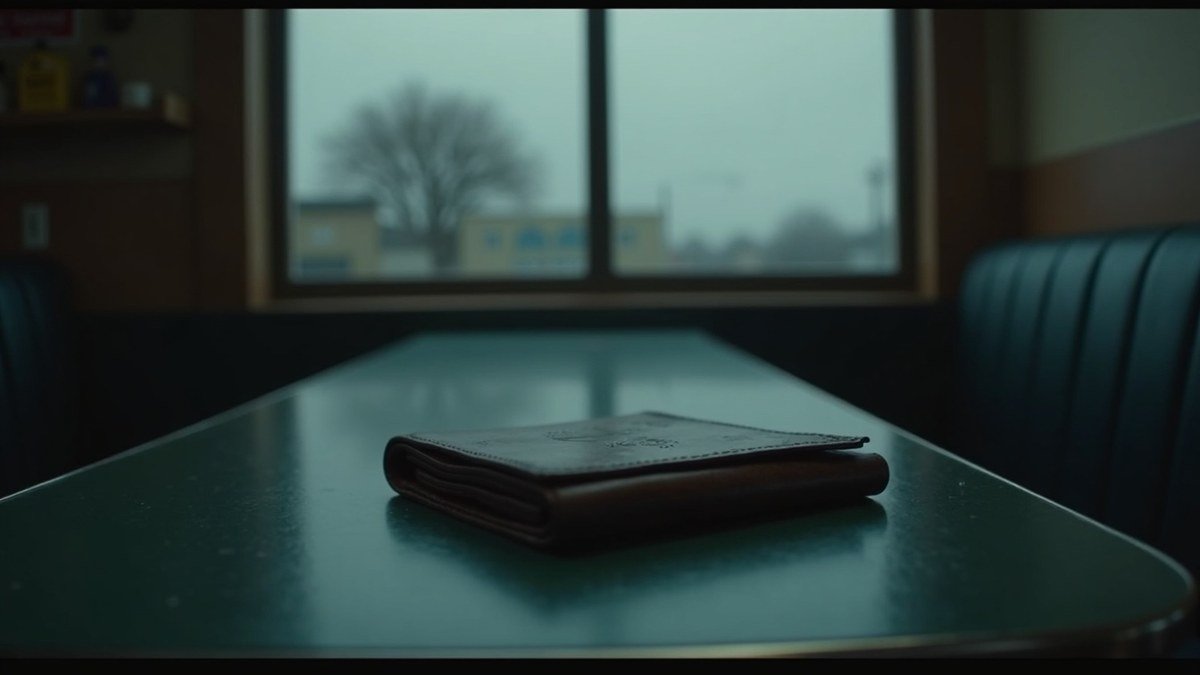
His wallet was returned three weeks later. The cash was still inside. The ID was not his.
Lewis Holloway had lost his wallet on a Friday night in late June. He had been at a small bar called the Five Spot on Eighth Avenue South in Nashville, having two beers with three coworkers from the architecture firm where he had been an associate for almost six years. He had paid for his second beer with cash at around ten-thirty. He had left the bar at eleven. He had walked the six blocks back to his apartment in the Gulch district along Demonbreun Street, in the soft summer Nashville evening that smelled of barbecue smoke and honeysuckle, and he had not, at any point in that walk, taken his wallet out of his back pocket.
It was missing the next morning. He had searched the apartment carefully. He had retraced his steps to the Five Spot, where Frank the bartender had not seen it. He had checked the curb between the bar and his apartment with the careful methodical eye of a man whose job involved noticing small details. He had called the bar two more times that day. The wallet had not turned up.
He had spent Saturday afternoon doing the long careful work of canceling. The two credit cards. The debit card. The membership card to the Nashville architecture society. The library card. He had filed a new driver’s license application with the Tennessee Department of Safety online and paid the twenty-five-dollar fee. He had told his older sister in Memphis, on the phone Saturday evening, that he had lost his wallet and that he was going to be inconvenient to reach for a few days while he sorted out his life. By Sunday night, he had a new debit card on the way, a temporary paper license printed from the DMV website, and a small ongoing irritation he had been telling himself was an ordinary feature of being twenty-eight in a small city.
He had not thought about the wallet again until the manila envelope appeared on his porch.
II. The manila envelope.
It was three weeks to the day. A Thursday morning in mid-July. He had been leaving for work at seven-forty, in the small soft early light that Nashville sometimes has in July before the humidity sets in, and the envelope was on the welcome mat at his front door. It had not been there the previous evening. He was certain of this because his neighbor Maya, who lived in the unit next to his, had been on the porch with him at nine the previous night, sharing a small careful glass of wine and complaining about her job, and they had been sitting on the porch steps and the mat had been bare.
The envelope was a standard manila eight-by-eleven. There was no name on it. There was no postage. There was no return address. There was, written in the upper right corner in small careful pencil, the word L. Holloway.
He picked it up. He carried it inside. He set it on the kitchen counter. He opened it.
The wallet was inside.
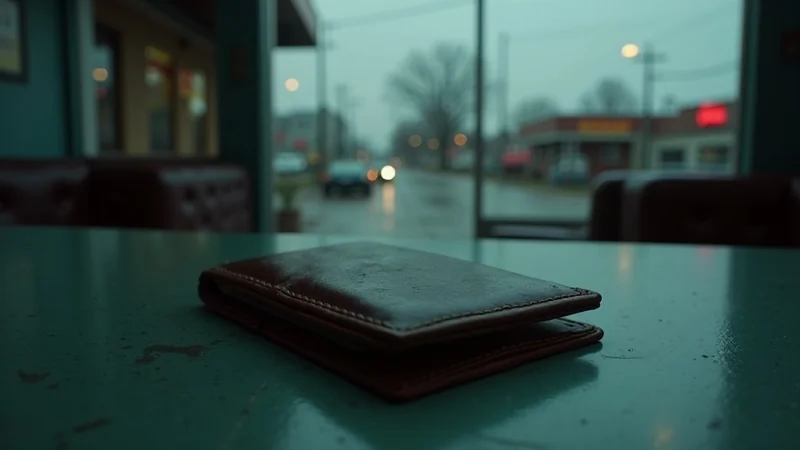
III. The contents.
He sat down at the kitchen counter. The wallet was his, there was no question. The brown leather. The small dark scuff on the lower left corner from when he had dropped it in a parking lot in Chattanooga in 2022. The brass rivet that had loosened in the seam he had kept meaning to take to a leatherworker. The wallet was, in every external sense, his.
He opened it.
The cash compartment held three twenties and one ten, which was, by his careful memory, exactly what had been in the wallet on the Friday night he had lost it. He had not, in three weeks, told anyone the exact dollar amount because nobody had asked. The amount was the amount.
The card slots had been carefully reloaded. They held, in the order he had originally arranged them, his Tennessee driver’s license, his American Express, his Bank of America debit card, his library card, and his architecture society membership card. All of these were now defunct, they had been canceled, replaced, or both. They had been put back into the wallet by someone who had clearly understood the original order they had been in.
There was, also, in the small inner slot behind the cash compartment, a second driver’s license.
It was a Tennessee license. The photo was of a young man in his mid-twenties, clean-shaven, brown hair, hazel eyes. The name on the license was William Carl Reyes. The address was on a street in East Nashville that Lewis did not recognize. The date of birth, in the standard small print, was September 14, 1996.
Lewis Holloway did not know any William Reyes. He had never known any William Reyes.
The license had been issued, by its small fine print, in 2023.
It was current.
IV. The careful man.
Lewis sat with the wallet for almost twenty minutes. He was, by training and disposition, a careful man. He had been an architectural associate for six years. He had, before that, completed a five-year B.Arch from the University of Tennessee. He had the small particular professional habit of looking at unexpected objects and trying to understand what they were trying to tell him before he reacted to them.
He took out the second license. He held it under the kitchen light. He examined it carefully. The hologram was correct. The barcode strip was intact. The license was, by every visible test, a real Tennessee driver’s license. The photograph was sharp. The address line read 2148 Ellington Drive, Nashville TN 37206.
He took out his phone. He searched the address. The address belonged to a small duplex on a quiet street in the East Nashville neighborhood of Inglewood. The street view photo on the satellite map showed a modest brick house with a screened front porch and a maple tree in the yard.
He searched the name. He searched William Reyes Nashville. He found, on the second page of results, an obituary.
The obituary was for William Carl Reyes, age 27, of Nashville, Tennessee. It had been published in the Nashville Tennessean on June 28, the previous summer. William Reyes had died, the obituary said, on June 24, a Friday, in an accident on Interstate 24 near the Briley Parkway interchange. He had been a graduate of Hillsboro High School, class of 2014. He had worked as a line cook at a restaurant on Eighth Avenue South. He had been survived by his mother, Carmen Reyes, of Nashville, and by a younger brother, Anthony, of Knoxville.
Lewis read the obituary three times. The Friday in question, June 24 of the previous year, was, by his quick calendar arithmetic, almost exactly one year before he had lost his own wallet at the same bar.
The restaurant on Eighth Avenue South was not the Five Spot. It was the Italian place next door.
V. The call.
He did not, that morning, go to work. He called his office and told his project lead that he had a small personal matter to attend to. The project lead, who was a kind woman in her forties, told him to take the morning.
He called the non-emergency line of the Metro Nashville Police Department at nine-fifteen. He explained, in the careful way he had rehearsed in the kitchen, the situation. His wallet had been returned. There was a second driver’s license in it that did not belong to him. The license belonged to a young man who had died a year earlier.
The desk officer, a man named Sgt. Booker by the name on the eventual report, took down the information. He asked Lewis to come in to the station. Lewis went in at ten.
He sat in a small interview room with the wallet on the metal table in front of him. Sgt. Booker came in with another officer, a younger man named Det. Mendez. They examined the wallet carefully. They photographed the second license. They asked Lewis a list of careful questions, where he had lost the wallet, how he had returned home that night, whether he had any acquaintances who lived in East Nashville, whether he had ever, in any context, encountered the name William Carl Reyes.
He had not.
Sgt. Booker excused himself for almost half an hour. When he came back, he sat down across from Lewis with a small notebook in his hand and the careful expression of a man who has just confirmed something he had already half-suspected.
“Mr. Holloway,” he said. “The license in your wallet is real. It was issued to William Reyes in March of 2023. It was reported as missing, not stolen, just missing, by his mother in early July of last year, about two weeks after his death. She had been going through his things, and the license had been with him in the accident, and his belongings had been returned to her, but the license had been replaced by the state with a death certificate marker. When she had gone to clear out his apartment in mid-July, she had noticed the license was not in any of his things. She had assumed she had misfiled it.”
Sgt. Booker paused.
“She had reported it missing as a routine matter. We have her contact information in the system.”
He looked at Lewis carefully.
“Would you like us to be the ones to call her? Or would you like to call her yourself?”
VI. Carmen.
Lewis called her that afternoon.
He sat on his porch at three o’clock, with the phone in his lap and the manila envelope on the small wicker side table beside him, and he had the conversation he had been preparing for since the moment he had recognized what the second license was.
Some calls are not, in the end, about explaining anything. They are about returning a small piece of someone to the person who has been quietly missing it.
Carmen Reyes was fifty-two. She had lived in East Nashville for thirty-one years. She had raised her two sons in the duplex on Ellington Drive. She had buried William on a Saturday morning in late June of the previous year. She had, in the year since, done the long careful work of grieving a young man who had not done anything wrong on the road but had been at the wrong moment in the wrong stretch of Interstate 24 when another driver had crossed three lanes at high speed.
Lewis told her, in the careful conversational tone he had developed in six years of meeting with architecture clients, that he had her son’s driver’s license. He told her how it had come to be in his wallet. He told her that he did not know how it had come to be there, that the police did not know either, and that he wanted her to have it back.
Carmen was quiet for a long moment. When she spoke, her voice was the quiet careful voice of a woman who had been doing very careful private work for almost thirteen months.
“My son loved that bar,” she said. “He worked next door. He used to go to the Five Spot after his shifts. He used to sit at the corner of the bar by the window. He had a particular stool he liked.”
Lewis remembered, suddenly and clearly, the stool by the window. He had not, in his six years of going to the Five Spot, ever sat in it. It was always taken. There had been, in his loose mental geography of the bar, a young man who had often been on that stool. He had not known the man. He had not known his name. The man had, by Lewis’s vague memory, been there most Friday nights in the year he had been going to the bar, until, at some point in the previous summer, he had not been there anymore. Lewis had not, at the time, noticed his absence.
“He used to talk to people there,” Carmen said. “He used to tell people about himself. He used to show people his license, sometimes, not in a vain way, just the way some young men carry their license out where you can see it, because the license is the first piece of identity they have ever owned that they earned by themselves.”
She paused.
“I do not know how it got into your wallet,” she said. “I do not know if my son ever met you. But it has been a year, Mr. Holloway. And I have been waiting for that license.”
VII. The afternoon.
He drove the license to East Nashville that afternoon. He met Carmen at the small brick duplex on Ellington Drive. She had baked, in the morning hours after his call, a small pan of empanadas de carne, which she pressed on him at the door in the careful way that Latin American mothers press food on visitors they have just met and have already begun to think of with a small protective fondness.
He sat with her at her kitchen table for almost two hours. She showed him a small framed photograph of William at his Hillsboro High School graduation. She showed him a photograph from a family vacation to the Smoky Mountains in 2018. She told him, in her careful warm voice, small particular things about her son, that he had been afraid of dogs as a child, that he had finally gotten over the fear in his early twenties, that he had been planning, the summer he died, to enroll part-time at Nashville State Community College to study restaurant management.
Lewis listened. He did not, in the way he had braced himself to, feel awkward. He felt, instead, the small steady gravity of a kitchen table in East Nashville on a Thursday afternoon, with a manila envelope on the chair beside him and a woman across the table who had been carrying a small private grief for almost thirteen months and who had, that afternoon, found a small piece of her son returned to her by a stranger.
He drove home at five-thirty. The Nashville evening had begun to thicken into the particular hot golden weather that July had been working toward all day. He did not, on the drive, listen to anything on the radio.
VIII. Why it stays.
I have been writing for The Chapbook for almost nine years, and the stories that turn on a small inexplicable object (a wallet that returns three weeks later with a stranger’s license tucked into it) are the stories that I have learned to write most carefully. There are several possible explanations for what happened to Lewis Holloway’s wallet. The Metro Nashville Police, in the small final paragraph of their incident report, did not endorse any of them. The report noted only that the wallet had been returned, that the missing license had been recovered, that the matter was being closed without further investigation, and that the family of the deceased had been notified.
What I can tell you, because Carmen Reyes told me with her own steady careful voice over the kitchen table in East Nashville the afternoon I sat with her in October, is that her son had, in the last year of his life, had a small particular habit of carrying his license loose in his back pocket without a wallet. He had lost it twice that way. The Tennessee Department of Safety had told him, the second time, that they would not issue him another for free if he lost it again. He had, in response, begun showing the license to people at the Five Spot as a kind of joke about his own carelessness.
Lewis Holloway and William Carl Reyes had probably, at some point in the year before William’s death, been at the same bar on the same evening. They had probably not spoken. The wallet on the curb in late June, three weeks before the manila envelope had appeared, had been picked up by someone (possibly Carmen, possibly Anthony, possibly a careful kind stranger from the bar who had wanted to do a small honest thing) and returned, with William’s license tucked into it, in a way that closed a small open loop in the universe that nobody had asked to be opened.
Across the United States, small unexplainable kindnesses arrive, sometimes, in the careful private form of a manila envelope on a porch. For broader context on the long careful work of American grieving families, readers can spend time with the archives at the Library of Congress or the long-form reporting at PBS NewsHour. The Chapbook keeps its narratives clean, human, and responsible, read more in the Editorial Policy.
Lewis Holloway and Carmen Reyes still see each other, about once a month, at a small Mexican restaurant in East Nashville where Carmen’s younger son Anthony now works as the manager. They do not, when they sit at the small back table together, discuss the license. They discuss, instead, ordinary things, the weather, the new building Lewis’s firm is designing on Music Row, the small careful flower garden Carmen has begun to plant in the side yard of the duplex on Ellington Drive.
The license is, by Carmen’s careful private decision, framed on the wall of her son’s old bedroom, which she has not, in two years, redecorated.