Every other teacher had stopped calling on him. Mrs. Alvarez called on him every single day for three years.
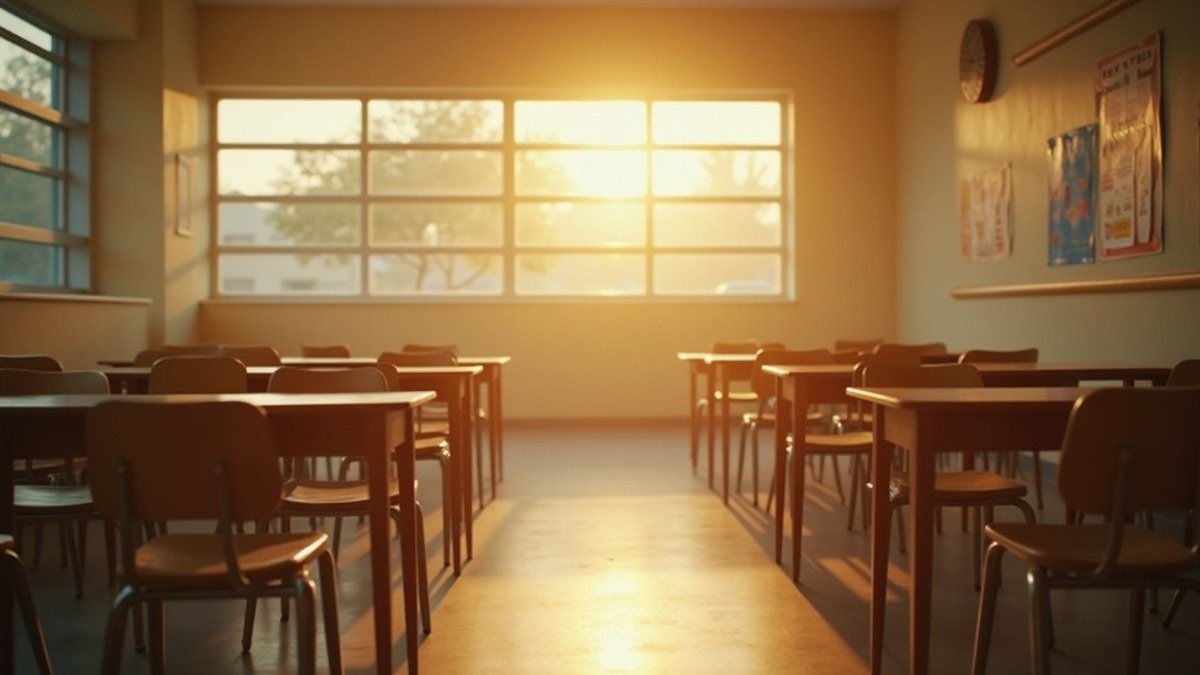
The fifth-grade classroom at Lincoln Elementary in southwest Fresno had thirty-one desks arranged in five rows of six, with the sixth row holding only one desk, the desk against the back wall, by the window, half-shaded by the leaves of a tall pepper tree that had been planted in the schoolyard in 1962. That last desk had been the desk of a long line of children whom the school had quietly decided to leave alone. Carmen Alvarez had been teaching at Lincoln for twenty-two years. She had watched four principals come and go. She had taught the children of children she had once taught. She knew, with a calm and unsentimental precision, what the desk against the back wall meant.
The child at that desk in the fall of the academic year I am writing about was a boy named Devon Walker. He was ten. He had transferred in from another school in southeast Fresno in the second week of September, with a thin folder of records that did not, by themselves, tell anyone much. He was small for his age. He was very quiet. He wore the same gray hooded sweatshirt almost every day, even on the eighty-degree afternoons in October when the classroom’s old wall-mounted air conditioner ran in a long noisy sigh from the second period until dismissal.
He did not, in the first two weeks, speak in class. He did not, in the first month, raise his hand. The other teachers in the building (the math teacher who took the fifth grade for forty-five minutes after lunch, the physical education teacher who supervised the playground, the special education aide who came in on Tuesdays and Thursdays) had all, by mid-October, more or less stopped calling on him. They had not done it cruelly. They had done it the way teachers in busy underfunded schools sometimes do, by quiet exhausted triage, by the slow recognition that there were twenty-eight other children in the room who would respond, and that the small bandwidth a teacher had on a Tuesday afternoon in the third week of October was, for practical purposes, the only bandwidth she had.
Carmen Alvarez did not stop calling on him.
II. The first month.
I should say, before I describe what Mrs. Alvarez did, that I sat with her in her small living room in a modest stucco house in northwest Fresno for almost four hours on a Saturday in March. She did not, when I asked her about Devon, immediately understand what I was asking about. She said, “I have had many students named Devon.” When I described the boy I meant, she nodded slowly. She said, “Yes. The boy at the back desk that year.”
She did not, in our conversation, ever once describe herself as a person who had done anything special. She described, instead, the small ordinary thing she had done. It was the same small ordinary thing, she said, that she had done with every child in her twenty-second year and every year before it, going back to her first classroom at age twenty-three in a portable trailer in Bakersfield in 2003.
She called on him.
She called on him every day. She called on him whether his hand was raised or not. She called on him gently. She called on him when she could see, from across the room, that he had been listening, when his eyes had tracked, briefly, with the math problem on the board, or when his shoulders had shifted, very slightly, with a question she had asked the class. She called on him in the small soft conversational tone she had been refining for twenty-two years, the tone that did not demand and did not embarrass, the tone that left the door open and the room quiet.
For the first four weeks, he did not respond. He would, when she called his name, look up. He would meet her eyes for a fraction of a second. Then he would look down again. He would shake his head, sometimes, very slightly. He would not say I don’t know. He would not say I wasn’t listening. He would not say anything.
Mrs. Alvarez, after each of these small non-responses, would nod once and move on. She would not, she explained to me, ever skip him the next day. She would call on him again, on a different question, in the same gentle tone, the way a person waters a plant whether or not the plant looks like it is going to make it through November.
III. The first answer.
It came in early November. The class was working on long division. Mrs. Alvarez had written a problem on the board, 486 ÷ 6, and she had asked, for the second time that week, whether anyone in the class could begin to talk her through how to set up the problem.
She did not look at Devon. She had learned, over many years, that some children responded better when she was not looking at them. She looked at the board.
“Mr. Walker,” she said. “What is the first thing we have to do here?”
There was a long silence.
Then, very quietly, from the back of the room: “You have to see how many sixes go in the first number.”
The classroom did not stop. Mrs. Alvarez did not, she told me, allow it to stop. She did not, she said, do the thing some teachers do, which is to make a small big production of the first answer from a child who has not spoken in months. She did not say very good, Devon. She did not turn dramatically to face him. She did, instead, what she would have done for any child in the room. She continued the math.
“That’s right,” she said. “How many sixes can we get into 4?”
“None,” Devon said.
“So what do we do?”
“You look at the next number.”
“That’s right. What’s the next number?”
“48.”
“And how many sixes can we fit in 48?”
“Eight.”
“Beautiful,” she said, and she wrote the 8 on the board, in her steady chalk hand, and she went on to the next step of the problem. She did not, for the rest of the class period, call on him again that day. She did not, when class ended, hold him back to praise him. She let him walk out with the rest of the children.
But the next day, in the same gentle conversational tone, she called on him again.
He answered.
IV. The first year.
A teacher’s smallest reliable kindness (the choice to call on a child whom no one else is calling on) is, in some classrooms, the longest hand a child has ever been offered.
By the time Christmas break arrived in mid-December, Devon Walker was speaking in class, in short careful sentences, two or three times a day. He was not yet raising his hand. But he was answering when called on. He had, in a development that surprised no one who had been watching, a particular and unusual aptitude for arithmetic, the kind of aptitude that comes from a child who has done a great deal of quiet careful thinking on his own, without the steady scaffolding that other children get at home. By the end of January, he was the strongest math student in the classroom. By the end of February, he had been moved, on Mrs. Alvarez’s careful recommendation, into the small advanced math group that met after lunch on Wednesdays. By the end of the school year in June, he had taken the state mathematics assessment and scored in the ninety-fifth percentile.
I do not know, and Mrs. Alvarez does not know, what Devon’s situation at home had been during the years before fifth grade. The school file, she told me, was thin. There had been a custody change. There had been an aunt. There had been a period of time when his attendance records were missing for almost three months. These are the kinds of facts that show up in school files in southwest Fresno and that, in the careful private code of veteran teachers, mean a great deal more than they say.
What Mrs. Alvarez did know was that, by the end of the year, the boy at the back desk by the pepper tree was a different child than the one who had arrived in September.
V. The second year.
The thing that makes the story worth telling, however, is not the first year. It is the second year and the third.
Devon moved into the sixth grade in the fall, into a different teacher’s classroom across the hall. Mrs. Alvarez did not, technically, have him as a student anymore. She still saw him in the cafeteria. She still saw him on the playground. She still saw him in the hallway between classes. She did, on her own initiative and without ever telling anyone, three small ordinary things.
She greeted him by name every morning, in the same gentle conversational tone she had used in fifth grade. She walked past the sixth-grade classroom during her own preparation period twice a week, on Tuesdays and Thursdays, and she would catch his eye through the door and nod once. She kept a small space on the corner of her desk where, on Friday afternoons, she would put a small ziplock bag of carrot sticks and a small bag of plain pretzels, exactly two snack-sized portions, and she would, when she saw him in the hallway after the dismissal bell, hand it to him without commentary.
She did this every Friday for two school years.
She did not, when I asked her about the snack bag, characterize it as charity. She said it was simply the case that some children left school on Friday afternoons and did not eat dinner until Saturday lunch, and that she had been in a classroom long enough to be able to tell which children those were, and that the size of a fifth-grade classroom in southwest Fresno made it impractical to bring snacks for all the children who needed them, but that the math involved was different for one child at a time.
She did this through sixth grade and through seventh grade. By eighth grade, Devon had grown almost six inches. He had begun, in the awkward way of all eighth graders, to lengthen out of the gray sweatshirt he had worn in fifth grade. He had, at her suggestion, joined the after-school chess club at Lincoln (which was supervised by Mrs. Alvarez on Wednesday afternoons) and had become, by the end of seventh grade, the third-strongest player in the school. He was reading more. He was making careful friendships with three other boys in the chess club who would, in their own quiet way, become his close people for the rest of middle school.
VI. The hallway in March.
The conversation that Mrs. Alvarez told me about most carefully (the conversation that has the particular quiet weight of the small important moments in long teaching careers) happened in the hallway outside the eighth-grade classroom on a Wednesday afternoon in March.
Devon was thirteen. He had stopped, by then, eating the Friday snacks. He had a part-time job (paper, technically illegal for a thirteen-year-old, but real) folding laundry at a small Vietnamese-owned dry cleaning shop two blocks from Lincoln, and he had, for the first time in his life, his own money. The boy who had taken his place at the back desk by the pepper tree was a small quiet sixth-grade girl named Ellie, and Mrs. Alvarez had begun, that fall, to call on her every day. She had, she explained to me, sometimes more than one Devon in a single year. She had, in fact, almost always had at least one.
Devon stopped her in the hallway. He had grown almost to her height. He stood, in the awkward formal way of a thirteen-year-old who has carefully rehearsed something, with his hands in his pockets and his eyes on a spot on the wall about six inches to the left of her face.
“Mrs. Alvarez,” he said.
“Yes, Mr. Walker.”
“I wanted to say. Thank you. For calling on me. In fifth grade.”
There was a long silence in the hallway. Other children were moving around them, on their way to the buses, in the small storm of an end-of-day American middle school. Mrs. Alvarez told me she did not, in the moment, know exactly what to say. She had been thanked, in her career, many times. She had been thanked, in her career, in many ways. She had not been thanked, before that afternoon, by a child who had stopped her in a hallway and remembered the small ordinary thing she had done three years earlier.
“You are welcome, Mr. Walker,” she said. “You were always going to answer. I just had to ask.”
He nodded. He looked down at his hands. He looked back up.
“I am going to be a teacher,” he said.
She nodded once. She did not, she told me, say anything more. She held his eye for a moment. She let him walk on, toward the buses.
VII. The next eight years.
Devon Walker finished middle school at Lincoln. He attended high school across town. He was the first member of his family to graduate from a four-year college. He attended Fresno State on a partial academic scholarship, with the remainder of his tuition covered through a careful patchwork of small grants and the Vietnamese dry cleaning shop, whose owners had quietly contributed a small monthly stipend to him for almost five years and whom he still visits on Sundays. He majored in mathematics. He minored in education.
He is now in his fifth year as a sixth-grade math teacher at a middle school in southeast Fresno, the same neighborhood he grew up in. He has, in the past three years, been recognized twice by the school district for the quality of his classroom culture. He has, in the way of all teachers who came up through someone, a small particular habit he has not, he told me, ever consciously thought about until I asked him about it.
He calls on every student in his class every day. He calls on the ones whose hands are not raised. He calls on them in a gentle conversational tone. He does not, when they do not answer, embarrass them. He moves on. The next day, in the same conversational tone, he calls on them again.
VIII. Why it stays.
I sat with Mrs. Alvarez in her living room in March, almost twenty-five years into her career. I sat with Devon Walker in his classroom in May, on a Friday afternoon after dismissal, with the chairs flipped up onto the desks and the sun coming in through the high windows of his sixth-grade room. I asked him whether he ever told his own students about Mrs. Alvarez.
He did not, he said, talk about her. He said the calling-on was a small private discipline of his own classroom, something the students did not need to know the genealogy of in order to receive. He said, with a careful precision that surprised me, that the value of being called on every day, in his experience, was not in being told that the act of calling on you was a gift. The value was in the act itself, performed over many years, without commentary, by a teacher who simply behaved as if you were a person in the room.
Some kindnesses cannot be wrapped. Some kindnesses must be repeated.
Across the United States, in classrooms in towns and cities and rural districts that most of the country never thinks about, teachers are quietly performing this small ordinary discipline every day. They are calling on the child who has not spoken in three weeks. They are walking past a hallway twice on Tuesdays to nod at a child in another grade. They are keeping carrot sticks in their desk drawer. For broader context on the long American history of public education, readers can spend time with the careful work of the Library of Congress or the long-form reporting at PBS NewsHour. The Chapbook keeps its narratives clean, human, and responsible, read more in the Editorial Policy.
Mrs. Alvarez is now in her twenty-fifth year at Lincoln. She has not, in our conversation in March, mentioned retirement. She has, in her classroom, a back desk by the pepper tree where a small quiet child is sitting this spring. She has been calling on that child every day. She did not, in our conversation, tell me the child’s name.
Some hands have to be raised twice. Some hands have to be raised every day for three years. The work of raising them is, on the whole, the long quiet country in which American teaching has always done its best work.