The wallet had eight hundred dollars in cash and no ID. He spent three hours walking the city until he found the owner.
The bench was on the west side of Lincoln Park, just south of the small playground that fills with families on weekday afternoons in late spring. Marcus Davies had been sitting on it for almost two hours on a Tuesday in May. He was fifty-one. He had been, by his own careful accounting, without a fixed address since the late summer of 2022, after a long slow private series of difficulties (a job loss, a small medical bill that had become a larger one, a careful family argument that had ended with the closing of a door he had not, at the time, understood was being permanently closed) had reduced him, by careful gradual stages, from a man with a small studio apartment in the Cole neighborhood to a man with a backpack, a bedroll, and the careful slow practical knowledge of which Denver public benches it was safe to spend the middle of an afternoon on.
He had not eaten since the previous morning. He had, in the front pocket of his backpack, a small plastic bag containing two granola bars from the food pantry on West Colfax that he had been saving for the dinner he was planning to eat that evening on the same bench. He had been thinking, when the wallet appeared, about whether he should eat one of the granola bars now and save one for the morning, or whether he should keep both for the careful slow evening he was planning to spend with the small paperback book he had been reading.
The wallet was not, in any way, where he was looking. It was sitting on the asphalt path about four feet from the end of the bench, half tucked into the small bed of mulch around a young aspen tree the park had planted in 2023. It had been, by the look of it, there for perhaps ten or fifteen minutes. The afternoon foot traffic in the park, in May, was steady (joggers in small clusters, mothers with strollers, a small careful number of dog walkers) and none of them, in the time Marcus had been on the bench, had noticed the small dark rectangle in the mulch.
He noticed it because he had been, in the careful private way that careful homeless people sometimes are, watching the ground.
He stood up. He walked to it. He picked it up.
II. The contents.
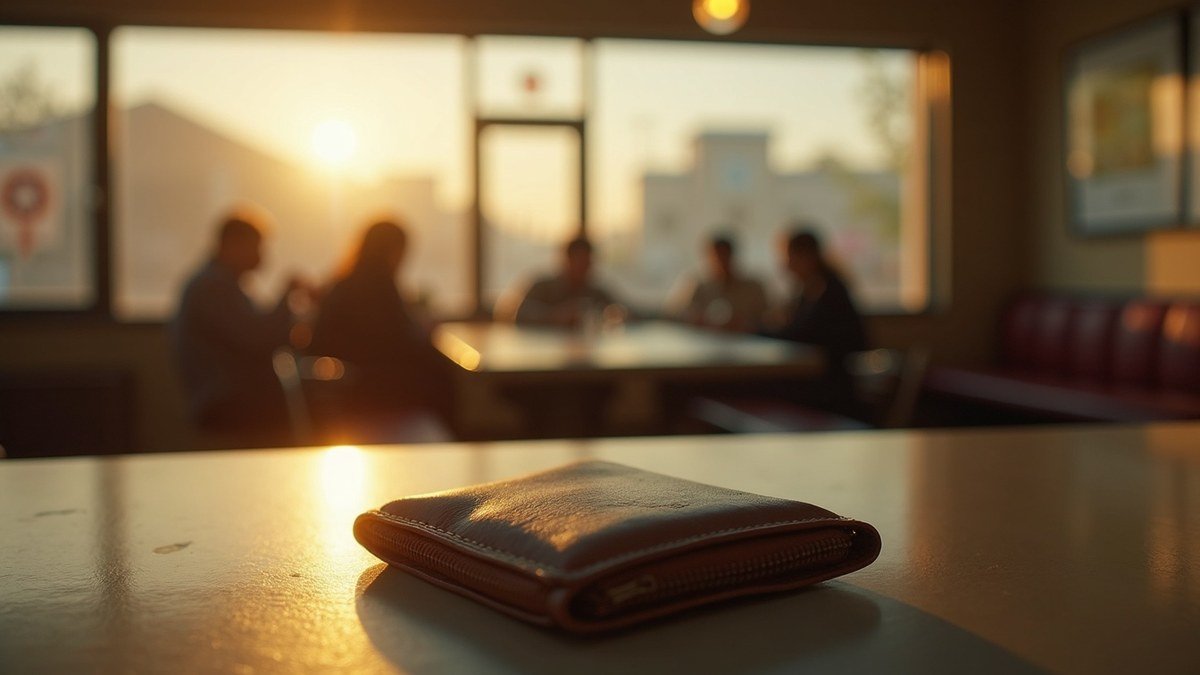
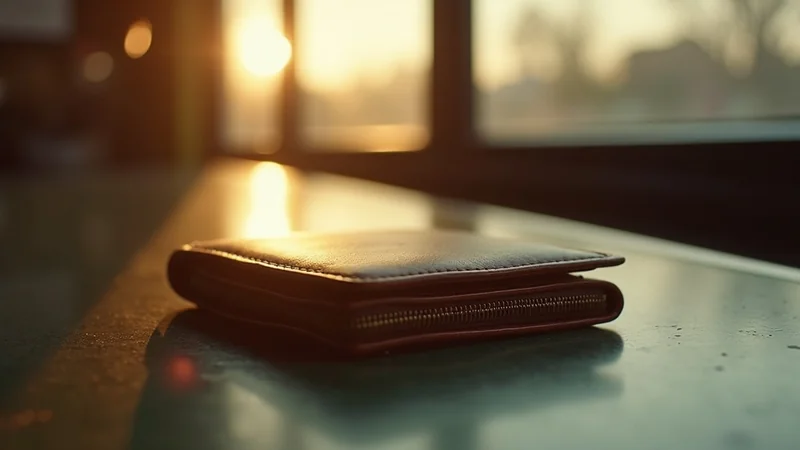
The wallet was a man’s wallet, a brown leather bifold, well-worn but not falling apart, with a small dark scuff at the lower left corner. Marcus stood on the asphalt path with it in his hand for a moment. He looked around the park. There was nobody, in the immediate vicinity, who appeared to be looking for a wallet. The nearest joggers were small dots on the eastern loop. The mothers with strollers were down by the playground.
He walked back to the bench. He sat down. He opened the wallet.
The cash compartment held, he counted carefully, twice, eight hundred dollars in clean newer hundreds, fifties, and twenties. Eight one-hundred-dollar bills had been the largest block. The rest had been in fifty and twenty denominations.
The card compartment was empty.
The ID slot was empty.
There were, in the small inner pocket behind the cash, two folded pieces of paper. Marcus took them out. The first was a small receipt from a pharmacy on East Colfax dated the same morning. The receipt was for a single item, a prescription refill, with the name D. KOWALCZYK printed at the top.
The second piece of paper was a small handwritten note, in blue ballpoint, on the back of a torn-off corner of grocery list paper. It said only: Call Dr. Park back about Saturday. Don’t forget the rosemary.
Marcus sat with the two pieces of paper in his hand for a long time. The cash, eight hundred dollars, was the largest sum of money he had held in his own hands in almost two and a half years.
III. The arithmetic of an honest man.
I want to write this section carefully, because the popular American story about a homeless man who finds a wallet tends, in the soft sentimental way magazines write these stories, to skip over the careful private moment in which the homeless man does, or does not, sit with the contents of the wallet long enough to make a real decision.
Marcus sat on the bench for almost twenty minutes.
He did the careful arithmetic. Eight hundred dollars was, in the small practical economy of his current life, almost three months of rent at the cheapest single-room-occupancy hotel he knew about, the small one on East 17th that had a careful sliding-scale program for people who were trying to get back into housing. Eight hundred dollars was twenty-eight nights at a low-end motel where, in February, he had stayed for a week during the worst of the cold snap. Eight hundred dollars was, by the small practical math of his current life, three or four months of small steady warm meals.
He thought about it.
He thought about the small note. He thought about Dr. Park and the call about Saturday. He thought about the rosemary. He thought about the kind of man who carried, in his wallet, eight hundred dollars and a small written reminder about rosemary. He thought about the careful particular note the rosemary made him feel, the small domestic detail of a person preparing for a Saturday meal that probably involved cooking for somebody else.
The rosemary, in the end, was what made the decision.
He stood up. He picked up his backpack. He folded the wallet shut. He put it in the front pocket of his jacket, where he could feel it against his chest. He started walking.
IV. The pharmacy.
The pharmacy on East Colfax was about two and a half miles from the bench in Lincoln Park. It was a small independent neighborhood pharmacy called Cherry Creek Drugs, which had been at the same address since 1953 and which was, in the careful loose neighborhood mapping that careful homeless people sometimes maintain, one of the small handful of businesses in the area that had, in the past, treated Marcus politely when he had come in to ask about over-the-counter medication for the slow careful joint pain he had developed in his late forties.
He walked there at a steady pace. He arrived a little after four. The pharmacy was, that afternoon, lightly busy. There was an older woman at the counter picking up a prescription. There was a small careful sign by the door asking visitors not to use the restroom for purposes other than the immediate sale.
Marcus waited.
When the older woman had finished, he walked to the counter. The pharmacist behind it was a man in his late fifties, with the small careful steady manner of an independent pharmacist who had been doing the work for thirty years. Marcus had seen him before, on three or four occasions, though they had never properly spoken.
“Excuse me, sir,” Marcus said. “I am looking for a customer of yours. A Mr. D. Kowalczyk. I found his wallet. I want to return it to him.”
The pharmacist looked at him for a moment. The pharmacist had the small particular practiced careful look of an independent pharmacist evaluating an unusual request. He looked at the wallet, which Marcus had taken out of his jacket pocket and was holding flat on the counter in front of him.
“I cannot,” the pharmacist said carefully, “give you a customer’s address. I am sure you understand.”
“Yes, sir,” Marcus said. “I am not asking you for it. I am asking if you could call him. Tell him I am here. I will wait outside. If he wants to come, he can come.”
The pharmacist looked at him for another long moment.
“Wait here, please,” he said.
He walked into the small back office. Marcus could see him, through the glass, picking up the phone. The conversation lasted about three minutes. The pharmacist came back to the counter.
“Mr. Kowalczyk would like to come in person,” he said. “He is about twenty minutes away. Would you like to wait inside, or outside?”
“Outside is fine,” Marcus said. “Thank you.”
He walked out. He sat on the small concrete bench by the pharmacy’s front door. He waited.
V. The man who came.
The man who arrived twenty-three minutes later was in his late seventies. He was tall, slightly stooped, with the careful slow movements of a man who had been managing a small arthritis condition for many years. He was wearing a navy windbreaker over a button-down shirt, dark slacks, and a pair of carefully maintained brown leather shoes that looked as if they had been resoled at least twice in their long careful life.
He had driven. He parked carefully in the small five-space lot beside the pharmacy. He got out. He walked, with the small unhurried pace of a man who had been an architect or an engineer in a previous careful working life, to the bench where Marcus was sitting.
Marcus stood up. He held out the wallet.
The man took it. He opened it. He counted the cash, carefully, the way Marcus had counted it, and he looked at the small note about Dr. Park and the rosemary. He looked at Marcus.
“You walked here from Lincoln Park,” he said.
“Yes, sir.”
“That is a long walk.”
“It is not as long as some I have made.”
The man looked at him for a long moment. He had the small particular careful eyes that some older men have, the eyes of a person who has been doing his own private serious thinking for the entire seventy-eight years of his life and who has not, by any visible sign, stopped doing it.
“What is your name, son?” he said.
“Marcus.”
“Marcus what?”
“Marcus Davies.”
“David Kowalczyk.”
He held out his hand. Marcus shook it. The handshake was firm in the careful older man’s way, not the dramatic American grip, but the steady solid one.
“Marcus,” David said. “I would like to buy you dinner. There is a small diner two blocks over. The food is good. Would you let me?”
Marcus did not, for a small moment, know what to say. He had not, in two and a half years, been bought dinner by anybody he did not know.
“Yes, sir,” he said. “I would.”
VI. The dinner.
The diner was called the Highland Café. It had been on the same corner since 1948. David ordered a turkey sandwich with a small green salad. Marcus, after a careful slow look at the menu, ordered a hamburger with a side of mashed potatoes. David asked for two coffees. Marcus added a small careful chocolate milkshake to his order, with the small particular apologetic tone of a man who had not had a milkshake in a very long time.
They sat across from each other in a small wooden booth by the window.
David told him about the rosemary. He had been planning to make, that Saturday, a small slow roast for a small careful Saturday dinner with his daughter and her two children, who would be driving in from Boulder. The rosemary was for the roast. His wife had, for forty-six years, been the one who had remembered the rosemary. She had died in November.
He was, he told Marcus, still in the slow careful early stage of figuring out which of the small household things (the rosemary, the Dr. Park appointments on Saturdays, the careful weekly calls to his sister in Pittsburgh) he was going to have to remember himself now. The eight hundred dollars in the wallet was, he explained with the careful precision of a man who had been a small careful saver for forty years, the cash he had withdrawn that morning to buy a new lawn mower at the small hardware store on East Sixth, because the old one had stopped working in April and he had, by careful private arithmetic, decided he could justify a slightly nicer model now.
He asked Marcus about himself. Marcus told him, in the careful slow shortened way that careful homeless men sometimes tell their own stories to careful older men in diners, about the job loss in 2022, about the small medical bill that had become a larger one, about the careful family argument in late summer of that year that had ended with him not having a place to live.
David listened. He did not, in the careful way some Americans sometimes do, interrupt with advice. He did not ask invasive questions. He drank his coffee. He nodded at the right places. He asked, near the end, whether Marcus had been to the modest, deliberate office of the Colorado Coalition for the Homeless on East Colfax, which David knew about because he had, for the last six years before retirement, served on a small advisory board for a foundation that had helped fund some of their programs.
Marcus had been there. He had been, by his own careful admission, on three waitlists. The waitlists, in 2024, had been long.
David paid for dinner. Marcus thanked him.
VII. What David did about it.
The story, in the small soft sentimental way magazines like to write these stories, would end here. Marcus had returned the wallet. David had bought him dinner. The two men would, in the small soft American version, exchange quiet, unhurried handshakes outside the diner and walk in their separate directions, and the story would be a neat, patient confirmation that there is good in the world.
The actual story, which Marcus told me in a small deliberate conversation almost eleven months after the afternoon in question, is more interesting.
David Kowalczyk asked Marcus, in the diner, whether he would be willing to come back to the diner the following Tuesday at the same time. David said he was not, in any way, promising anything specific. He said he had, in his long careful working life, learned not to promise anything specific to a person whose life he did not yet adequately understand. But he said that he had a modest, attentive network of contacts in Denver from his quiet, exacting working life, that he was now retired and had time on his hands, and that he would, over the intervening week, see what he could careful slowly find out.
Marcus came back. David was there.
He came back a third Tuesday. David was there.
By the eighth Tuesday, which was now early July, David had, with the steady careful effectiveness of a retired engineer with a quietly long contact list, helped Marcus move up to the top of one of the waitlists. By the eleventh Tuesday, late July, Marcus had moved into a small unhurried single-room-occupancy unit in a transitional housing program on East 17th Avenue.
By September, Marcus had begun part-time work in the kitchen of the diner. The diner’s owner (a careful woman in her sixties named Maria, who had known David for almost thirty years from his careful early Tuesday morning breakfasts in the booth by the window) had needed someone to wash dishes and prep vegetables for the lunch rush. Marcus had washed dishes professionally in his late twenties. He had remembered, with surprising speed, how.
By November, he had been promoted to short-order cook.
VIII. Why it stays.
I sat with Marcus in the same booth by the window of the Highland Café in April, eleven months after the afternoon he had walked from Lincoln Park to the pharmacy with the wallet in his jacket pocket. Marcus was, by then, fifty-two. He had been working full-time at the diner for almost six months. He had moved, in February, out of the transitional housing and into a plain, watchful studio apartment three blocks from the diner. He was, by his own careful private accounting, saving a small portion of every paycheck, with the careful intention of, by the end of his fifty-third year, having enough in the bank to begin the slow careful work of repairing the relationships in his family that he had not, in the long careful difficult years of 2022 and 2023, been in a position to repair.
David Kowalczyk still ate breakfast at the diner most Tuesday mornings. He was, by his own careful description, becoming a careful slow regular in the way older Denver widowers sometimes do. He and Marcus did not, in the small loose protocol of the diner, sit together. Marcus was, after all, the cook. David sat in the booth by the window. They greeted each other in the modest, deliberate way that an older man and a younger man greet each other when they have, in the careful long American way, become quiet friends.
Marcus asked me, near the end of our conversation, whether I was going to write about him. I told him I was. He thought about it for a moment.
“Could you mention the rosemary, please,” he said. “I think the rosemary is the part.”
He was right. The rosemary was the part.
Across the United States, in small parks and on small benches and in the careful slow afternoons of careful slow American days, small ordinary kindnesses are still being chosen by people whom the popular American story would not, in any usual sense, have predicted to be the ones choosing them. For broader context on the careful slow long American work of housing recovery, readers can spend time with the materials at the U.S. Department of Housing and Urban Development or the long-form reporting at PBS NewsHour. The Chapbook keeps its narratives clean, human, and responsible, read more in the Editorial Policy.
The bench in Lincoln Park is still there. The quiet, unhurried aspen tree the park planted in 2023 has grown, in three years, to about ten feet. Marcus walks past it most Sunday mornings, on the careful slow weekly route he has begun to walk through his old streets, with the small steady weather of a man who has been quietly held by the small kindness of one stranger and is, in his own careful slow way, beginning to figure out how to hold others.
The rosemary, in David’s careful new private domestic routine, is on a small list taped to the inside of his pantry door. He has, by his careful private admission, only forgotten it once in eleven months. Marcus, in November, sent him a small handwritten note. The note said only: Don’t forget the rosemary., M.
David has it on the fridge.