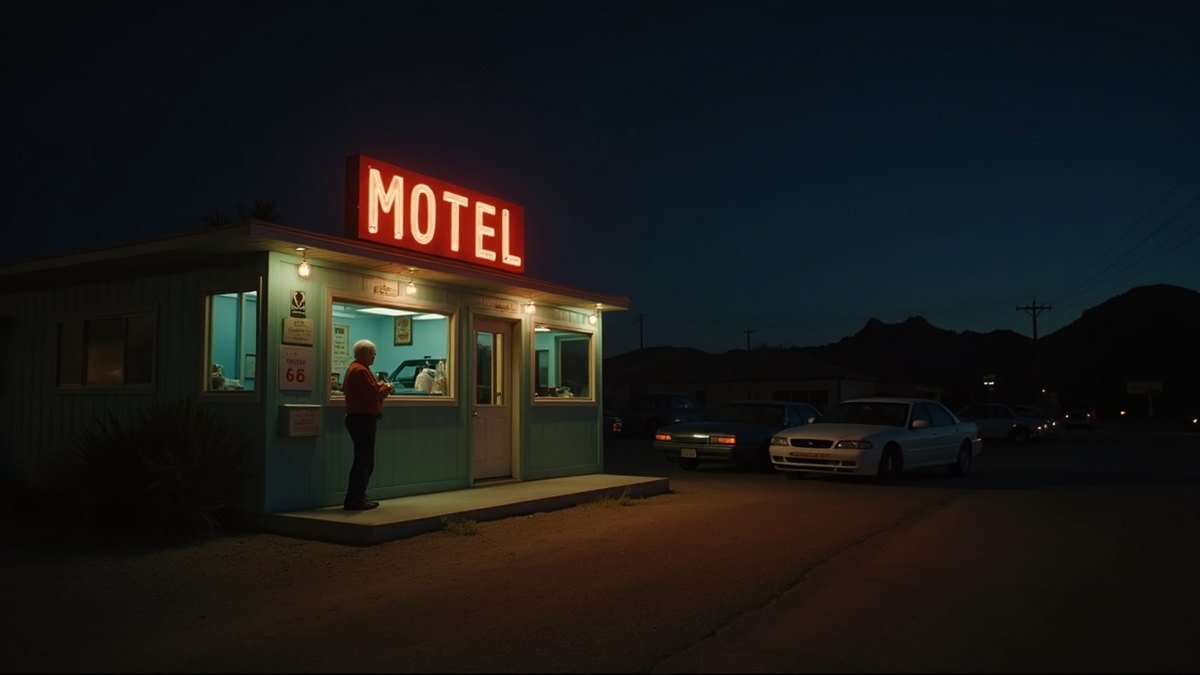
Marvin Stroud could not sleep, and so for eleven years he had been paid to stay awake, behind the front desk of a motel on old Route 66, where the only thing to do at three in the morning was watch the cars. He could not have told you why he memorized the plates. He only knew that he did.
The motel sat on the east side of Flagstaff, Arizona, on the stretch of the old highway that the interstate had long ago made quiet, a low courtyard place of twelve rooms with a neon sign that buzzed and a gravel lot and the pines coming right up to the back of the property. Flagstaff sits at seven thousand feet, and the nights there are cold and enormous and very dark, and the trains come through sounding their horns at the crossings all night long.
Marvin was fifty-eight. He had worked the overnight desk, eleven at night to seven in the morning, since 2013. He had come to it the way people come to night work, sideways, after a divorce and a layoff and a long flat stretch, and he had discovered that the shift suited a man who did not sleep anyway. The insomnia had been with him most of his adult life. The doctors had names for it and pills for it and none of the pills had worked, and somewhere along the way he had stopped fighting it and started using it.
What he used it for, mostly, was watching. There is a particular quality of attention that comes to a man alone at a desk in the deep middle of the night, and Marvin had it. He noticed things. He noticed which trucker always paid in exact change, and which traveling nurse cried in her car before she came in, and which families were running from something and which were only tired. And he noticed the cars. Every car that pulled into the lot, he read the plate, and without trying to, without wanting to, he kept it.
He described it to me as something close to involuntary, the way some people cannot help reading every sign they pass. A plate would come into the cone of the sodium light, and he would read it, and it would lodge. State, numbers, letters, the little county frame some people put around them, the dent, the rust, the bumper sticker. He had, by his own estimate, tens of thousands of them in there. He did not know what they were for. They were for nothing. They were just the furniture of his nights.

II. The habit nobody asked for.
I want to spend a moment on the habit itself, because the habit is the actual subject of this story, more than the night everything happened. We live in a culture that has made a great deal of money convincing us that attention is a resource to be spent on screens, and Marvin Stroud is a man who spent his attention, for eleven years, on a gravel parking lot in the dark, for no reason and no reward.
His coworkers thought it was a little strange, when they thought about it at all, which was seldom, because Marvin worked alone. The day manager, a kind woman named Lupe, knew he could recite the plate of any regular and assumed it was a party trick. It was not a party trick. Marvin did not perform it. He only mentioned it once or twice over the years, and was met with the mild, dismissive amusement that the world reserves for the small useless excellences of quiet men.
Because that is what it was, until one night it wasn’t: a small useless excellence. The kind of thing a person does well that the world has no slot for. Marvin had no use for his plates. The DMV did not want them. The police did not know he had them. They sat in his head like a library no one had ever checked a book out of.
I have come to think the world is full of these unspent excellences, and that we are poorer for having no place to put them. The man who knows every bird by its call and works in a warehouse. The woman who can read a room’s mood the instant she enters and answers phones for a dentist. We have built an economy that pays for a narrow band of talents and lets the rest run quietly to waste, and we call the people who possess them eccentric, or we do not notice them at all, right up until the rare day the wasted talent turns out to be the one thing required, and then we call it a miracle, when it was only a man being allowed, for once, to be useful in the exact shape he was made.
He told me, on the porch of the little house he rents, that he had sometimes felt foolish about it, in the daylight hours when he could not sleep either. A grown man hoarding license plates like a magpie hoarding foil. He had wondered, he said, whether it was a symptom of something, whether the same broken switch that would not let him sleep was the thing filling his head with numbers. He had never imagined it was good for anything. Why would he have.
III. The blue sedan.
On a Tuesday night in the late autumn of 2021, a little after midnight, a blue sedan pulled into the lot. Marvin read the plate. It was an out-of-state plate, and the car parked in the dark spot at the far end, past the ice machine, where the light did not quite reach, and a man came in alone and paid cash for room fourteen and did not meet Marvin’s eyes and went back out.
None of that was, by itself, unusual. Cash is common on the old highway. People avoid the light for a hundred ordinary reasons. A man not meeting your eyes at midnight is a man who is tired, or shy, or sad, far more often than he is anything else. Marvin logged the plate the way he logged them all, without alarm, and went back to his book and his coffee and the trains.
What I keep returning to is how ordinary the whole arrival was, how completely it failed to announce itself. There was no alarm in Marvin that night, because there was nothing to be alarmed by. A cash payment, a far parking spot, a man who would not meet his eyes. Marvin had seen each of those a thousand times attached to nothing worse than exhaustion or shame. The plate went into his head exactly as unremarkably as forty thousand others had, filed without flag or note, and that, he wants understood, is the point. He was not on watch. No one is ever on watch. The attention that saved the girl was the same idle, undirected, useless attention he had been paying every night for eleven years to nothing in particular.
I am not going to describe the man, or the car, beyond what I have, and I am not going to describe what was happening in room fourteen, because there is nothing in that room that needs to be on this page, and because the people who later had to know those things have asked that they stay where they belong, in a sealed file. This is not a story about a crime. There are a great many stories about crimes. This is a story about a man at a desk.
IV. Three hours later.
A little after three in the morning, the small television behind the desk, which Marvin kept on low for company, broke from its loop of weather and ran an emergency alert. An AMBER Alert. A child taken from a town more than two hundred and fifty miles away, earlier that night. The alert gave a description of a vehicle, and a partial plate.
Marvin read the partial plate on the screen, and the cold went through him all at once, because he had read the whole of that plate three hours before, in the cone of the sodium light, on a blue sedan now parked past the ice machine in the dark spot where the light did not reach.
He has tried, for my sake, to describe the next few minutes, and he is not a man with many words for the inside of himself. He said the first thing he felt was doubt. He had so many plates in his head. Was he sure. Could he be confusing it with another. The partial on the screen was only a partial. A reasonable man, a tired man, a man who did not want trouble on a quiet shift, could have told himself he was imagining it, could have decided not to be the fool who calls the police at three in the morning about a feeling.
Marvin did not do that. He went to the registration card for room fourteen, and he looked at nothing on it, because the name would be false and he knew it, and instead he walked quietly to the office window and looked at the blue sedan in the dark, and he read the plate again with his own eyes, the whole of it, and it matched the partial, and he went back to the desk and he picked up the phone.
He told me the doubt was the worst part, worse than any fear that came later, because the doubt was a door out. If he let himself believe he might be wrong, he could set the phone down and go back to his book and never know, and never be the fool, and never carry it. The easier thing was right there, warm and reasonable, whispering that a man cannot possibly be sure of one plate among forty thousand at three in the morning. He stood at the office window in the dark and made himself read it again with his own eyes, not his memory, the actual letters and numbers on the actual metal, because he understood, dimly, that memory could be argued with and the window could not.
V. The call.
He did not call 911 and announce it loudly. That was the second careful thing he did, and Deputy Carla Reyes of the Coconino County Sheriff’s Office, who took the consequences of that call, told me it may have mattered as much as the first. Marvin understood, without being trained to understand it, that room fourteen was forty feet away across a gravel lot, and that a loud night clerk is an audible night clerk, and that the worst thing he could do was startle the man in the room.
So he called the non-emergency line, and he spoke quietly, and he gave the dispatcher the full plate, and the room number, and the location of the car, and the fact that the light did not reach it, and he asked, in a low voice, that they please not come in with sirens. Then he did the third careful thing. He turned off the buzzing neon sign, which he had the switch for, so that the lot went darker, and he sat back down at the desk and picked up his book and held it open and did not look up, so that if the man in fourteen walked past the office on his way to anything, he would see only a bored clerk reading, a thing as common and invisible as the dark.
Deputy Reyes and the others came without sirens. They came carefully, the way they are trained to come, and what happened in the next twenty minutes is theirs to know and not mine to tell, except for the one fact that is the only fact that matters: the child was alive, and the child went home.
I have left out the worst of what those twenty minutes might have been, and I have done it on purpose, and I want to say why. Deputy Reyes told me that the difference between the outcomes in cases like this one is often measured in seconds, and in noise, and in whether the person who first notices does the quiet thing or the loud thing. Marvin had no training that told him to call the non-emergency line, to lower his voice, to kill the neon, to hold a book open and look bored. He did all of it on instinct, the instinct of a man who had spent eleven years learning, without knowing he was learning, exactly how invisible a night clerk can be, and how much that invisibility was suddenly worth.

He had spent eleven years paying attention to a thing nobody asked him to watch, and on one night out of four thousand, the attention was the only thing in the world that could have done what it did.
VI. The deputy.
Carla Reyes has been a deputy for sixteen years. She has, she told me, a professional wariness of luck, because luck is not a thing you can train or count on or thank. When she first heard, in the after-action quiet, that the break in the case had been a motel clerk who happened to have memorized a license plate three hours before an alert that referenced only a partial, she did not believe it. She thought there had to be more. A camera. A tip. Something systematic.
There was no camera on the dark end of the lot. There was no tip. There was a man with a broken sleep switch and a head full of plates, and a partial number on a three a.m. television, and the willingness to trust himself against the easier voice that said go back to your book.
“I’ve built cases for a year that fell apart,” she said. “And this one turned on a thing a man did for free, for no reason, for over a decade, that nobody knew he was doing. I don’t have a box on my report for that. I had to write it in the margin.”
She drove out to the motel a week later, off duty, in her own truck, to thank him in person, which she said she does not usually do. She found Marvin on the overnight shift, behind the desk, reading. She told me he seemed embarrassed by her, and changed the subject to her vehicle, and recited, after a glance out the window, the plate of the county truck she had borrowed once two years before to bring a runaway back to the same motel. She had forgotten the night entirely. He had not.
She had come, she admitted, half expecting to find something she could understand, a man with a system, a notebook, a method she could write up and recommend. Instead she found a tired insomniac with a paperback and a habit he was faintly ashamed of, who could not explain how he did the thing he did and did not think the thing was worth explaining. It unsettled her, she said, in a way the case itself had not. We want our saviors to be legible. We want there to be a reason. And the reason, in this case, was only that one broken, watchful man had been quietly paying attention for over a decade to a thing the world had told him did not matter.
VII. What it cost and didn’t.
There was a small wave of attention afterward, the kind a story like this draws. A local reporter. A proclamation from the county. A check from a national fund that recognizes such things, which Marvin used to fix his truck and to pay a dentist he had been avoiding. He found the attention exhausting and a little unreal, and he was relieved when it passed, and the lot went quiet again, and the trains came through, and he went back to being a man no one looks at, which is the thing he is best at being.
He did not, he wants me to make clear, become a different man. The insomnia did not lift. The plates did not stop. If anything, he told me, the habit got heavier for a while, because now he knew what it could mean, and so he could no longer pretend it was nothing, and a thing you can no longer pretend is nothing is a thing you carry differently. He sat in the lot every night reading every plate, knowing now, in a way he had not known before, that any one of them might someday matter, and that he would not know which until it was too late to have started paying attention.
So he paid attention to all of them. Which is, when you think about it, the only way attention has ever worked.
There is a loneliness in that, and Marvin did not hide it from me. To pay attention to everything, on the chance that one thing will matter, is to live permanently braced, permanently a little apart, watching the lot while everyone else is asleep. He had done it for eleven years for nothing, and he would do it for however many more for the memory of one night, and he knew the odds were overwhelming that no such night would ever come again, and that he would die having read a million plates and used exactly one. He had made his peace with that arithmetic. It was, he said, still a better arithmetic than spending the same years asleep.
VIII. Why it stays.
I sat with Marvin Stroud on the porch of his rented house on the east side of Flagstaff, in the late afternoon before a shift, with the pines going dark behind him and the cold already coming down off the peaks. He is sixty now. He works the same desk. He still cannot sleep.
I asked him whether he thought of himself as a hero, a word the proclamation had used, and he made a face as though the word tasted wrong, and he said no, and he meant it. He said a hero is a person who runs toward a danger, and that he had not run toward anything. He had sat at a desk and made a phone call and turned off a sign. He said it the way a man says a thing he has decided is true and will not be argued out of.
“All I did,” he said, “was notice. I’ve been noticing my whole life. It never did anybody any good before. It did somebody good once. That’s a better record than most people get, I figure.”
We are taught to dismiss the quiet, useless attentions of quiet, ordinary people, right up until the night one of them is the only thing standing between a child and the dark.
There is a whole apparatus in this country built to recover missing children, a serious and careful one, and it depends, more than its technology, on ordinary people being willing to see and to say. Readers who want to understand that work, and how to be useful to it, can start with the resources at the National Center for Missing & Exploited Children or the public material from the FBI. The Chapbook keeps its narratives clean, human, and responsible, read more in the Editorial Policy.
Before I left, the light nearly gone, a car went by on the old highway, fast, and Marvin’s eyes followed it without his seeming to decide to let them, and his lips moved very slightly, and I understood that he had just read the plate, and kept it, and added it to the library no one checks out, against the chance, the four-thousand-to-one chance, that the night would come again when somebody needed him to have been paying attention all along.